
Gender-affirming feminising urogenital reconstruction
Creation of vulval and optional vaginal anatomy with urethral relocation, retaining penile-inversion, peritoneal and bowel substitution variants and their urinary risks.
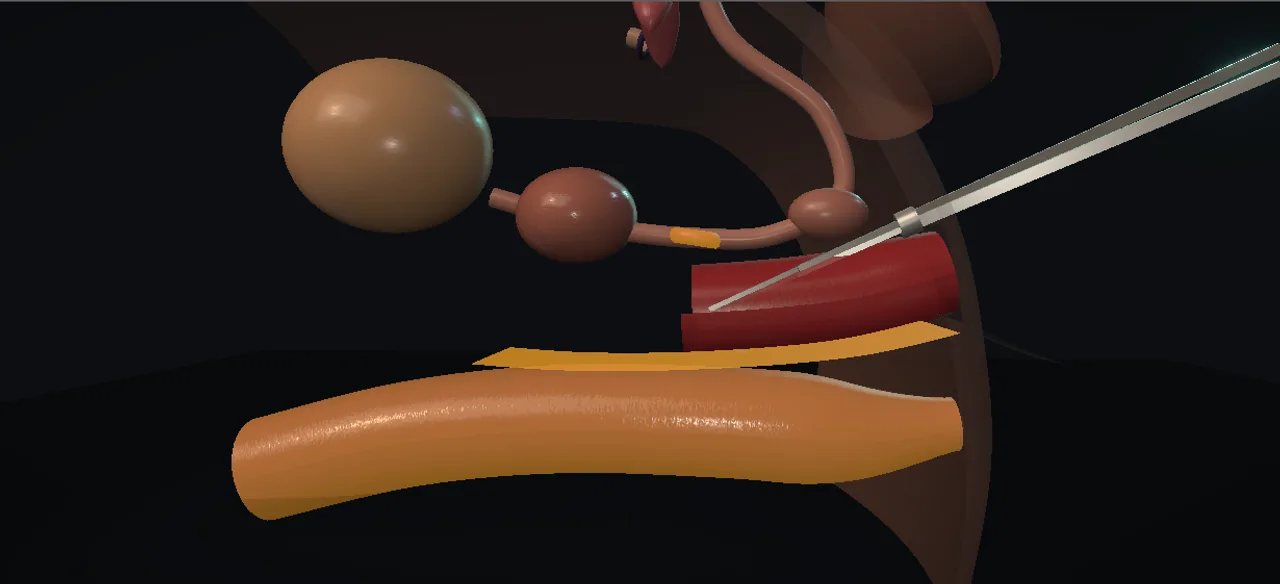 Interactive 3D Interactive penile inversion vaginoplasty Open the 3D animation
Teaching catalogue only. This coverage record is not a patient pathway or operative instruction.
Typical place in practice
Individualised gender-affirming goals after multidisciplinary assessment, fertility preservation discussion and informed consent about dilation, sexual and urinary outcomes.
Alternatives and neighbouring procedures
No genital surgery, orchidectomy alone, zero-depth vulvoplasty, or staged consideration of vaginal-canal creation.
Same procedure family, explicit technique branches
These are variations of this canonical operation. Complication modules below identify whether they apply to all branches or only to named approaches.
Penile-inversion vaginoplasty
Creates a vaginal canal and vulva from local genital tissues.
Peritoneal flap vaginoplasty
Adds vascularised peritoneum to create or extend the vaginal apex.
Bowel vaginoplasty
Uses bowel for primary or revision vaginal substitution.
Zero-depth vulvoplasty
Avoids a deep vaginal cavity and ongoing canal dilation.
Revision vaginoplasty or urethral revision
Treats stenosis, prolapse, fistula, hair, urinary spraying or cosmetic concerns.
High-level sequence
Coverage outline only; not a step-by-step technical guide.
- Define desired depth, sexual, urinary and reproductive goals
- Plan tissue availability and preserve neurovascular supply to sensate structures
- Create safe rectoprostatic/rectovesical space only when a canal is intended
- Shorten and relocate urethra and construct vulva/canal
- Support wound care, dilation where applicable and lifelong urinary/sexual follow-up
Every failure mode is its own module.
Timing and variation coverage are recorded for each module.
Rectal injury or rectovaginal fistula
Deep canal creation or revision can enter the rectum and cause severe delayed fistula.
Applies to: Penile-inversion vaginoplasty · Peritoneal flap vaginoplasty · Bowel vaginoplasty · Revision vaginoplasty or urethral revisionUrethral injury, fistula or meatal stenosis
Relocation and shortening can leak, scar or produce urinary spraying and recurrent infection.
Applies to: All variantsBleeding, pelvic collection or infection
Large pelvic and perineal wounds can conceal haemorrhage and become infected.
Applies to: All variantsSkin, flap, clitoral or canal necrosis
Tissue tension or compromised pedicles can cause partial loss and sensory injury.
Applies to: All variantsVaginal stenosis, loss of depth or prolapse
Scar, inadequate tissue, dilation difficulty or apical support failure can alter canal dimensions.
Applies to: Penile-inversion vaginoplasty · Peritoneal flap vaginoplasty · Bowel vaginoplasty · Revision vaginoplasty or urethral revisionUrinary incontinence, retention or recurrent infection
Outlet dissection, changed flow direction and pelvic-floor effects can alter urinary function.
Applies to: All variantsBowel leak, mucus, malodour or diversion colitis
Bowel substitution adds anastomotic and lifelong mucosal consequences.
Applies to: Bowel vaginoplastyAltered sensation, sexual pain or inability to achieve intended sexual function
Sensory and sexual outcomes depend on nerve preservation, healing, dimensions and individual goals.
Applies to: All variantsSources for this module
Dilatation, DVIU, anastomotic, graft, flap, staged and perineal procedures.
Accessed 2026-08-03 · opens source European Association of Urology EAU Guidelines on Sexual and Reproductive HealthPenile prosthesis, Peyronie disease, priapism and reproductive surgery.
Accessed 2026-08-03 · opens source