
Gender-affirming masculinising urogenital reconstruction
Multistage creation of a phallus, lengthened urethra and scrotum using metoidioplasty or flap phalloplasty, with prosthetic stages and urethral revision linked but distinct.
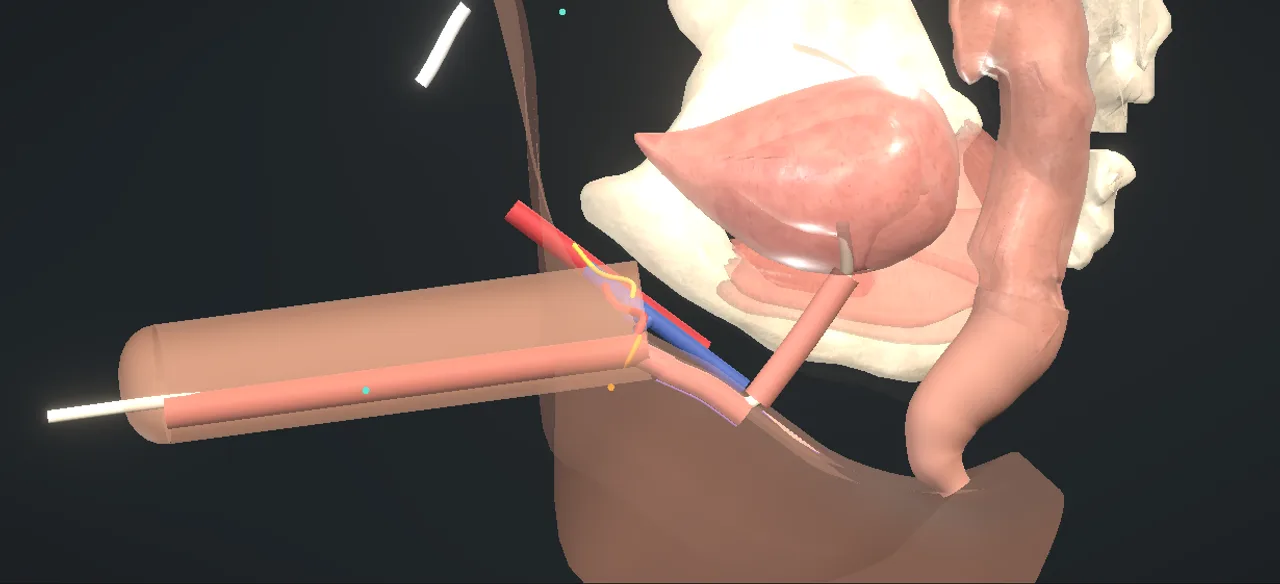 Interactive 3D Interactive radial forearm phalloplasty: the urological stages Open the 3D animation
Teaching catalogue only. This coverage record is not a patient pathway or operative instruction.
Typical place in practice
Individualised gender-affirming goals after multidisciplinary assessment, fertility discussion and informed consent about staged surgery and revision burden.
Alternatives and neighbouring procedures
No genital surgery, limited external-genital procedures without standing urination, metoidioplasty versus phalloplasty, or staged decisions over time.
Same procedure family, explicit technique branches
These are variations of this canonical operation. Complication modules below identify whether they apply to all branches or only to named approaches.
Metoidioplasty with or without urethral lengthening
Creates a sensate small phallus using native erectile tissue.
Radial-forearm free-flap phalloplasty
Constructs shaft and urethra from forearm tissue with microsurgical transfer.
Anterolateral-thigh or other flap phalloplasty
Uses alternative donor tissue with technique-specific bulk and urethral options.
Scrotoplasty and testicular prostheses
Creates a scrotum in a staged or combined pathway.
Penile prosthesis and revision
Adds penetrative rigidity after sensation and tissue healing.
Urethral fistula or stricture revision
Treats a common junctional or neourethral complication.
High-level sequence
Coverage outline only; not a step-by-step technical guide.
- Define individual urinary, sexual, sensory, appearance and reproductive goals
- Plan donor tissue, urethral lengthening and staging
- Create a well-perfused phallus and tension-aware urethral continuity
- Complete scrotal and later prosthetic components only after appropriate healing
- Provide lifelong urinary, sexual, donor-site and implant follow-up
Every failure mode is its own module.
Timing and variation coverage are recorded for each module.
Partial or total flap loss
Arterial thrombosis, venous congestion or tissue compromise can threaten the phallus and requires time-critical recognition.
Applies to: Radial-forearm free-flap phalloplasty · Anterolateral-thigh or other flap phalloplastyUrethral fistula, leak or stricture
Long multi-segment urethral construction has several vulnerable joins and blood-supply transitions.
Applies to: All variantsUrinary retention, spraying or inability to void standing
Patency, geometry and continence can limit the intended urinary outcome.
Applies to: All variantsWound infection, dehiscence or pelvic collection
Large composite wounds and urinary contamination can compromise healing.
Applies to: All variantsDonor-site functional, sensory or cosmetic morbidity
Flap harvest can affect limb strength, sensation, scarring and graft healing.
Applies to: Radial-forearm free-flap phalloplasty · Anterolateral-thigh or other flap phalloplastyAltered or absent erotic/tactile sensation and pain
Nerve coaptation and native-tissue preservation do not guarantee sensory outcomes.
Applies to: All variantsTesticular or penile prosthesis infection, erosion or failure
Implants in reconstructed tissue have device-specific revision risks.
Applies to: Scrotoplasty and testicular prostheses · Penile prosthesis and revisionDissatisfaction or psychological distress
Staging, complications and outcome variability require sustained, person-centred support.
Applies to: All variantsSources for this module
Dilatation, DVIU, anastomotic, graft, flap, staged and perineal procedures.
Accessed 2026-08-03 · opens source European Association of Urology EAU Guidelines on Sexual and Reproductive HealthPenile prosthesis, Peyronie disease, priapism and reproductive surgery.
Accessed 2026-08-03 · opens source