
Revision sheet
Pelvic fracture urethral injury
7 steps, each one the authored title and caption from the interactive animation, with the frame captured from that step. Read it before the case, or print it and work through the steps in order.
Teaching only, not for diagnosis or treatment decisions. The text on this sheet is the animation's own step copy, reproduced verbatim.
UrOops3D · UroRef · © Nity G
- 01
The shearing injury
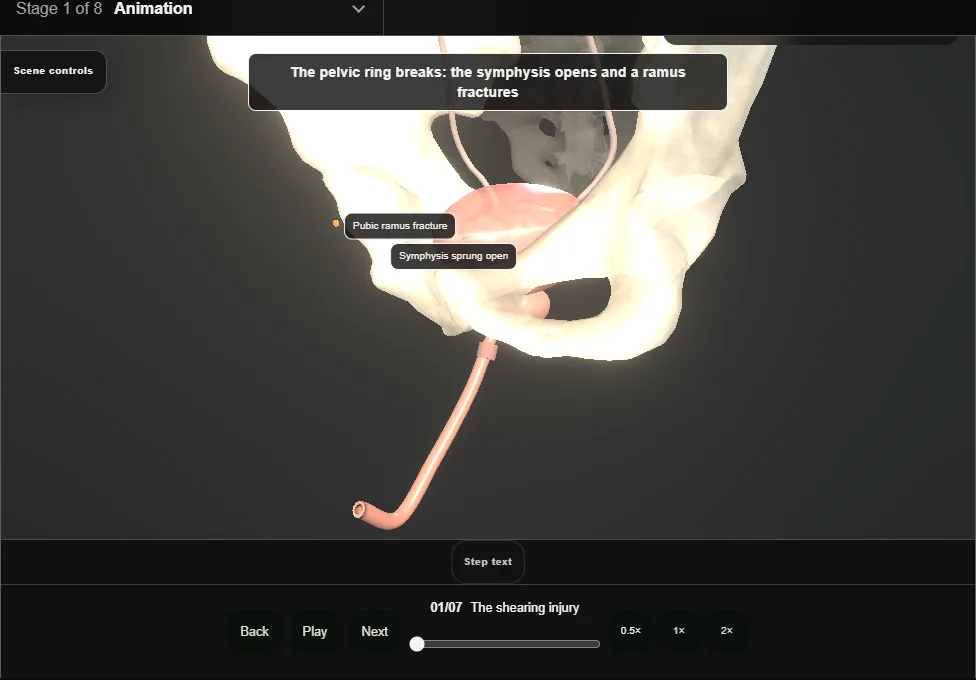
- The membranous urethra is torn where it is fixed at the pelvic floor: the fracture shears the prostate and its urethra off the bulbar urethra.
- The prostate avulses and rides high, and the gap fills with the pelvic haematoma.
- 02
Blood at the meatus, prostate high
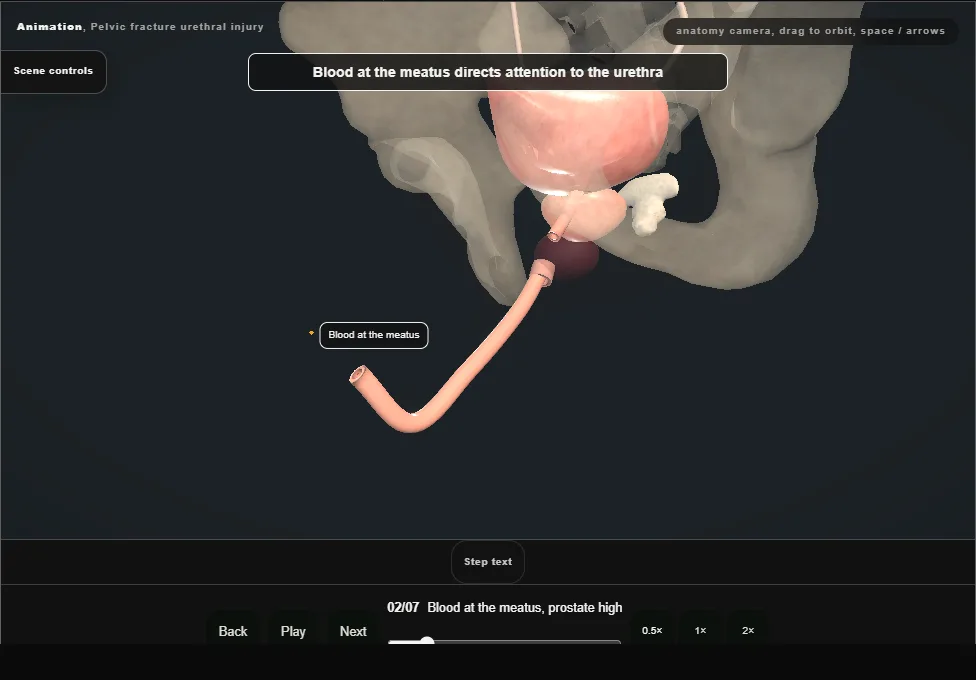
- Blood at the meatus, difficulty or inability to void, and a high-riding prostate on rectal examination.
- The finding forbids a blind catheter: one forceful pass turns a partial tear into a complete one.
- 03
Gentle retrograde urethrogram
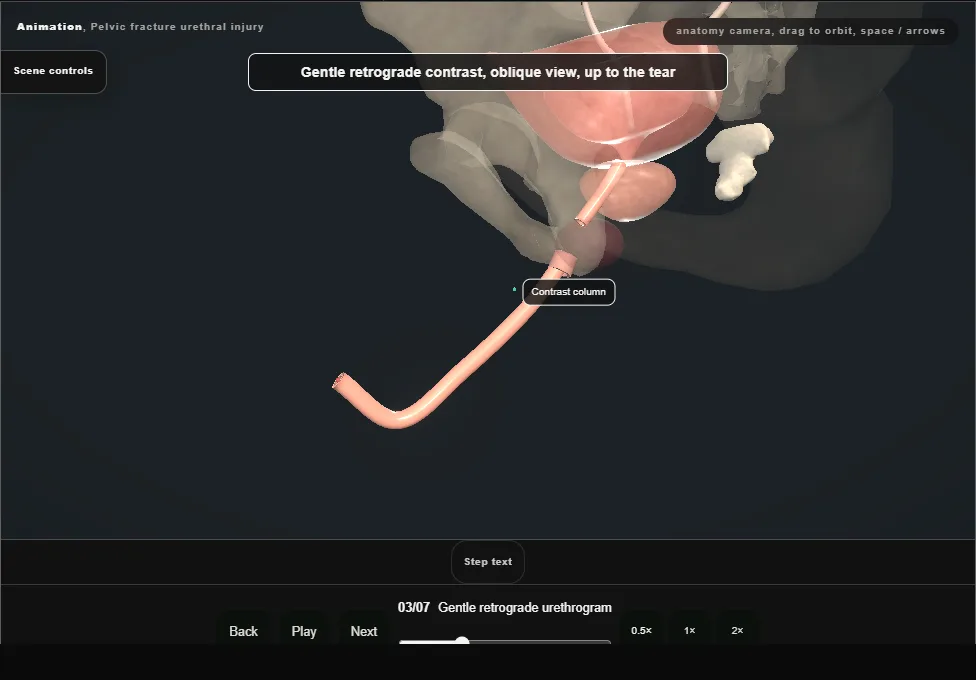
- Contrast is injected gently, never forced, and imaged obliquely.
- Contrast stopping at the membranous level and extravasating names the injury: partial if any contrast passes into the bladder, complete if none does.
- 04
Partial injury: one gentle attempt
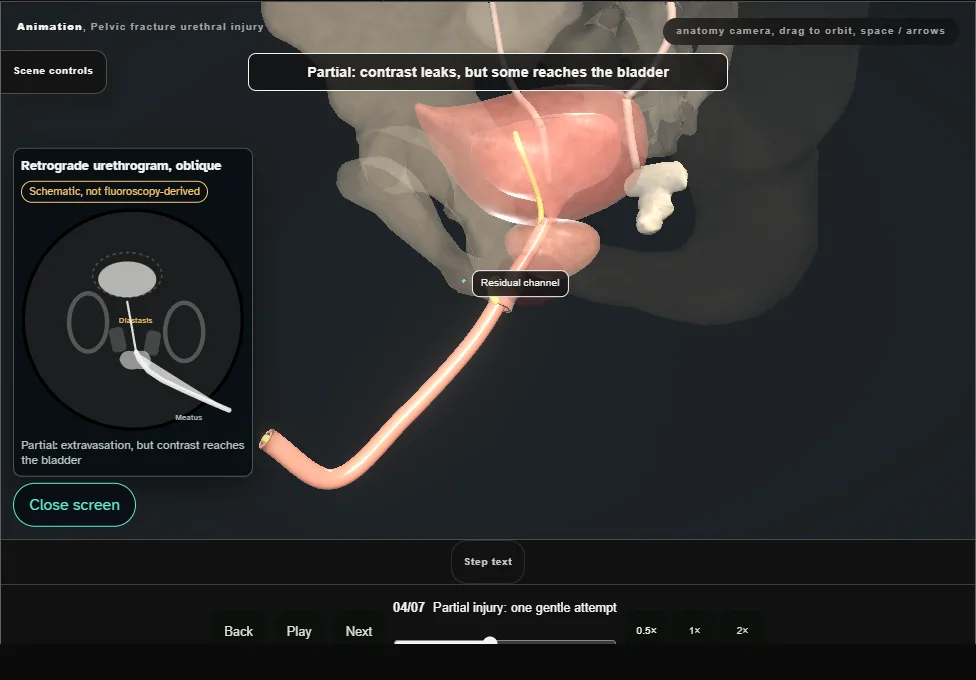
- A partial tear may take one gentle catheter by experienced hands, feeding it under vision or fluoroscopy.
- It passes, drains the bladder, and splints the healing tear.
- 05
Complete injury: suprapubic
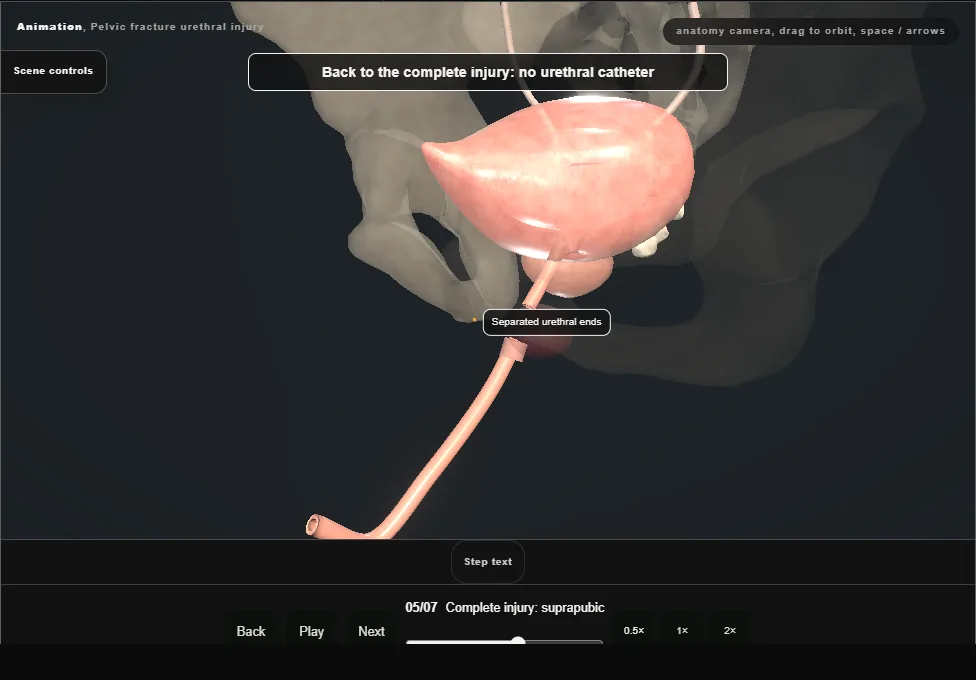
- Nothing should pass urethrally.
- The bladder is drained suprapubically, the injury is left to declare itself, and reconstruction is planned electively once the haematoma matures, typically at about three months.
- 06
The expected stricture
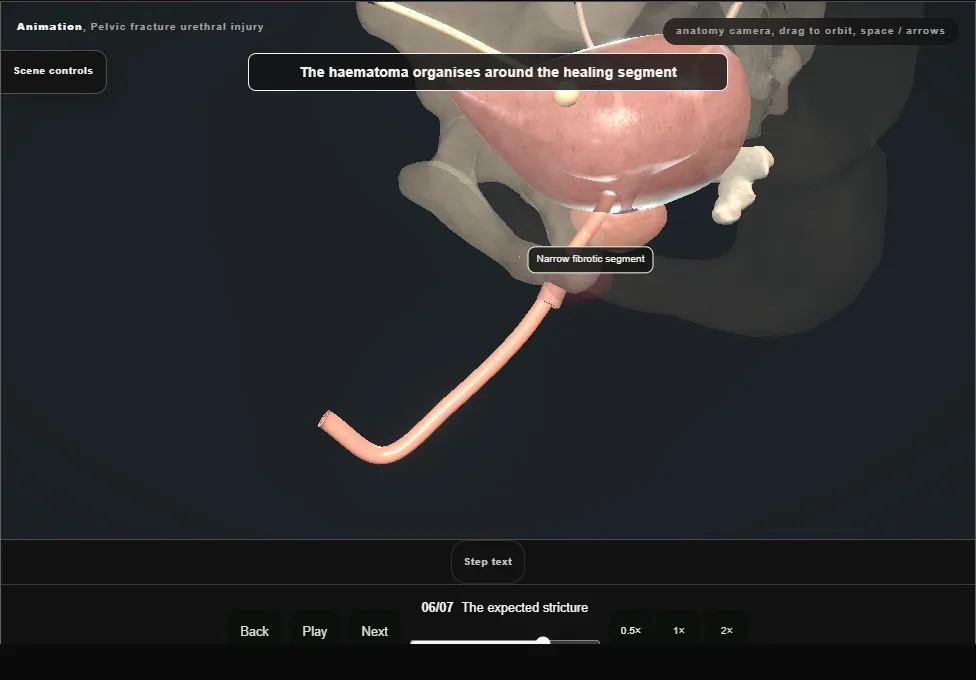
- Whatever the initial strategy, the injured segment heals narrow: the stricture after realignment is expected, not a failure.
- It is assessed and treated electively, at three months and on purpose.
- 07
Delayed anastomotic repair
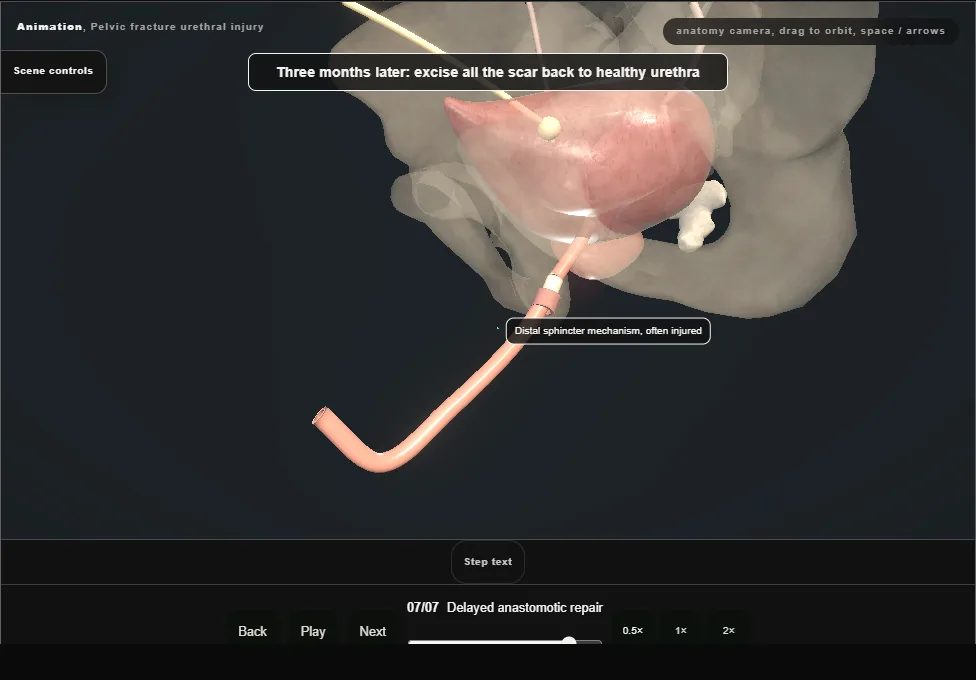
- Through a perineal approach the scarred segment is excised and the ends spatulated and joined, tension-free.
- The distal sphincter mechanism is often damaged by the injury, so continence after repair depends largely on a competent bladder neck.
Derived from UrethralTraumaScene.tsx at build time: every step title and caption above is the authored
ProcedureDef text, reproduced verbatim, and this page shares its readable-points renderer with the animation
itself. 7 of 7 steps have a captured frame.
Text fingerprint 5eb82f49bd72c407. A caption edit without a re-capture fails the production
check, so the sheet and the animation cannot drift apart silently.