
Urethral trauma diversion and realignment
Acute protection of urinary drainage after anterior or posterior urethral injury, with suprapubic diversion, selected realignment and delayed reconstruction treated as linked stages.
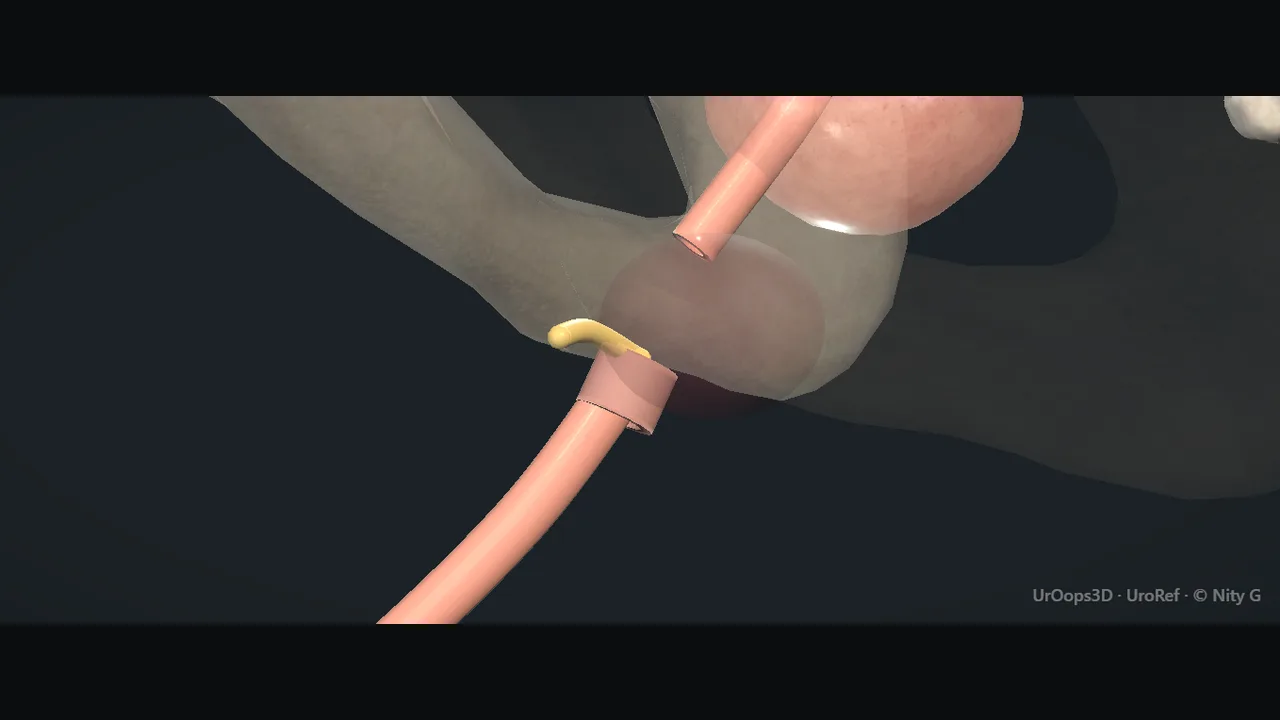 Interactive 3D Interactive operative model Open the 3D animation
Teaching catalogue only. This coverage record is not a patient pathway or operative instruction.
Typical place in practice
Suspected partial or complete urethral disruption after pelvic, straddle, penetrating or iatrogenic trauma.
Alternatives and neighbouring procedures
The balance between gentle transurethral catheterisation, endoscopic realignment and suprapubic diversion depends on injury pattern, stability and expertise.
Same procedure family, explicit technique branches
These are variations of this canonical operation. Complication modules below identify whether they apply to all branches or only to named approaches.
Suprapubic urinary diversion
Protects the injured urethra and secures drainage before delayed reassessment.
Endoscopic primary realignment
Restores continuity without formal acute scar excision in selected stable patients.
Immediate open repair
Repairs a clean, accessible defect where tissue and associated injuries permit.
Delayed urethroplasty pathway
Treats the resulting distraction defect or stricture in a planned specialist setting.
High-level sequence
Coverage outline only; not a step-by-step technical guide.
- Identify likely injury without repeated blind instrumentation
- Stabilise associated pelvic and abdominal trauma
- Establish safe bladder drainage
- Select diversion, realignment or immediate repair for the injury context
- Reassess later for stricture, continence, erection and definitive reconstruction
Operative notes
Concise operative notes covering the key steps, landmarks and watch points, in the order you encounter them.
Anterior urethral injury rules
What it does: safe handling of a torn urethra.
- Bruise or stretch: catheter 7-10 days.
- Suspected full tear: NEVER pass a catheter blind.
- Default: supra catheter above the pubis.
- Leave it 6 weeks. Then image. Rebuild at 8-12 weeks.
- Partial tear? Wire via flexible scope is allowed. Any resistance: stop.
- Repair at once only if: stable patient, stab or gunshot wound, alone, or urethra torn with a fractured penis.
- Repair: trim, free up, spatulate both ends. (Spatulate = cut open lengthways.) Join with no tension, over an 18Fr catheter.
- Catheter out at 2 weeks. Voiding study first.
- No grafts in dirty acute wounds.
From the UroRef Operative Quick Guide. Open the note page →
Every failure mode is its own module.
Timing and variation coverage are recorded for each module.
Failed access, false passage or worsened disruption
Repeated or forceful catheter and wire passage can extend the urethral injury.
Applies to: All variantsBleeding or pelvic haematoma disturbance
Instrumentation and open exposure can disrupt tamponaded pelvic bleeding.
Applies to: All variantsUrinary infection, extravasation or abscess
Inadequate drainage through a contaminated injury can lead to deep infection.
Applies to: All variantsUrethral stricture or obliteration
Scar is a common long-term consequence regardless of the acute drainage route.
Applies to: All variantsUrinary incontinence
The original injury and treatment can impair bladder-neck or sphincter function.
Applies to: All variantsErectile and ejaculatory dysfunction
Pelvic neurovascular injury frequently coexists and must be tracked independently of urethral patency.
Applies to: All variantsSuprapubic catheter complication
Blockage, displacement, leakage or visceral injury can compromise the diversion.
Applies to: Suprapubic urinary diversionSources for this module
Renal, ureteric, bladder, urethral and genital trauma and reconstruction.
Accessed 2026-08-03 · opens source European Association of Urology EAU Guidelines on Urethral StricturesDilatation, DVIU, anastomotic, graft, flap, staged and perineal procedures.
Accessed 2026-08-03 · opens source