
Ureteric trauma and iatrogenic injury repair
Immediate or delayed restoration of ureteric drainage after external or iatrogenic injury, organised by injury level, length, timing and tissue viability.
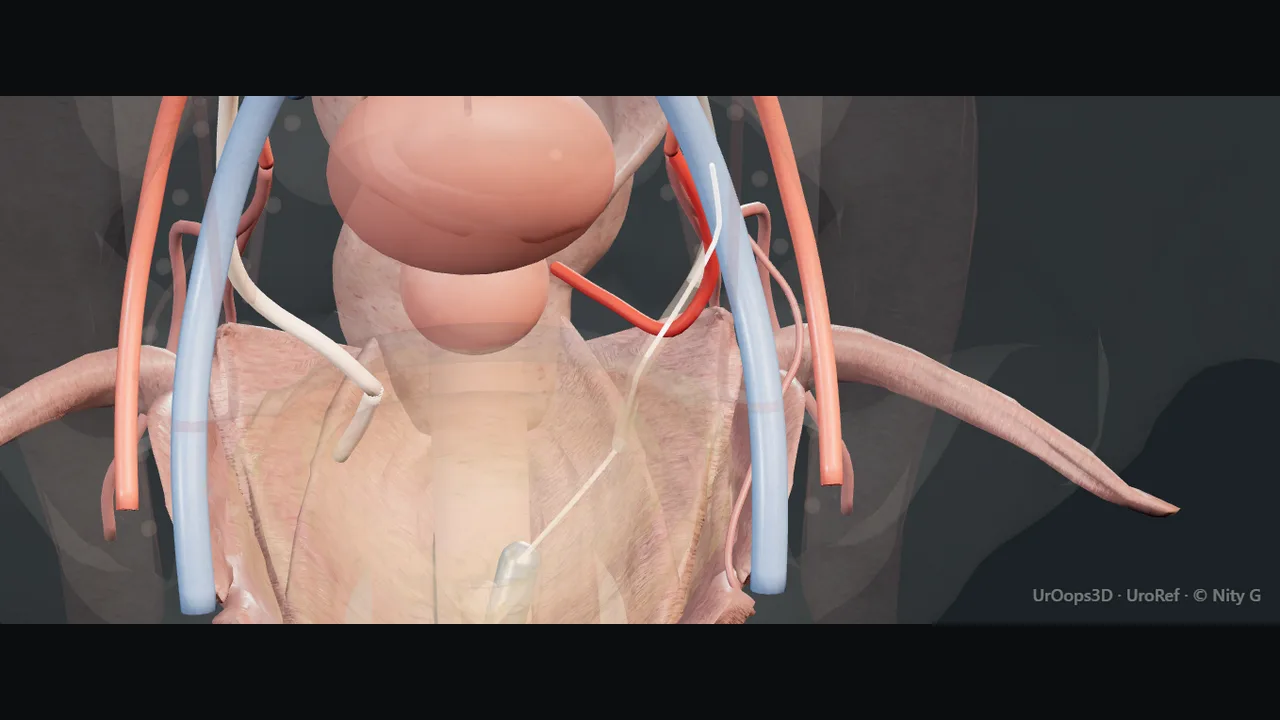 Interactive 3D Interactive ureteric injury: recognition and repair Open the 3D animation
Teaching catalogue only. This coverage record is not a patient pathway or operative instruction.
Typical place in practice
Recognised ligation, thermal injury, perforation, transection, devascularisation or delayed urinary leak/obstruction attributable to ureteric injury.
Alternatives and neighbouring procedures
Temporary internal or percutaneous drainage may be definitive for selected minor injuries or a bridge to reconstruction in an inflamed field.
Same procedure family, explicit technique branches
These are variations of this canonical operation. Complication modules below identify whether they apply to all branches or only to named approaches.
Stent or nephrostomy management
Bridges a partial injury or controls leak and obstruction before reassessment.
Ureteroureterostomy
Reconnects selected short viable upper or mid-ureteric defects.
Ureteric reimplantation with psoas hitch or Boari flap
Bridges a distal or longer defect using bladder mobilisation.
Complex substitution or autotransplant pathway
A tertiary option for extensive loss when simpler repair is impossible.
High-level sequence
Coverage outline only; not a step-by-step technical guide.
- Define injury level, length, viability, contamination and renal function
- Restore drainage and control urine leakage
- Debride non-viable tissue while preserving blood supply
- Create the simplest tension-free watertight reconstruction appropriate to the defect
- Drain and monitor for leak, obstruction, infection and renal recovery
Operative notes
Concise operative notes covering the key steps, landmarks and watch points, in the order you encounter them.
Ureteric rebuild - the ladder
What it does: 4 ways to bridge a missing ureter length.
1: reimplant, short low gaps
- Cut out the diseased end. Fill the bladder.
- Cut 3 cm through bladder muscle only.
- Open mucosa at the far end.
- Lay the spatulated ureter in.
- Close muscle over it. That tunnel stops reflux.
- Catheter 7-10 days.
2: psoas hitch, gains 5-8 cm
- Free the bladder: cut the OPPOSITE side umbilical artery, +/- superior vesical.
- Oblique cut across the bladder top.
- Finger inside pushes bladder up to psoas.
- 3-6 stitches, vertical, into psoas tendon. Vertical misses the nerve along psoas. Shallow misses the leg nerves.
- Hitch BEFORE joining, or the ureter kinks.
- Stent out 7-14 days.
3: Boari flap, gains 12-15 cm
- Bladder flap on a pedicle (superior vesical artery). Base 4 cm wide. Tip 3 cm. Length = gap + 3-4 cm.
- Fix tip to psoas.
- Ureter through the back of the flap. Spatulate.
- Join mucosa to mucosa, 4/0. No tension.
- Roll the flap closed over a catheter.
- Cystogram at 2 weeks. Then catheter out.
4: ileal ureter / kidney swap
- Know the concept only. Full-length gaps.
From the UroRef Operative Quick Guide. Open the note page →
Every failure mode is its own module.
Timing and variation coverage are recorded for each module.
Urinary leak or urinoma
An unrecognised extent of injury or failed repair can cause persistent retroperitoneal or intraperitoneal leakage.
Applies to: All variantsStricture and recurrent obstruction
Ischaemia, thermal spread or anastomotic scarring may narrow the ureter.
Applies to: All variantsInfection or sepsis
Urine leakage and obstructed drainage can become infected.
Applies to: All variantsRenal functional loss
Delayed recognition or persistent obstruction can damage the affected kidney.
Applies to: All variantsVascular, bowel or contralateral ureteric injury
Emergency or delayed reoperative dissection distorts retroperitoneal planes.
Applies to: All variantsDevice displacement, blockage or forgotten stent
Temporary drainage requires documented follow-up, exchange and removal.
Applies to: Stent or nephrostomy managementMetabolic or bowel complication
Bowel substitution or transplant-level surgery adds systemic and gastrointestinal risks.
Applies to: Complex substitution or autotransplant pathwaySources for this module
Renal, ureteric, bladder, urethral and genital trauma and reconstruction.
Accessed 2026-08-03 · opens source British Association of Urological Surgeons Patient information leaflets by procedureUK patient-facing procedure, alternatives, recovery and complication framing.
Accessed 2026-08-03 · opens source