
Revision sheet
Ureteric injury: recognition and repair
9 steps, each one the authored title and caption from the interactive animation, with the frame captured from that step. Read it before the case, or print it and work through the steps in order.
Teaching only, not for diagnosis or treatment decisions. The text on this sheet is the animation's own step copy, reproduced verbatim.
UrOops3D · UroRef · © Nity G
- 01
Where, and by whom
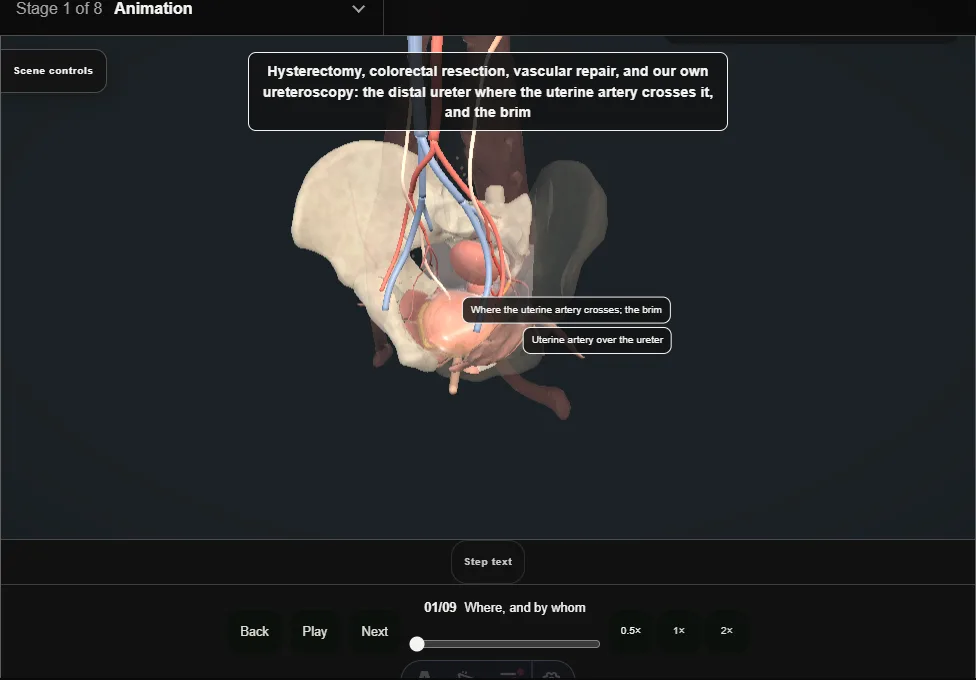
- Hysterectomy, colorectal resection, vascular repair and ureteroscopy: the distal ureter where the uterine artery crosses over it, and the brim.
- Clipped, tied, cut, burnt or crushed; most are not seen at the time.
- 02
Recognition at the time
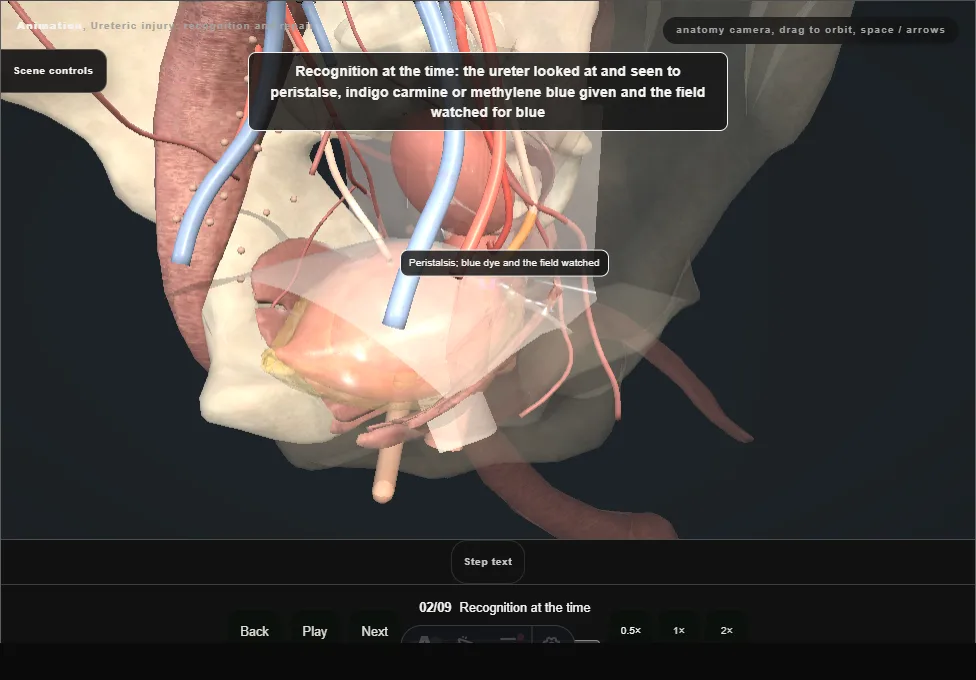
- The ureter looked at and seen to peristalse; indigo carmine or methylene blue given and the field watched for blue; a retrograde on the table if the field is unclear.
- 03
The clip, the tie, the burn
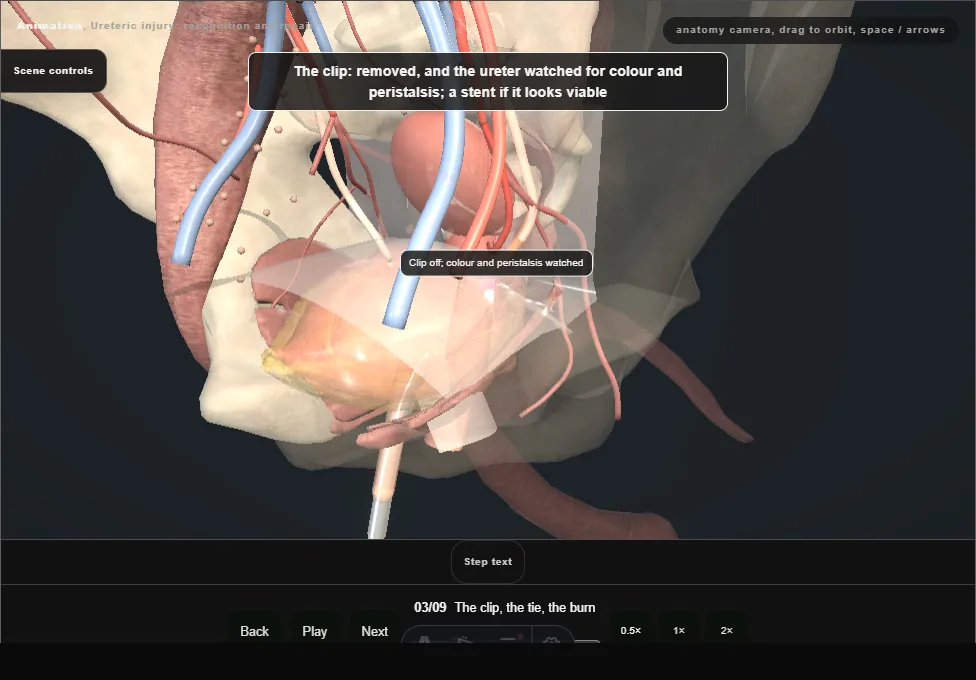
- The clip removed and the ureter watched for colour and peristalsis, a stent if it looks viable.
- A ligated segment is assessed after release; devitalised tissue or thermal injury needs debridement and repair.
- 04
The injury found late
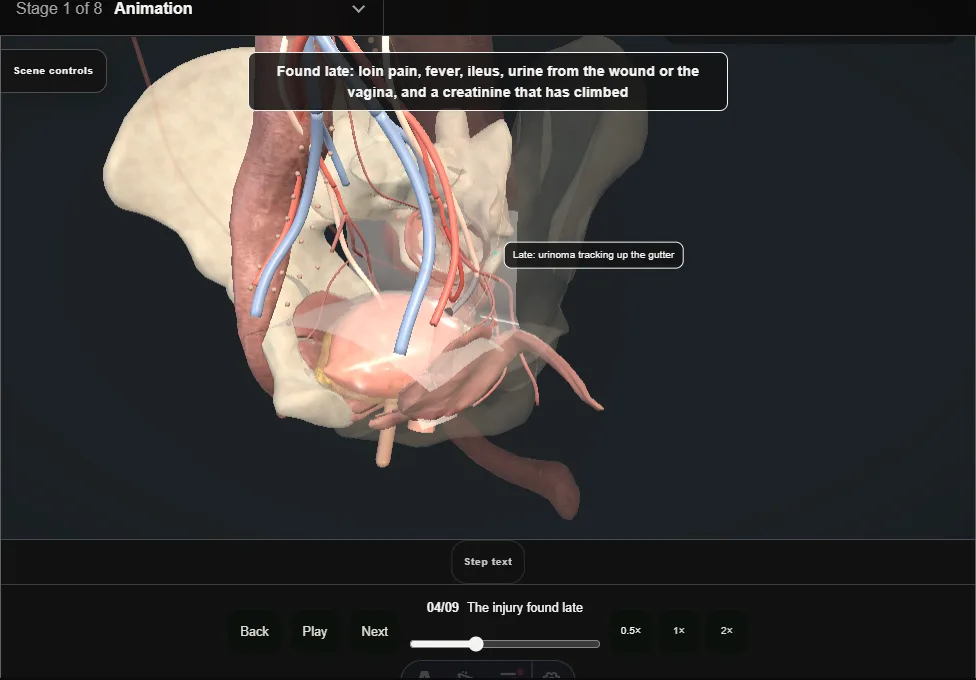
- Loin pain, fever, ileus, urine from the wound or the vagina, a creatinine that has climbed.
- Or nothing at all, and a kidney found silent months later.
- 05
Imaging the leak
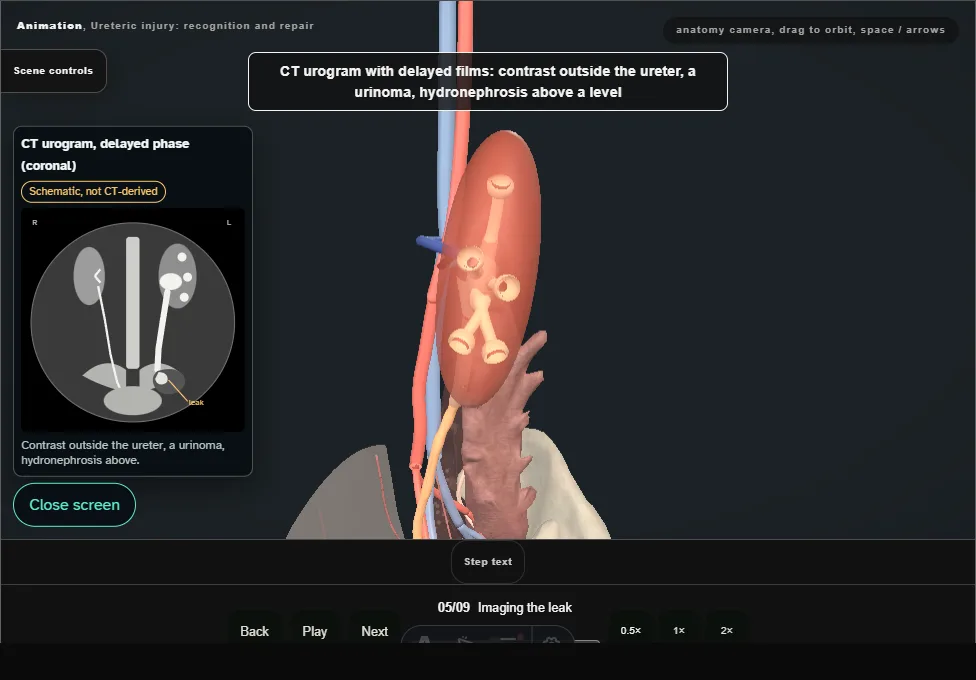
- CT urogram with delayed films: contrast outside the ureter, a urinoma, hydronephrosis above a level.
- A nephrostomy and antegrade study give the level and the length; a retrograde from below gives the rest.
- 06
Principles of repair
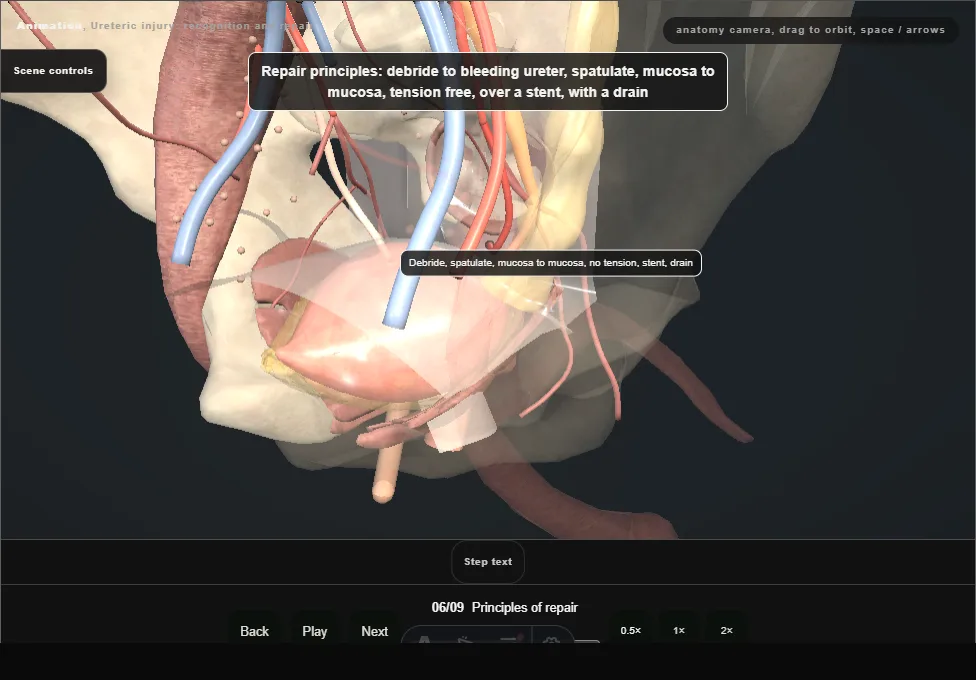
- Debride to bleeding ureter, spatulate, mucosa to mucosa, tension free, over a stent, with a drain.
- The blood supply in the adventitia is respected: a ureter stripped to repair it strictures.
- 07
Repair by level
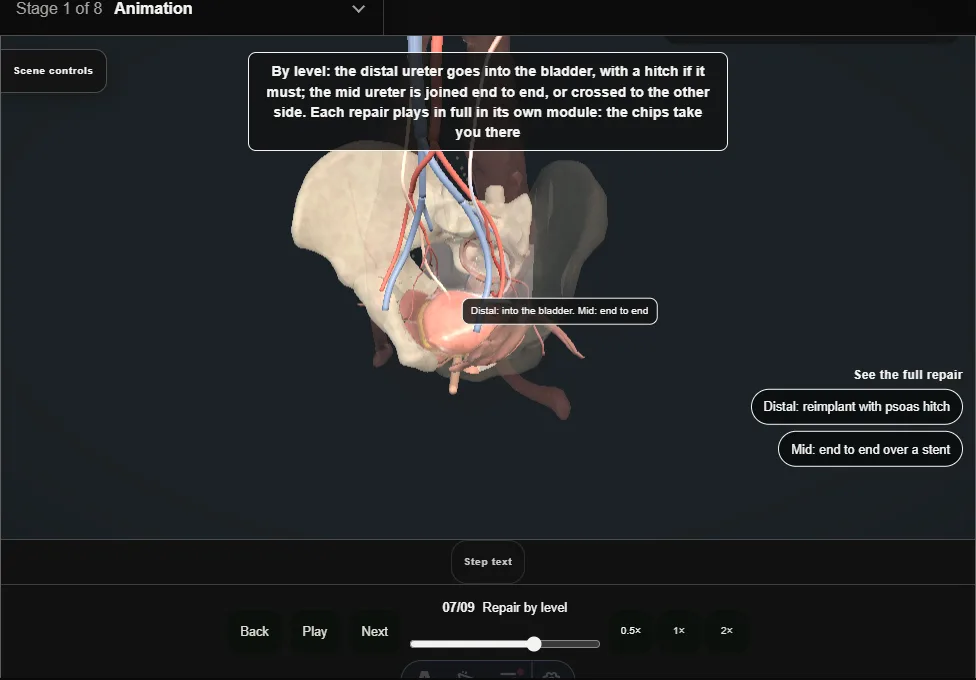
- The distal ureter into the bladder, with a hitch if it must; the mid ureter end to end or crossed to the other side; the upper ureter end to end or to the pelvis; a long loss is an ileal ureter or an autotransplant.
- 08
Nephrostomy and delayed reconstruction
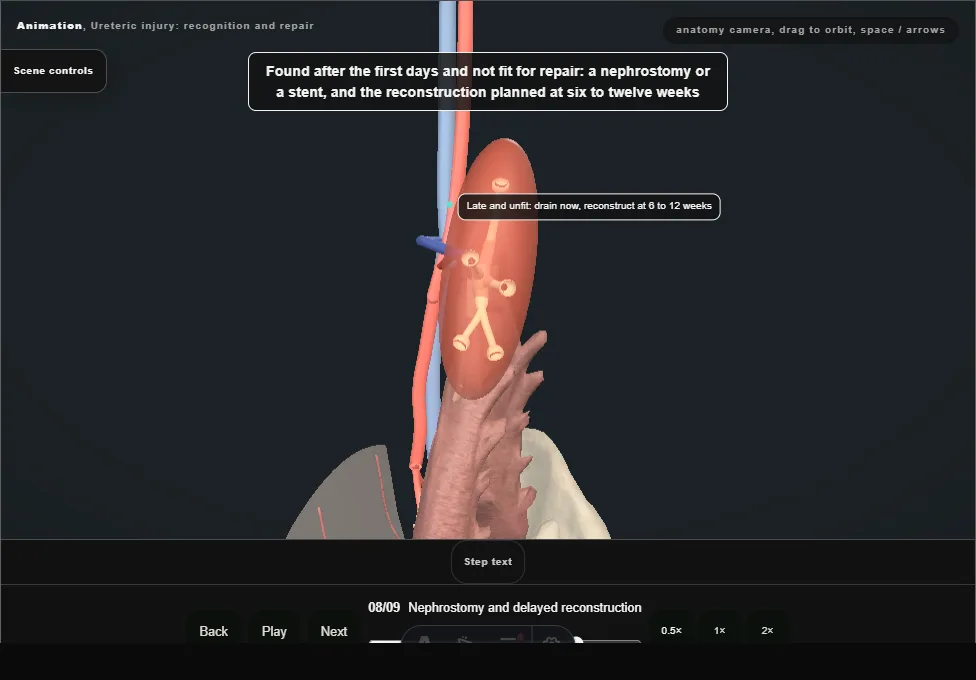
- Found after the first days and not fit for repair: a nephrostomy or a stent, and reconstruction at six to twelve weeks.
- A stent across the injury may be the whole treatment; one that will not pass is a nephrostomy tonight.
- 09
Documentation and after
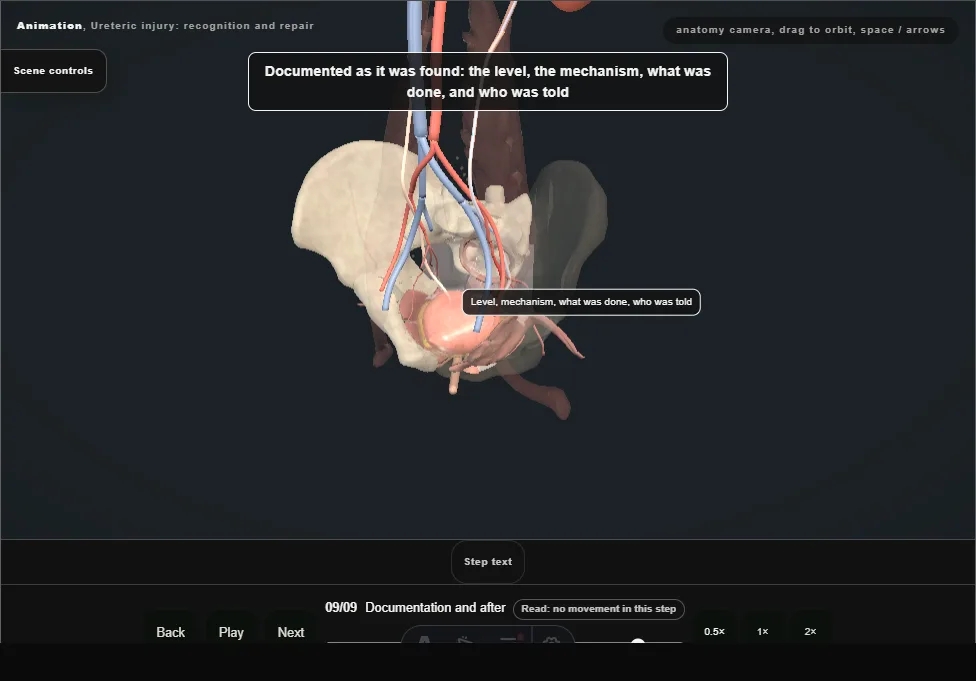
- Documented as found: the level, the mechanism, what was done, and who was told.
- The stent six weeks, imaging after it, and the kidney followed for a year: a stricture is late and quiet.
Derived from pelvis/UretericTraumaScene.tsx at build time: every step title and caption above is the authored
ProcedureDef text, reproduced verbatim, and this page shares its readable-points renderer with the animation
itself. 9 of 9 steps have a captured frame.
Text fingerprint a524b8af66e61261. A caption edit without a re-capture fails the production
check, so the sheet and the animation cannot drift apart silently.