Adult acquired buried penis: escutcheonectomy, release and skin graft
A penis of normal length is hidden in a suprapubic fat pad under a pannus, its skin scarred by lichen sclerosus and its mouth narrowed to a moist pit.
The repair releases the cicatrix, removes the fat pad by escutcheonectomy, excises the diseased shaft skin, anchors the penile base to the rectus fascia and covers the shaft with a split skin graft.
Advanced tierFRCS andrology, genital reconstructionInteractive 3D
How to use this module. Play through the nine steps, or use Back and Next. Watch the fat ghost to show the buried shaft, the ellipse marked and taken away, the diseased skin come off and the graft curl round the shaft. The triggers show graft loss, a broken wound and the fat pad re-forming.
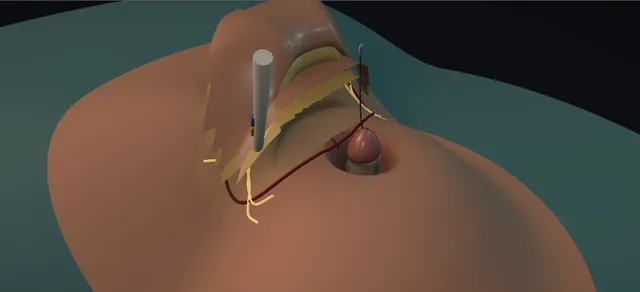
The buried shaft inside the suprapubic fat pad, and what lies round it. Schematic, not to scale; relationships only.
With the patient supine, the penis points away from the abdomen and 12 o'clock is the dorsum, toward the head.
Before the repair the shaft lies upright inside the fat of the mons, its glans at the bottom of a narrow pit, with the pannus hanging over it from above.
The ellipse lies on the mons above the penile base; the dorsal bundle runs under Buck's fascia at 12 o'clock and the urethra ventrally at 6 o'clock.
›Suprapubic fat pad (escutcheon) - the fat of the mons that buries the shaft; removed by escutcheonectomy.
›Pannus - the apron of lower abdominal skin and fat that hangs over the mons; removed by panniculectomy when large.
›Cicatricial ring - the scarred, narrowed mouth of the pit in which the glans is hidden.
›Penile shaft - of normal length, buried rather than small; its skin is scarred by lichen sclerosus.
›Buck's fascia - the layer under the shaft skin; the diseased skin is excised superficial to it and the graft lies on it.
›Dorsal neurovascular bundle - the deep dorsal vein, the paired dorsal arteries and nerves under Buck's fascia at 12 o'clock.
›Urethra and corpus spongiosum - ventral, just beneath the diseased ventral skin.
›Rectus fascia - the anchor for the dermis at the penile base, which holds the penopubic angle.
›Suprapubic lymphatics - at the lateral margins of the excision; their division gives lymph leak, seroma and lymphoedema.
›Thigh donor site - where the split skin graft is taken; dressed and healing on its own.
Assess and optimiseA large pannus hangs over a deep suprapubic fat pad and only a moist, narrowed opening shows; the glans is out of sight. He cannot aim his stream, sits to void, dribbles and cannot keep the area clean, and some men arrive with a suprapubic catheter. The shaft within is of normal length. Weight, diabetes control and the lichen sclerosus are addressed before surgery. where it bites: the skin of the pit is macerated and infected; the wound complications start here, and a poorly controlled diabetic heals badly.
Position and markIn theatre he lies supine with the pannus held up toward the head. A transverse ellipse is marked over the mons: its lower edge just above the penile base, its upper edge on the abdomen, wide enough to take the fat pad that buries the shaft. A pannus large enough to need its own excision is planned with the plastic surgeons as a panniculectomy. where it bites: too little taken and the penis is buried again; the marking is checked with the pannus down as well as up.
Release the cicatrixThe cicatricial ring at the mouth of the pit is divided at 12 o'clock and the scar released until the mouth is as wide as the shaft. The glans comes into view. A stay stitch through the glans holds the shaft up and gives traction for the rest of the operation. where it bites: the urethra lies beneath the ventral scar; the ring is divided dorsally, never at 6 o'clock.
EscutcheonectomyThe ellipse is incised through skin and the wedge of skin and fat is taken off the rectus fascia as one piece, with diathermy and careful haemostasis. The lymphatic-rich tissue at the lateral margins is divided with care and its larger channels are tied. With the fat pad gone, the penis stands clear of the abdomen and the penopubic angle reappears. where it bites: the lymphatics and the spermatic cords at the lateral and lower margins; a lymph leak or seroma follows careless division.
Excise the diseased shaft skinThe shaft skin scarred by lichen sclerosus is excised from the corona to the base, in the plane superficial to Buck's fascia, leaving a narrow healthy cuff at the base. The dorsal neurovascular bundle stays covered by its fascia and the ventral dissection keeps clear of the urethra. where it bites: the dorsal neurovascular bundle under Buck's fascia, and the urethra just beneath the scarred ventral skin.
Fixation and closureThe dermis at the penile base is anchored to the rectus fascia with several interrupted stitches, so the penopubic angle is held and the penis cannot be drawn back into the fat. The abdominal flap is then advanced and the wound closed transversely in layers over a drain. where it bites: tension on the transverse closure in a heavy patient; this wound is where the infection and dehiscence happen.
Split skin graftA split skin graft is taken from the thigh with a dermatome and the donor site is dressed. The graft is laid on the bare shaft, wrapped round it with the seam on the ventral side, sutured at the corona and the base and quilted to the shaft so that it cannot lift or shear. where it bites: the donor site on the thigh, which can be more painful than the penis; a graft that is not quilted lifts on a collection and fails.
Dressing and catheterA compressive dressing holds the graft still against its bed for the first days and a urethral catheter keeps it dry. The graft, the abdominal wound, the donor site and the voiding are reviewed when the dressing comes down. Early mobilisation and thromboprophylaxis follow local practice. where it bites: a dressing that slips lets the graft shear; it is checked daily.
The later resultOnce the graft has taken, the penis stands clear of a flat suprapubic area with a transverse scar. He can stand to void, keep clean and in many cases resume sexual activity. Continued weight loss and treatment of the lichen sclerosus keep the result. where it bites: weight regain: the fat pad re-forms and the penis is buried again.
The spatial relationships the animation is built to make automatic. Before you read each one, ask yourself: at this point in the operation, what is about to go wrong, and what is my first move? The save for each sits in the Complications tab.
RiskDorsal penile neurovascular bundle - under Buck's fascia at 12 o'clock; the shaft skin is excised superficial to the fascia so the bundle is never seen bare.
RiskUrethra beneath diseased ventral skin - scarred ventral skin lies close on the spongiosum; the cicatrix is divided dorsally and the ventral excision kept shallow.
RiskLymphatic-rich suprapubic tissues - at the lateral margins of the ellipse and over the spermatic cords; divided with care, the larger channels tied.
RiskGraft donor site - the thigh; a second wound with its own pain, bleeding and infection, dressed and reviewed with the others.
Trigger each of these live in the Animation tab, then read the save: the first move, the escalation trigger, and the line that goes in the op note.
Graft loss
a patch of graft, usually ventral, fails to take: pale and then dark and sloughy over the bare bed.
Shear, a haematoma or seroma under the graft, and infection are the usual causes.
The save
Take the dressing down and look: a collection under living graft is let out through a small cut and the graft pressed back.first move
Keep the area clean and dressed and the catheter in until the bed is healthy; small patches heal from their edges.
A large area of loss, an exposed urethra or infection spreading from the bed: senior review and a plan for debridement and regrafting.escalation trigger
Record the percentage of graft take, where the loss is, the state of the bed and the plan.document
Wound infection or dehiscence
the transverse abdominal wound breaks down in its middle, with cellulitis round it: the commonest complication after this repair, and commoner the heavier the patient.
The save
Open the wound where it is fluctuant, drain it and send pus for culture.first move
Treat the cellulitis with antibiotics per local guidance, check the blood glucose, and dress the wound; negative-pressure dressing for a large open wound.
Spreading infection, systemic sepsis, or crepitus or necrosis at the wound: back to theatre the same day for debridement.escalation trigger
Note the extent of the breakdown, the culture, the antibiotics and the dressing plan.document
Recurrence of burial
months later the fat pad re-forms as weight returns, or the base was not fixed, and the penis is buried again.
Higher body mass index is the main risk.
The save
Confirm the cause on examination: re-formed fat pad, a contracted scar at the base, or new diseased skin.first move
Weight loss with the help of the weight management service, and treatment of any active lichen sclerosus.
Revision of the escutcheonectomy and the fixation is offered once the weight is stable; a reconstructive centre for a second repair.escalation trigger
Record the weight, what has recurred and the advice given.document
Lymphoedema of the shaft skin
swelling of the graft or the remaining genital skin after division of the suprapubic lymphatics, or the progression of a lymphoedema that was there before; it can bury the penis again.
The save
Elevation and compression garments, and treatment of any cellulitis, which drives it.first move
Lymphoedema service input and skin care.
Persistent or progressive genital lymphoedema: referral to a genital reconstruction centre for excision and grafting.escalation trigger
Note the extent, the treatment and the referral.document
Urethral or neurovascular injury
the urethra opened under the scarred ventral skin while the cicatrix is released or the skin excised, or the dorsal bundle damaged by dissection deep to Buck's fascia.
The save
Stop and identify the injury; pass a catheter to splint the urethra.first move
Close a small clean urethral opening in layers over the catheter before the graft goes on.
A larger urethral injury or stricture disease from lichen sclerosus: a reconstructive urologist decides between repair and a staged approach.escalation trigger
Record the site and size of the injury, the repair, the catheter plan and that the patient was told.document
When the case turns: the problem, then the next move.
ActionThe pannus is very large - a panniculectomy with the plastic surgeons, in the same sitting or staged; the escutcheonectomy alone leaves the apron to bury the penis again.
ActionThe scrotum is engulfed or lymphoedematous - a scrotoplasty, excising the redundant or lymphoedematous scrotal skin, as part of a composite repair.
ActionEnough healthy shaft skin remains - release and fixation without grafting; only irreversibly diseased skin is excised.
ActionMeatal stenosis or a urethral stricture from lichen sclerosus - assessed before surgery; a meatotomy or urethroplasty is planned alongside or after the release.
ActionSplit or full thickness graft - a split skin graft from the thigh is the standard choice here; a full thickness graft, sometimes from the excised escutcheon itself, is an option, and the series that compared them found no difference in outcome.
The examiner stems this scene prepares you for. Try to answer out loud first, then reveal, and learn the discriminator, the detail that turns a pass into a strong pass.
QA man with a body mass index well above 40 is referred because he cannot see his penis, sits to void and has recurrent infections of the skin. What is going on, and what causes it?reveal answer
This is an adult acquired buried penis.
The penis itself is usually of normal length; it is hidden by the suprapubic fat pad and the pannus above it, and the skin round its mouth has become scarred and narrowed.
The EAU guideline on sexual and reproductive health names obesity as the main risk factor, with lichen sclerosus and the treatment of penile cancer, and notes that an aggressive circumcision can contribute.
The mechanism is a cycle: urine pools in the pit, the skin is macerated and infected, lichen sclerosus scars it and draws the opening in, and the scar then tethers the shaft inside the fat.
Lymphoedema of the genital skin is a further cause.
I would ask about voiding, hygiene, sexual function and any suprapubic catheter, examine with the pannus lifted, and look for meatal stenosis and urethral stricture from the lichen sclerosus.
Strong pass
Saying the shaft is of normal length and buried, not small, and describing the cycle of maceration, lichen sclerosus and cicatrix.
QHow would you prepare him for surgery?reveal answer
I would counsel him extensively, as the EAU guideline recommends, because this surgery carries a high complication rate.
I would refer him to the weight management service, since a lower body mass index reduces both complications and recurrence;
Chestnut and colleagues found that a body mass index of 40 or more carried a 12.7-fold increase in the odds of recurrence.
I would optimise his diabetes, stop smoking, treat the lichen sclerosus and any active skin infection, and assess the urethra by flow rate and, if needed, urethrography or cystoscopy.
I would plan the repair with a plastic surgeon when a panniculectomy is likely, and explain that he will have a catheter, a graft dressing and a donor site on the thigh.
Surgery should not wait indefinitely for weight loss that does not come, but every kilogram matters.
Strong pass
Weight, diabetes and smoking optimised, the urethra assessed for lichen sclerosus stricture, and the patient told of the high complication rate.
QWhat are the components of the reconstruction, and when is each needed?reveal answer
I think of it as a ladder, as in the staging of Jun, Gallegos and Santucci.
Where there is only a phimotic band, its release may be enough.
Where the shaft skin is diseased, it is excised and replaced with a split skin graft.
Where the scrotum is engulfed or lymphoedematous, a scrotoplasty is added.
Where a suprapubic fat pad buries the shaft, an escutcheonectomy is needed, and where a pannus hangs over it, a panniculectomy.
In their series of 73 men about half needed the escutcheonectomy or panniculectomy stages.
In every case the dermis at the penile base is anchored to the rectus fascia or pubic periosteum; Voznesensky and colleagues did this in all of their patients.
Suprapubic liposuction and suspensory ligament release are described for men who are not obese, but the lengthening they give on the table is partly lost by three months, and I would not use ligament release in an obese man.
Strong pass
Say both
Matching each component to a finding
With fixation of the penile base in every case
Examiner note
Matching each component to a finding, with fixation of the penile base in every case.
QWhich graft would you use, and what take rate would you quote?reveal answer
I would use a split skin graft from the thigh, laid on Buck's fascia, with the seam ventral, sutured at the corona and the base and quilted, under a compressive dressing with a catheter.
Fuller and colleagues reported a split skin graft take of 80 to 100 per cent, with a mean of 91.7 per cent, in 12 men, and Tang and colleagues reported 80 to 100 per cent take in their first 5.
Erpelding and colleagues reported complete take in 16 patients treated largely as day cases.
A full thickness graft is an alternative and can be taken from the excised escutcheon;
Monn and colleagues reported that all 13 such grafts took, and Gül and colleagues found no difference in outcome between split and full thickness grafts.
I would quote those figures, and warn him that a small patch of loss is common and usually heals.
Strong pass
Say both
Quoting a sourced take rate
Knowing that full thickness grafts perform as well in the series that compared them
Examiner note
Quoting a sourced take rate and knowing that full thickness grafts perform as well in the series that compared them.
QWhat complications and what recurrence rate would you discuss?reveal answer
The commonest problems are wound complications: infection and breakdown of the transverse abdominal wound, cellulitis, seroma and lymph leak from the suprapubic tissues, and graft loss.
Jun and colleagues recorded complications within 30 days in 60 per cent of 73 men, most of them Clavien-Dindo grade I or II.
Erpelding and colleagues found surgical site infection the commonest complication and body mass index the significant risk factor.
For recurrence, Chestnut and colleagues reported reburial in 17 of 76 men, 22 per cent, at an average of 436 days, with each point of body mass index raising the odds by 12 per cent.
I would also mention lymphoedema, altered sensation and sexual function, and the donor site.
Against that, the patient-reported results are good: Voznesensky and colleagues found that 92 per cent would choose the surgery again.
Strong pass
Say both
Giving a sourced recurrence rate
Tying both recurrence and complications to body mass index
Examiner note
Giving a sourced recurrence rate and tying both recurrence and complications to body mass index.
Curriculum. Supports learning relevant to the ISCP Urology Curriculum syllabus topic Andrology. Not a workplace-based assessment and not evidence of competence.
Two minutes
Close the lap: recall it before you leave.
Say it aloud, then reveal. Reading is not remembering.
01The relationshipSay the critical spatial relationship out loud, then reveal.reveal
Memory frame
With the patient supine, the penis points away from the abdomen and 12 o'clock is the dorsum, toward the head.
Why?
Before the repair the shaft lies upright inside the fat of the mons, its glans at the bottom of a narrow pit, with the pannus hanging over it from above. The ellipse lies on the mons above the penile base; the dorsal bundle runs under Buck's fascia at 12 o'clock and the urethra ventrally at 6 o'clock.
02The first moveGraft loss. Your first move?reveal
First move
Take the dressing down and look: a collection under living graft is let out through a small cut and the graft pressed back.
03The escalation triggerGraft loss. What makes you call for help?reveal
Escalate when
A large area of loss, an exposed urethra or infection spreading from the bed: senior review and a plan for debridement and regrafting.
04The discriminatorWhat turns a pass into a strong pass?reveal
Strong pass
Saying the shaft is of normal length and buried, not small, and describing the cycle of maceration, lichen sclerosus and cicatrix.
05The pitfallWhere does this operation bite first?reveal
Pitfall
Dorsal penile neurovascular bundle
Why?
under Buck's fascia at 12 o'clock; the shaft skin is excised superficial to the fascia so the bundle is never seen bare.
Revision practice with self-marked answers, not an assessment of clinical competence. Kept in
this browser only; it does not sync between devices.