UrOops3D, danger-zone atlas

Schematic model.

Operative animation, Epididymal cyst excision

Epididymal cyst excision and epididymectomy

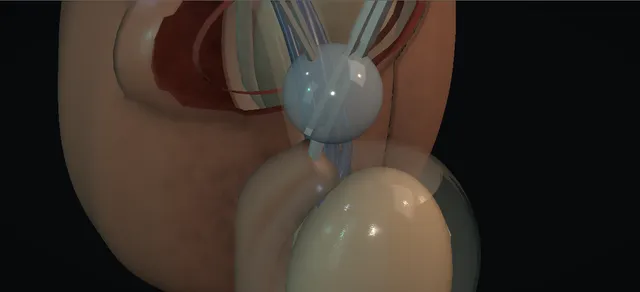
Scrotal excision of a symptomatic epididymal cyst. The testis is delivered through an anterior hemiscrotal incision, the tunica vaginalis opened, and the cyst dissected off the head of the epididymis down to its neck, which is tied and divided so that the cyst comes away intact.

A second path shows the epididymectomy: the vas divided and the epididymis lifted off the testis from tail to head. The lesson is the plane on the cyst wall, the testicular vessels at the upper pole, and the fertility cost of operating at all.

Core tier FRCS andrology, the scrotal lump and benign scrotal surgery Interactive 3D

Operative visualisation

Schematic scene preview: Epididymal cyst excision
Preparing the 3D anatomy…

UrOops3D · UroRef · © Nity G

How to use this module. Play through the eight steps, or use Back and Next. Watch the testis come out, the cyst lift off the head on its neck and the tie go on clear of the upper pole. The triggers show cut tubules, an ischaemic testis, a haematoma, and the epididymectomy as a second path.

Click me next Section 2 of 8 Anatomy The structures this operation works between, and the one it must not cross.

The structures in the scene

Epididymal cyst excision: how the structures relateThe epididymal cyst on the head of the epididymis, and what lies round it. Epididymal cyst: thin-walled, transilluminates: under its base; stay on the cyst wall Tubules of the epididymal head (danger). Epididymal cyst: thin-walled, transilluminates: enter the upper pole beside it; never in the tie Testicular artery and veins (danger). Epididymal cyst: thin-walled, transilluminates: above and behind it, felt separate Testis and tunica albuginea. Epididymal cyst: thin-walled, transilluminates: opened in front to reach it Parietal tunica vaginalis. Epididymal cyst: thin-walled, transilluminates: far from it; divided only in epididymectomy Vas deferens at the tail. Epididymal cyst: thin-walled, transilluminates: returned untwisted at the end Spermatic cord (danger).Epididymal cyst:thin-walled,transilluminates!Tubules of theepididymal head!Testicular arteryand veinsTestis and tunicaalbugineaParietal tunicavaginalisVas deferens at thetail!Spermatic cordunder its base;stay on the cystwallenter the upperpole beside it;never in the tieabove and behindit, felt separateopened in front toreach itfar from it;divided only inepididymectomyreturned untwistedat the endTargetDangerLandmarkContext
The epididymal cyst on the head of the epididymis, and what lies round it. Schematic, not to scale; relationships only.
  • Seen from the patient's right with the testis delivered and the tunica vaginalis open, the epididymis runs down the posterolateral border of the testis from the head on the upper pole to the tail at the lower pole.
  • The cyst sits on the head, above and behind the testis.
  • The tubules of the head lie directly under its base, and the testicular vessels reach the upper pole at its posterior border, a short distance medial to it.
  • ›Epididymal cyst - a thin-walled fluid sac arising from the efferent ductules or the epididymal tubules, usually at the head; it transilluminates.
  • ›Head of the epididymis - on the upper pole, posterolateral; its tubules carry sperm from the testis and lie under the base of the cyst.
  • ›Body and tail of the epididymis - down the posterolateral border to the lower pole, where the vas begins.
  • ›Testicular artery and veins - reach the testis at the upper pole, at its posterior border, close to the head of the epididymis.
  • ›Artery of the epididymis - a branch to the epididymis near the junction of the upper and middle third of the testis; tied in an epididymectomy.
  • ›Vas deferens - leaves the tail and ascends behind the testis into the cord; divided above the tail in an epididymectomy.
  • ›Tunica vaginalis - parietal layer opened to reach the cyst; the visceral layer covers testis and epididymis.
  • ›Tunica albuginea - the capsule of the testis; the epididymectomy plane lies on it and does not breach it.
  • ›Scrotal skin and dartos - thin and vascular; opened across the front of the hemiscrotum.
Click me next Section 3 of 8 Steps The operation in order, with the landmark that guards each move.

Operative steps

  1. Examination and consent A smooth lump above and behind the testis, felt separate from it, that transilluminates; ultrasound confirms an epididymal cyst and a normal testis. Consent covers recurrence, haematoma, infection, chronic pain, testicular atrophy and the risk to fertility on that side. Supine, prepared, draped and a time-out.
    where it bites: a lump that cannot be felt separate from the testis is not an epididymal cyst until ultrasound says so.
  2. Incision The cyst is palpated again under anaesthesia. A transverse incision is made across the front of the right hemiscrotum, and the dartos is divided with diathermy down to the parietal tunica vaginalis.
    where it bites: the dartos bleeds; each point is coagulated as it is met.
  3. Delivery of the testis The testis is pushed up from below and delivered through the incision, with the epididymis and the cyst, inside its tunica vaginalis. It is held from behind and the spermatic cord is kept straight.
    where it bites: the cord is not twisted or put on stretch while the testis lies out of the scrotum.
  4. Tunica opened, cyst found The parietal tunica vaginalis is opened down the front of the testis. The cyst is found at the head of the epididymis: thin-walled, smooth and blue-grey, separate from the testis. Its relations are seen before anything is dissected.
    where it bites: the tubules of the head lie under the base of the cyst, and the testicular vessels enter the upper pole beside it.
  5. Dissection off the epididymis The cyst wall is held with fine forceps without puncturing it and is dissected off the head of the epididymis with fine scissors, staying on the cyst wall, until its broad base narrows to a single neck: the tubule or efferent ductules that feed it.
    where it bites: a plane that strays off the cyst wall opens the head of the epididymis and its tubules.
  6. Neck tied, cyst removed intact The neck is tied close to the cyst and divided beyond the tie, and the cyst comes away intact and goes to pathology. A cyst that ruptures is opened and its whole wall excised; it is not left behind.
    where it bites: the tie goes on the neck alone, clear of the upper pole, never round the vessels there.
  7. Base cauterised, head covered The base on the head is lightly cauterised, keeping meticulous haemostasis, and the covering of the head is closed over the base. Epididymis, testis and cord are inspected and found intact, the testis pink.
    where it bites: bleeding left in the bed now becomes a haematoma tonight.
  8. Return and closure The testis is returned to the scrotum in its normal position with the cord untwisted. The dartos is closed with a running absorbable stitch and the skin with interrupted ones; a drain is optional. A dressing and a scrotal support are applied.
    where it bites: a testis returned twisted is a torsion made in theatre.
Click me next Section 4 of 8 Danger zones Where this operation bites, and why it bites there.
Critical relationship

Danger zones

The spatial relationships the animation is built to make automatic. Before you read each one, ask yourself: at this point in the operation, what is about to go wrong, and what is my first move? The save for each sits in the Complications tab.

  • RiskEpididymal tubules and vas deferens - under the base of the cyst and through the head; a cut there obstructs this side. The vas is divided only in an epididymectomy.
  • RiskTesticular vessels - enter the upper pole beside the head; a tie or a dissection taken deep at the head can take them.
  • RiskTunica and testicular parenchyma - the epididymectomy plane lies on the tunica albuginea; a breach exposes the tubules of the testis and bleeds.
  • RiskThe cord on return - the testis goes back untwisted, in its normal position.
Practise it Take me into the scene Opens the animation at a danger moment and asks you to predict the mechanism and your first move before it reveals.
Click me next Section 5 of 8 Complications The save for each one: the first move, the escalation trigger, the op-note line.

Complications and immediate saves

Trigger each of these live in the Animation tab, then read the save: the first move, the escalation trigger, and the line that goes in the op note.

Epididymal tubules cut

  • the scissors leave the cyst wall and open the head of the epididymis, with milky fluid at the breach.
  • Scarring of the epididymis that impairs fertility is a listed risk of the operation.
The save
  1. Stop dissecting. Find the cyst wall again above the breach and go on only in that plane. first move
  2. Secure haemostasis at the breach with the lightest cautery, and close its covering with a fine absorbable stitch.
  3. In a man who wants children, or whose other side is not normal, call a senior before going further; a microsurgical opinion may be needed later. escalation trigger
  4. Op note: that the head was opened and where; tell him that this side may now be obstructed. document

Testicular ischaemia

  • a tie taken deep on a broad neck has gone round the testicular vessels entering the upper pole, and the testis turns dusky.
  • Damage to the testicular blood supply resulting in atrophy is a listed risk.
The save
  1. Take the tie off at once. Warm the testis in a moist swab and watch its colour. first move
  2. Re-tie the neck alone, close to the cyst, once the vessels are seen clear of it.
  3. A testis that stays dark is a senior decision now, on its viability and what to do about it. escalation trigger
  4. Op note: the tie, its release, the colour before and after; plan a review of testicular size. document

Scrotal haematoma

  • that evening the right hemiscrotum is tense, swollen and bruised; a haematoma that resolves slowly or needs surgical drainage is a listed risk.
The save
  1. Examine him: a soft, stable swelling is managed with a support, ice and analgesia, and reviewed. first move
  2. Stop any anticoagulant or antiplatelet only on the advice of whoever prescribed it.
  3. A tense, expanding or very painful haematoma is a senior review now; it may need exploration, evacuation and haemostasis. escalation trigger
  4. Record the size and progress of the swelling and the plan, and tell him what would bring him back. document
Click me next Section 6 of 8 Troubleshooting When the case turns: the problem, then the next move.

Intra-operative troubleshooting

When the case turns: the problem, then the next move.

  • ActionThe cyst ruptures during dissection - the fluid is sucked away and the collapsed wall is held and dissected out completely; a wall left behind is a recurrence.
  • ActionA very large cyst fills the wound - it may have to be decompressed with a needle so that the testis can be delivered; the wall is then excised in full as before.
  • ActionSeveral cysts, or one wrapped round the epididymis - the more of the epididymis is dissected, the higher the risk to the tubules; a partial epididymectomy is sometimes the cleaner operation, and is consented for beforehand.
  • ActionClear fluid with sperm in it - a spermatocele and an epididymal cyst are managed the same way; both go to pathology.
  • ActionA solid component on ultrasound - it is not a simple cyst; it is assessed as a solid lump, with tumour markers where the testis is involved, before anything is done.
  • ActionThe cyst comes back - recurrence is a listed risk; repeat surgery adds to the risk to the epididymis, so a small recurrence that does not trouble him is left alone.
Click me next Section 7 of 8 FRCS viva Say it out loud, then mark yourself against the model answer.

FRCS viva questions

The examiner stems this scene prepares you for. Try to answer out loud first, then reveal, and learn the discriminator, the detail that turns a pass into a strong pass.

QA man of thirty has a lump above his right testis. How do you assess it?reveal answer
  • I would take a history of how long it has been there and whether it hurts, and ask about his family plans.
  • On examination the key question is whether I can get above the lump and whether it is separate from the testis.
  • A smooth, fluctuant lump above and behind a normal testis that transilluminates is an epididymal cyst or a spermatocele.
  • The differential includes a hydrocele, which surrounds the testis so that it cannot be felt separately;
  • a varicocele, a bag of veins that fills on standing;
  • an inguinoscrotal hernia, which I cannot get above;
  • epididymitis, which is tender;
  • and a testicular tumour, which is in the testis and does not transilluminate.
  • I would arrange a scrotal ultrasound, which confirms a cystic lesion in the epididymis, shows the testis is normal, and picks up a solid component or a tumour that examination missed.
Strong pass

Say all three

  • Getting above the lump
  • Feeling the testis separately
  • Imaging the testis before calling it benign
Examiner note
Getting above the lump and feeling the testis separately, and imaging the testis before calling it benign.
QHe wants it removed. What do you tell him?reveal answer
  • I would first say that it does not need treatment: the BAUS leaflet advises leaving a small cyst that causes no significant symptoms, and that aspiration is not recommended because the fluid re-accumulates quickly.
  • If it troubles him, surgery is reasonable, but I would warn him that removing the cyst interrupts the passage of sperm from the testis and that this may be irreversible and can affect his fertility.
  • At his age that is the most important point, and if he wants children I would encourage him to wait.
  • I would quote the leaflet figures: swelling and bruising in almost all, recurrence, haematoma and infection each between 1 in 10 and 1 in 50, and chronic pain, epididymal scarring with impaired fertility, and testicular atrophy each between 1 in 50 and 1 in 250.
  • I would also tell him the testis may feel slightly bulkier afterwards.
Strong pass

Say both

  • Offering no operation as the first option
  • Putting the fertility warning first in a young man
Examiner note
Offering no operation as the first option and putting the fertility warning first in a young man.
QTalk me through the excision.reveal answer
  • After a time-out and antibiotics I palpate the cyst again, make an incision in the anterior wall of the hemiscrotum, divide the dartos and deliver the testis.
  • I open the tunica vaginalis and identify the cyst at the head, the tubules under its base and the testicular vessels at the upper pole.
  • I hold the cyst wall without puncturing it and dissect it off the epididymis, staying on the wall, until it hangs on a single neck.
  • I tie the neck close to the cyst and divide it, and send the cyst intact to pathology.
  • I lightly cauterise the base, inspect the epididymis, testis and cord, and return the testis in its normal position with the cord untwisted.
  • I close the dartos with a running absorbable stitch and the skin with interrupted ones, consider a drain, and apply a dressing and a support.
Strong pass

Naming the tie on the neck alone and the check that the cord is untwisted on return.

QA man has had chronic epididymal pain for two years. Is epididymectomy the answer?reveal answer
  • Only for a carefully selected man, and I would say so plainly.
  • The operative text lists chronic epididymal pain as an indication but notes that the pain may not be relieved.
  • The outcome depends on whether there is something to remove.
  • In the series of Calleary and colleagues, 35 epididymectomies, men with a palpable painful epididymal abnormality did best, 87.5 per cent cured.
  • In men with a normal examination and a normal ultrasound only 20 per cent were cured and a further 33 per cent improved, at best a 55 per cent chance of improvement.
  • In a larger series of 225 men, Cole and colleagues reported that 72 per cent were cured or improved, with worse odds for pain lasting more than a year, a psychiatric history or previous scrotal, inguinal or abdominal surgery.
  • So I would exclude other causes, try conservative treatment and a cord block, and counsel him that it may not work and that it ends sperm transport on that side.
Strong pass

Say both

  • Quoting the poor results when examination and ultrasound are normal
  • The loss of sperm transport
Examiner note
Quoting the poor results when examination and ultrasound are normal, and the loss of sperm transport.
QWhat are the steps of an epididymectomy, and what must you not damage?reveal answer
  • I use the same scrotal exposure and deliver the testis.
  • I isolate the vas just above the epididymis, tie it and divide it.
  • I lift the tail off the testis and find the plane on the tunica albuginea, and near the junction of the upper and middle third I tie the artery of the epididymis, taking care not to injure the testicular artery.
  • I dissect the rest of the epididymis off the tunica albuginea up to the head, where the testicular vessels enter the upper pole and must stay with the testis, and remove the vasoepididymal complex to pathology.
  • I lightly cauterise the bed, place a drain through a separate stab incision if infection is suspected, and return the testis untwisted before closing in layers.
  • The structures at risk are the testicular artery and veins at the upper pole and the tunica albuginea.
Strong pass

Say both

  • Placing the artery of the epididymis
  • Keeping the testicular vessels at the head with the testis
Examiner note
Placing the artery of the epididymis and keeping the testicular vessels at the head with the testis.
Click me next Section 8 of 8 Evidence The guidance each of these answers is built on.

Evidence and guidance

Operative Dictations in Urologic Surgery
Armenakas NA, Fracchia JA, Golan R. Epididymal cyst excision (spermatocelectomy), chapter 37, and Epididymectomy, chapter 38. Wiley, 2019
Followed for the indications, the essential steps and the template dictations. Chapter 37: an incision in the anterior hemiscrotal wall; the dartos and tunica vaginalis divided and the testis and epididymis delivered; the cyst identified and dissected from the epididymis. Its attachment is ligated and divided and the cyst sent to pathology, the base lightly cauterised, and testis, epididymis and cord inspected and returned untwisted. The dartos is closed running and the skin interrupted, with a drain at the discretion of the surgeon. Chapter 38: the vas ligated and divided proximal to the epididymis and the tail lifted off the testis. The artery of the epididymis is ligated near the junction of the upper and middle third, sparing the testicular artery, and the rest dissected off the tunica albuginea. The base is cauterised and a drain placed through a separate stab incision. Both chapters list chronic epididymal pain as an indication that may not be relieved. General practice, not from the chapters: the transverse incision, delivery before the tunica is opened, closing the covering of the head over the base, the handling of a ruptured or very large cyst, and every first, escalate and document step.
Open guideline
BAUS
British Association of Urological Surgeons. Removal of an epididymal cyst: information about your procedure. Leaflet A24/124, published September 2024, read 19 October 2026
No treatment needed if small or without significant symptoms; aspiration re-accumulates quickly and is not recommended. Removing the cyst interrupts the passage of sperm from the testis, may be irreversible and can interfere with fertility. The testis may feel slightly bulkier afterwards. Swelling and bruising in almost all; recurrence, haematoma that resolves slowly or needs drainage, and infection each between 1 in 10 and 1 in 50; chronic pain, scarring of the epididymis with impaired fertility, and damage to the testicular blood supply with atrophy each between 1 in 50 and 1 in 250.
Open guideline
International Journal of Andrology
Calleary JG, Masood J, Hill JT. Chronic epididymitis: is epididymectomy a valid surgical treatment? Int J Androl 2009;32:468-472
Abstract read 19 October 2026. 35 consecutive epididymectomies in 32 men, a UK series. With a palpable painful epididymal abnormality 87.5% were cured and the rest improved; with ultrasound abnormalities alone 67% had a satisfactory outcome; with a normal examination and ultrasound 20% were cured and a further 33% improved, at best a 55% chance of improvement.
Open guideline
Urology Practice
Cole RM, Andino JJ, Daignault-Newton S, Quallich SA, Hadj-Moussa M. Epididymectomy is an effective treatment for chronic epididymal pain. Urol Pract 2024;11:409-415
Abstract read 19 October 2026. 225 men over 20 years with pain localised to the epididymis; 72% cured or improved at last follow-up. Pain for more than 1 year, a diagnosed psychiatric condition, or previous scrotal, inguinal or abdominal surgery other than vasectomy reduced the odds of relief.
Open guideline

Curriculum. Supports learning relevant to the ISCP Urology Curriculum syllabus topic Andrology. Not a workplace-based assessment and not evidence of competence.

Two minutes

Close the lap: recall it before you leave.

Say it aloud, then reveal. Reading is not remembering.

  1. 01 The relationship Say the critical spatial relationship out loud, then reveal. reveal
    Memory frame

    Seen from the patient's right with the testis delivered and the tunica vaginalis open, the epididymis runs down the posterolateral border of the testis from the head on the upper pole to the tail at the lower pole.

    Why?
    The cyst sits on the head, above and behind the testis. The tubules of the head lie directly under its base, and the testicular vessels reach the upper pole at its posterior border, a short distance medial to it.
  2. 02 The first move Epididymal tubules cut. Your first move? reveal
    First move

    Stop dissecting.

    More detail
    Find the cyst wall again above the breach and go on only in that plane.
  3. 03 The escalation trigger Epididymal tubules cut. What makes you call for help? reveal
    Escalate when

    In a man who wants children, or whose other side is not normal, call a senior before going further; a microsurgical opinion may be needed later.

  4. 04 The discriminator What turns a pass into a strong pass? reveal
    Strong pass

    Say all three

    • Getting above the lump
    • Feeling the testis separately
    • Imaging the testis before calling it benign
    Examiner note
    Getting above the lump and feeling the testis separately, and imaging the testis before calling it benign.
  5. 05 The pitfall Where does this operation bite first? reveal
    Pitfall

    Epididymal tubules and vas deferens

    Why?
    under the base of the cyst and through the head; a cut there obstructs this side. The vas is divided only in an epididymectomy.

Revision practice with self-marked answers, not an assessment of clinical competence. Kept in this browser only; it does not sync between devices.