UrOops3D, danger-zone atlas

Schematic model.

Operative animation, Female urethroplasty

Female urethral stricture: a dorsal graft for a narrow urethra

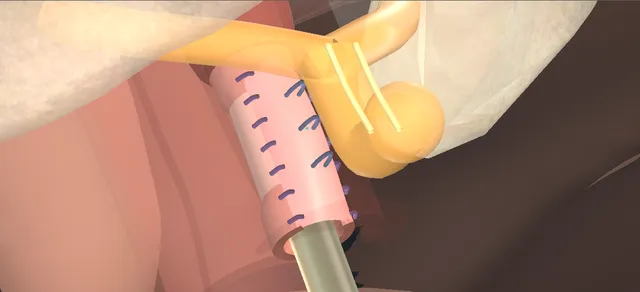
Reconstruction of a female urethral stricture with a buccal mucosal graft laid on the roof of the urethra.

Through a suprameatal incision the plane between the urethra and the clitoral bodies is opened, the roof is incised at twelve o'clock from the meatus back into healthy urethra, and the graft is sewn into the gap and quilted to the tissue above.

The lesson is a definitive repair that keeps away from the sphincter and the vaginal wall.

Advanced tier FRCS female and reconstructive urology, urethra Interactive 3D

Operative visualisation

Schematic scene preview: Female urethroplasty
Preparing the 3D anatomy…

UrOops3D · UroRef · © Nity G

How to use this module. Play through the seven steps, or use Back and Next. Watch the sound stop at the amber segment, the plane open under the clitoris, the roof open at twelve into healthy urethra, and the graft go in. The triggers show a recurrence, new incontinence and a fistula after a ventral repair.

Click me next Section 2 of 8 Anatomy The structures this operation works between, and the one it must not cross.

The structures in the scene

Female urethroplasty: how the structures relateThe narrow segment, its roof, and what lies above, behind and below it. Narrow segment of the distal urethra: opened along its roof; the graft fills the gap Urethral roof: opened at twelve, grafted. Narrow segment of the distal urethra: reached through a semilunar incision above it Meatus and suprameatal incision. Narrow segment of the distal urethra: lie above the dorsal plane; kept off the dissection Clitoral bodies and dorsal nerves (danger). Narrow segment of the distal urethra: lies behind it; the plane stops short of it Striated sphincter, mid-urethra (danger). Narrow segment of the distal urethra: lies beneath; a ventral repair opens this plane Anterior vaginal wall: not opened (danger). Narrow segment of the distal urethra: the roof cut is carried into it Healthy urethra beyond the narrowing.Narrow segment of thedistal urethraUrethral roof:opened at twelve,graftedMeatus andsuprameatal incision!Clitoral bodies anddorsal nerves!Striated sphincter,mid-urethra!Anterior vaginalwall: not openedHealthy urethrabeyond the narrowingopened along itsroof; the graftfills the gapreached through asemilunar incisionabove itlie above thedorsal plane; keptoff the dissectionlies behind it; theplane stops shortof itlies beneath; aventral repairopens this planethe roof cut iscarried into itTargetDangerLandmarkContext
The narrow segment, its roof, and what lies above, behind and below it. Schematic, not to scale; relationships only.
  • From the foot of the table in lithotomy the meatus lies above the introitus and the clitoris above the meatus.
  • The urethra runs back toward the bladder neck with the vagina beneath it.
  • The dorsal plane lies between its roof and the clitoral body; the sphincter surrounds the mid-urethra beyond the narrow segment.
  • ›Urethra - short, from the bladder neck to the meatus on the anterior vaginal wall; the narrow segment here lies in its distal half.
  • ›Narrow segment - fibrotic urethra with a small lumen; the sound stops at its distal face and the scope shows where it ends.
  • ›Meatus and vestibule - the suprameatal incision lies on the vestibule between the meatus and the clitoris.
  • ›Clitoral body and glans - above the distal urethra; the plane is opened beneath it and the graft is quilted to the tissue under it.
  • ›Dorsal nerves of the clitoris - run on the upper surface of the clitoral body, away from the plane; they are not dissected.
  • ›Clitoral crura - diverge from the body along each side of the urethra toward the pubic rami.
  • ›Striated sphincter - a sleeve round the mid-urethra; the dorsal plane stops short of it and the sides of the urethra are not freed.
  • ›Anterior vaginal wall - beneath the urethra; the dorsal approach does not open it, which is the reason a ventral repair carries a fistula risk and this one does not.
Click me next Section 3 of 8 Steps The operation in order, with the landmark that guards each move.

Operative steps

  1. Calibrate and confirm the length Lithotomy, with a ring retractor on the labia. The narrowing and the continence status have been confirmed before theatre with a flow rate, a residual and a voiding study. A sound is passed at the meatus and stops at the narrow segment; a fine scope is taken to its face and through it, to show where it begins and ends.
    where it bites: a stricture whose length and position are not known cannot be bridged with confidence.
  2. Suprameatal incision A semilunar incision is made on the vestibule above the meatus, between the meatus and the clitoris, from three o'clock over twelve to nine. Its edges are drawn apart to reach the tissue on the roof of the distal urethra.
    where it bites: the clitoris lies just above the incision.
  3. Open the dorsal plane The plane between the roof of the urethra and the clitoral bodies is developed with scissors from the meatus back, between ten and two o'clock, while a blade lifts the clitoris. It is carried beyond the narrow segment and no further: the sides of the urethra are left attached.
    where it bites: the clitoral bodies and their dorsal nerves above, and the sphincter at the mid-urethra behind and to each side.
  4. Open the roof at twelve The urethra is incised on its roof at twelve o'clock, from the meatus back through the narrow segment and on into healthy urethra. A sound then passes the whole length, and the gap left in the roof sets the size of the graft.
    where it bites: a cut that stops short of healthy urethra leaves the stricture at its proximal end.
  5. Lay and sew the graft A buccal mucosal graft is taken from the cheek as for a male urethroplasty and thinned. It is laid into the opened roof with its mucosa to the lumen, apex first. A catheter is passed and the graft is sewn to each edge of the opened urethra with interrupted absorbable stitches.
    where it bites: a graft sewn under tension or with its raw face to the lumen will not take.
  6. Quilt the graft The graft is quilted to the tissue under the clitoris with a few fine stitches, so that it lies flat on a vascular bed with no space beneath it for a collection. The roof of the narrowed segment is now the graft.
    where it bites: quilting stitches stay in the bed and do not take the clitoral bodies.
  7. Close, drain, reassess The suprameatal incision is closed over the repair and the catheter is left on drainage. Once it is out, the flow rate, the residual and continence are checked, and again after healing, against the findings before the operation.
    where it bites: new leakage is asked about and recorded at the first review.
Click me next Section 4 of 8 Danger zones Where this operation bites, and why it bites there.
Critical relationship

Danger zones

The spatial relationships the animation is built to make automatic. Before you read each one, ask yourself: at this point in the operation, what is about to go wrong, and what is my first move? The save for each sits in the Complications tab.

  • RiskClitoral neurovascular structures - the clitoral bodies and their dorsal nerves lie directly above the plane; the dissection keeps to the roof of the urethra.
  • RiskExternal urethral sphincter - the plane is carried only as far as the stricture requires, between ten and two o'clock, and stops short of the mid-urethra.
  • RiskUrethrovaginal tissue plane - left unopened by the dorsal approach; it is the plane a ventral repair works in, and the path of a fistula after one.
  • RiskHealthy urethra at the proximal end - the roof is opened into it, so the graft bridges the whole narrow segment.
  • RiskThe graft bed - quilted flat on to the tissue under the clitoris, so the graft takes.
Practise it Take me into the scene Opens the animation at a danger moment and asks you to predict the mechanism and your first move before it reveals.
Click me next Section 5 of 8 Complications The save for each one: the first move, the escalation trigger, the op-note line.

Complications and immediate saves

Trigger each of these live in the Animation tab, then read the save: the first move, the escalation trigger, and the line that goes in the op note.

Recurrent stricture

  • narrowing again, often at the proximal end of the graft where the cut stopped short of healthy urethra or the graft did not take; recurrence after any urethroplasty is reported across the series the guideline pools.
The save
  1. Measure the flow rate and the residual, calibrate the urethra and image the narrowing to find its site and length. first move
  2. Retention is relieved with a catheter and infection is treated before any plan is made.
  3. A further reconstruction is planned by a surgeon who does them regularly, with the tissue available and the state of the floor and the roof in mind. escalation trigger
  4. Self-dilatation is discussed as an option for a woman who does not want, or is not fit for, another operation.
  5. Notes: the symptoms, the flow rate and residual, the site and length of the narrowing, and the plan. document

New stress incontinence

  • stress leakage that was not there before, from a dissection carried round the sides of the urethra or back into the sphincter at the mid-urethra;
  • reported after dorsal and ventral grafts and more often after a vaginal flap.
The save
  1. In theatre: stop the dissection where it is; nothing more is freed proximally or laterally and nothing is cut in the sphincter. first move
  2. Finish the repair within the plane already opened.
  3. After healing, stress leakage is assessed with a history, an examination and urodynamics before any treatment is offered.
  4. Leakage that persists is discussed with a surgeon who treats female stress incontinence after urethral surgery. escalation trigger
  5. Op note: how far round and how far back the plane was opened, and the counselling given before the operation. document

Urethrovaginal fistula

  • a track from the urethral floor through the urethrovaginal septum into the vagina, after the ventral alternative, in which the floor is opened at six o'clock and a vaginal flap or graft laid into it.
The save
  1. Examine with a speculum and confirm that the fluid in the vagina is urine and where it comes from. first move
  2. Find the site of the opening in the urethra and in the vagina before any plan is made.
  3. A fistula that persists is referred to a surgeon who repairs them regularly; a vascularised flap may be needed. escalation trigger
  4. Check for infection and retention, and treat both.
  5. Notes: the approach used at the first operation, the findings now and the referral made. document
Click me next Section 6 of 8 Troubleshooting When the case turns: the problem, then the next move.

Intra-operative troubleshooting

When the case turns: the problem, then the next move.

  • ActionThe roof is scarred and the floor is healthy - the ventral approach is the alternative: the floor is opened at six o'clock through the anterior vaginal wall and a vaginal wall flap or a graft is laid into it. It works in the urethrovaginal plane, so a fistula and new incontinence must be part of the consent.
  • ActionAn isolated narrowing at the meatus - meatotomy or meatoplasty is the operation, which the guideline recommends for meatal strictures (weak). An augmentation is not needed.
  • ActionA first stricture, never treated - the guideline recommends dilatation as the initial treatment (weak), with repeat dilatation or planned self-dilatation at a first recurrence. Urethroplasty is for a second recurrence, or for a woman who wants a definitive treatment.
  • ActionRepeated dilatations, each lasting less - this is the argument for reconstruction: dilatation alone stays patent in well under half of women in the pooled series, and each dilatation adds scar. Offer urethroplasty rather than another dilatation.
  • ActionLittle healthy oral mucosa - a vaginal or labial graft, or a vaginal or labial flap, are the described alternatives; the guideline asks that the choice rests on the surgeon's experience and the tissue available.
  • ActionThe proximal limit is uncertain at the time of the cut - carry the roof incision on until a sound passes freely and the edges are soft and pink; the graft is cut to the gap and not the other way round.
Click me next Section 7 of 8 FRCS viva Say it out loud, then mark yourself against the model answer.

FRCS viva questions

The examiner stems this scene prepares you for. Try to answer out loud first, then reveal, and learn the discriminator, the detail that turns a pass into a strong pass.

QA woman of fifty has a poor stream and recurrent infections. How would you establish that she has a urethral stricture?reveal answer
  • I would start with the history, because the symptoms are non-specific: the EAU guideline lists frequency in 63 per cent, urgency in 55 per cent, incomplete emptying in 36 per cent, a poor flow in 32 per cent and incontinence in 31 per cent, and it notes that the diagnosis is often delayed by four to twelve years.
  • I would ask about previous urethral or vaginal surgery, instrumentation, radiotherapy and trauma; in the systematic review by Osman and colleagues, idiopathic and iatrogenic strictures were the two commonest causes.
  • I would examine the vulva and the urethra.
  • I would measure the flow rate and the residual, and I would ask for a voiding cystourethrogram or videourodynamics, which the guideline recommends in every woman with refractory symptoms, with a strong recommendation.
  • Cystourethroscopy confirms the narrowing and excludes other causes, and magnetic resonance imaging is mainly to exclude a diverticulum or a carcinoma.
  • Before any operation I would record her continence, because that is part of the consent.
Strong pass

Knowing that the symptoms are non-specific, that the diagnosis is late, and that the voiding study is a strong recommendation, not an option.

QShe has had three dilatations in two years. What do you advise?reveal answer
  • I would advise a urethroplasty.
  • The guideline recommends dilatation as the initial treatment, with a weak recommendation, and repeat dilatation or planned self-dilatation at a first recurrence;
  • it then makes a strong recommendation for urethroplasty in a woman with a second recurrence who cannot self-dilate or who wants a definitive treatment, which is her position.
  • The case against yet another dilatation is in the numbers.
  • The guideline quotes a mean patency of 40.1 per cent, with a range of 7.5 to 51 per cent, for dilatation alone at twelve to 59 months.
  • Osman and colleagues found a mean success of 47 per cent for dilatation at a mean of 43 months, against 80 to 94 per cent for the urethroplasty techniques, though with shorter follow-up.
  • Kowalik and colleagues concluded that women should be offered reconstruction as a definitive option rather than repeated dilatations.
  • Self-dilatation stabilises most women, 97 per cent in the guideline's pooled series, but the urethra is held open, not cured, and she would be doing it indefinitely.
Strong pass

Say both

  • Quoting the guideline's threshold of a second recurrence for urethroplasty
  • The durability of dilatation with its range
Examiner note
Quoting the guideline's threshold of a second recurrence for urethroplasty, and the durability of dilatation with its range.
QGraft or flap, dorsal or ventral? Talk me through your choice.reveal answer
  • The guideline does not choose one technique: it asks that the choice depend on the surgeon's experience, the availability and quality of graft or flap tissue, and the state of the floor against the roof, and Osman and colleagues found no high-level evidence for one over another.
  • With that said, I would offer her a dorsal onlay buccal mucosal graft.
  • The guideline's pooled figures for it are 83 per cent stricture-free, range 69 to 95, with new stress incontinence in 2.2 per cent;
  • for a ventral buccal graft 90.7 per cent with 3.2 per cent;
  • and for a ventral vaginal flap 81.4 per cent patency with new incontinence in 9.3 per cent.
  • The dorsal route keeps away from the vaginal wall, so it does not open the plane a fistula follows, and in Migliari's description the graft is quilted to the clitoral corpora, which gives it a good bed.
  • In the small comparison by Kowalik and colleagues, two of the vaginal flap repairs recurred and none of the dorsal grafts.
  • I would keep a ventral flap for a scarred roof with a healthy floor.
Strong pass

Say both

  • Saying that the guideline does not rank the techniques
  • Giving the pooled patency and new incontinence for each with the reason the dorsal route avoids a fistula
Examiner note
Saying that the guideline does not rank the techniques, then giving the pooled patency and new incontinence for each with the reason the dorsal route avoids a fistula.
QDescribe the dorsal onlay buccal graft urethroplasty.reveal answer
  • In lithotomy, with a ring retractor, I would calibrate the urethra and confirm the length of the narrowing with a fine scope.
  • I make a semilunar suprameatal incision from three to nine o'clock and develop the plane between the roof of the urethra and the clitoral bodies, keeping between ten and two o'clock and going only as far back as the stricture requires, so that the sides of the urethra and the sphincter are left alone.
  • I incise the roof at twelve o'clock from the meatus back through the stricture and into healthy urethra, until a sound passes freely.
  • The graft is harvested from the cheek and thinned.
  • I lay it into the gap with the mucosa to the lumen, pass a catheter and sew it to each edge with interrupted absorbable stitches, then quilt it to the tissue under the clitoris.
  • I close the suprameatal incision and leave the catheter, and after it is out I check the flow, the residual and continence.
Strong pass

Say both

  • Naming the clitoral bodies and their nerves as the structure above the plane
  • The limit of the dissection that protects the sphincter
Examiner note
Naming the clitoral bodies and their nerves as the structure above the plane, and the limit of the dissection that protects the sphincter.
QHow do you consent her, particularly about continence?reveal answer
  • I would explain that the aim is a durable repair and that the main risks are recurrence, the effects of the graft harvest in the cheek, bleeding, infection, a change in clitoral sensation, and a change in continence.
  • On continence I would be specific.
  • New stress incontinence has been reported after urethroplasty, in 2.2 per cent after a dorsal buccal graft and 9.3 per cent after a ventral vaginal flap in the guideline's pooled series, and transient urgency is also described;
  • Osman and colleagues found no new stress incontinence in their review.
  • I would tell her that I keep the dissection away from the sphincter for that reason.
  • I would record her continence before the operation, so that any change afterwards is measured against it.
  • I would also tell her that the evidence comes from small retrospective series, with no randomised comparison, so the figures are a guide and not a promise.
Strong pass

Say all three

  • Giving the incontinence figures by technique
  • Recording continence before the operation
  • Saying that the evidence is retrospective series
Examiner note
Giving the incontinence figures by technique, recording continence before the operation, and saying that the evidence is retrospective series.
Click me next Section 8 of 8 Evidence The guidance each of these answers is built on.

Evidence and guidance

Operative Dictations in Urologic Surgery
Armenakas NA, Fracchia JA, Golan R. Wiley, 2019
Searched for a chapter on female urethral stricture or female urethroplasty: there is none. Nothing on this page follows the book. The order of the steps comes from the hub sequence, the EAU guideline and Migliari et al; the danger lines, the first, escalate and document steps, the troubleshooting moves on the proximal limit and the quilting depth are general surgical practice and carry no figure.
Open guideline
EAU Guidelines
Urethral Strictures: Disease management in females, chapter 7, read 19 October 2026
Symptoms: frequency 63%, urgency 55%, incomplete emptying 36%, poor flow 32%, incontinence 31%; diagnosis delayed four to twelve years on average. Flow rate, residual and voiding cystourethrogram or videourodynamics in refractory symptoms (strong). Dilatation alone: mean patency 40.1% (range 7.5 to 51%) at twelve to 59 months; with self-dilatation, stabilisation 97%; new stress incontinence after dilatation 1.4%. Dorsal approach via a stricturotomy at twelve o'clock, ventral at six. Dorsal buccal graft stricture-free 83% (69 to 95%), new stress incontinence 2.2%; ventral buccal graft 90.7%, 3.2%; vaginal flap (ventral) 81.4%, new incontinence 9.3%. Dilatation as initial treatment (weak); repeat dilatation or self-dilatation at first recurrence (weak); urethroplasty at a second recurrence, or for a definitive treatment (strong); technique by experience, tissue and the state of the roof and floor; meatotomy or meatoplasty for meatal strictures (weak). The ranges are pooled from case series.
Open guideline
European Urology
Osman NI, Mangera A, Chapple CR. A systematic review of surgical techniques used in the treatment of female urethral stricture. Eur Urol 2013;64:965-73
Abstract read 19 October 2026. 221 patients, all retrospective case series; idiopathic and iatrogenic the commonest causes. Dilatation: mean success 47% at a mean of 43 months. Vaginal or labial flap 91% at 32.1 months; vaginal or labial graft 80% at 22 months; oral mucosa 94% at 15 months. No new stress incontinence reported. Urethroplasty 80 to 94% against dilatation under 50%, with shorter follow-up; no high-level evidence for one technique.
Open guideline
Journal of Urology
Migliari R, Leone P, Berdondini E, et al. Dorsal buccal mucosa graft urethroplasty for female urethral strictures. J Urol 2006;176:1473-6
Abstract read 19 October 2026. Three women. The urethra was freed dorsally and opened on its roof, the graft sutured to the margins of the opened urethra and the new roof quilted to the clitoral corpora; no incontinence afterwards. The dorsal opening, the margins and the quilting in the scene follow this description. The authors freed the urethra to the bladder neck; the scene opens the plane only beyond the narrow segment, to keep the dissection off the sphincter, which is general practice and not their method.
Open guideline
Urology
Kowalik C, Stoffel JT, Zinman L, et al. Intermediate outcomes after female urethral reconstruction: graft vs flap. Urology 2014;83:1181-5
Abstract read 19 October 2026. Ten women, all after multiple dilatations, treated with a vaginal flap urethroplasty or a dorsal buccal graft. Two vaginal flap repairs recurred; no dorsal graft did. The authors conclude that reconstruction should be offered as a definitive option rather than repeated dilatations.
Open guideline
European Urology
Romero-Maroto J, Verdu-Verdu L, Gomez-Perez L, et al. Lateral-based anterior vaginal wall flap in the treatment of female urethral stricture: efficacy and safety. Eur Urol 2018;73:123-8
Abstract read 19 October 2026. Nine women treated with a ventral, lateral-based anterior vaginal wall flap; mean follow-up 80.7 months; no recurrence and no new stress incontinence. Used for the ventral alternative in the troubleshooting; its figures are not quoted elsewhere on the page.
Open guideline

Curriculum. Supports learning relevant to the ISCP Urology Curriculum syllabus topic Urethral reconstruction. Not a workplace-based assessment and not evidence of competence.

Two minutes

Close the lap: recall it before you leave.

Say it aloud, then reveal. Reading is not remembering.

  1. 01 The relationship Say the critical spatial relationship out loud, then reveal. reveal
    Memory frame

    From the foot of the table in lithotomy the meatus lies above the introitus and the clitoris above the meatus.

    Why?
    The urethra runs back toward the bladder neck with the vagina beneath it. The dorsal plane lies between its roof and the clitoral body; the sphincter surrounds the mid-urethra beyond the narrow segment.
  2. 02 The first move Recurrent stricture. Your first move? reveal
    First move

    Measure the flow rate and the residual, calibrate the urethra and image the narrowing to find its site and length.

  3. 03 The escalation trigger Recurrent stricture. What makes you call for help? reveal
    Escalate when

    A further reconstruction is planned by a surgeon who does them regularly, with the tissue available and the state of the floor and the roof in mind.

  4. 04 The discriminator What turns a pass into a strong pass? reveal
    Strong pass

    Knowing that the symptoms are non-specific, that the diagnosis is late, and that the voiding study is a strong recommendation, not an option.

  5. 05 The pitfall Where does this operation bite first? reveal
    Pitfall

    Clitoral neurovascular structures

    Why?
    the clitoral bodies and their dorsal nerves lie directly above the plane; the dissection keeps to the roof of the urethra.

Revision practice with self-marked answers, not an assessment of clinical competence. Kept in this browser only; it does not sync between devices.