After the bladder is gone, a sphere of detubularised ileum sewn to the urethral stump so the patient voids through the urethra again, by the clock and by straining, with a continence that is good by day and imperfect at night.
This page is the selection, the Studer construction with its afferent limb, the urethral anastomosis, and the months of retraining that decide whether it was worth it.
Advanced tierFRCS uro-oncology, urinary diversionInteractive 3D
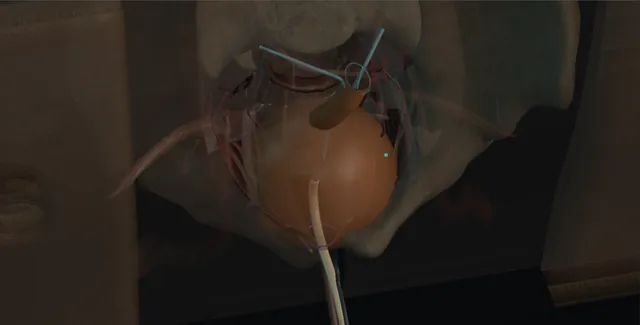
Open pelvis after cystectomy, the ileal sphere built above the urethral stump. Schematic, not to scale; relationships only.
With the bladder gone the pelvis is empty down to the urethral stump with its six sutures held on clips, and the ileal sphere is built in the wound above it on a mesentery that comes from the right.
The afferent limb rises from the top of the sphere toward the ureters at the pelvic brim, and the marked dependent point at the bottom drops onto the urethra when the packs are relaxed.
The catheter runs from the meatus, through the anastomosis, into the pouch.
›The membranous urethra and external sphincter - the stump left at the cystectomy; the six sutures take urethra and sphincter and nothing beside them.
›Terminal ileum and the ileocaecal valve - the segment ends fifteen to twenty centimetres proximal to the valve; fifty-five to sixty centimetres are taken.
›The afferent limb - the proximal ten to fifteen centimetres left as an isoperistaltic tube; the ureters join it and it rises from the top of the sphere.
›The mesentery of the pouch - divided deeper on the proximal side so the dependent point of the sphere drops to the urethra without pull.
›The dependent point - chosen with a finger before the sphere is closed; opened to a fingertip and no wider.
›The ureters at the brim - the left brought under the sigmoid mesentery; both spatulated and implanted end-to-side over single-J stents.
›The catheter - 20 or 22 French silicone, balloon in the pouch, flushed four to six times a day for three weeks.
Who is offered a neobladderThe patient having a radical cystectomy whose urethra can be kept: a negative urethral margin on frozen section, no tumour in the prostatic urethra or stroma in a man, no tumour at the bladder neck in a woman. Renal function good enough to handle the reabsorption, a creatinine under about 150 or an eGFR above 50, and normal liver function. No bowel disease that makes ileum unusable, no previous high-dose pelvic radiotherapy as a relative bar. And a motivated patient with the hands and the mind for it, who has heard and accepted that there will be leakage by day early and at night for good, that voiding is by the clock and by straining, and that they may have to catheterise themselves, women more often than men.
The ileal segmentWith the cystectomy and node dissection complete and the urethral stump prepared, the terminal ileum is delivered. A segment of fifty-five to sixty centimetres is measured with a tape along the antimesenteric border, its distal end fifteen to twenty centimetres proximal to the ileocaecal valve, sparing the last ileum for B12 and bile salts. The mesentery is transilluminated and the segment taken on its arcades, the mesentery divided between windows only as far as is needed for the loop to reach the urethra without tension, the proximal division deeper than the distal because the proximal end has to reach the pelvis last. Continuity is restored above the segment with a stapled side-to-side anastomosis and the mesenteric window closed. The loop is irrigated until clear. where it bites: the deepest point of the pouch has to reach the membranous urethra; a mesentery that is short here is a tensioned anastomosis and a stricture.
Detubularising, except the afferent limbThe proximal ten to fifteen centimetres of the segment is left intact as a tube: this is the afferent limb into which the ureters will be joined, and it stays isoperistaltic, carrying urine toward the pouch and giving a soft antireflux effect. The remaining forty to forty-five centimetres is opened along the antimesenteric border with the diathermy from the distal staple line up to the base of the limb, so that it lies as a long plate with its mesentery entering from behind. The reason is the same as in any reservoir: a tube of ileum contracts as a ring and makes pressure, an opened plate cannot. Bleeding from the edge is taken with the bipolar and the mucosa is wiped of mucus.
Folding and sewing the sphereThe opened plate is folded on itself into a U, the two limbs side by side, and the adjacent edges are sewn together with a running 3-0 Vicryl or PDS, mucosa to mucosa, from the fold outward. The plate is then folded a second time, at right angles to the first, and the remaining edges closed in the same way so that a sphere forms, the Studer principle: by Laplace, a large radius stores a large volume at a low pressure, and the double fold breaks every line of ileum that could contract as a unit. The afferent limb rises from the top of the sphere. Before it is closed the most dependent point of the pouch is chosen, where a finger drops to the urethra without pull, and marked. where it bites: a pouch whose lowest point does not drop onto the urethra without tension will be pulled up by its mesentery; choose the dependent point before the sphere is closed.
The ureters into the afferent limbThe left ureter is brought under the sigmoid mesentery through a generous window and both ureters are spatulated for fifteen to twenty millimetres on their lateral wall with the adventitia kept. Each is implanted end-to-side into the afferent limb, Bricker fashion, through a small enterotomy, mucosa to mucosa with interrupted 4-0 or 5-0 PDS, over a 6 or 7 French single-J stent passed up to the renal pelvis; a Wallace plate into the open end of the limb is the alternative. The stents are led down through the limb into the pouch. The join is refluxing by design: the afferent limb and the low pressure of the sphere protect the kidneys, and a tunnelled antireflux implant strictures more often than it helps. where it bites: the ureteric blood supply runs in the adventitia, medial above the pelvic brim and lateral below it; a stripped or tensioned ureter strictures at the join.
The urethral anastomosisAt the marked dependent point a small opening, the size of a fingertip, is made in the pouch, no larger, because a large opening funnels and kinks. The urethral stump was prepared at the cystectomy with five or six 2-0 or 3-0 Monocryl sutures placed through the membranous urethra and the sphincter and held on clips, at two, four, six, eight, ten and twelve o'clock. A 20 or 22 French silicone catheter is passed through the urethra into the pouch, the sutures are passed through the pouch opening from inside to out at the matching positions, the pouch is dropped down onto the urethra with the assistant relaxing the packs, and the sutures tied in turn from posterior to anterior, without tension. The catheter balloon is inflated in the pouch. where it bites: the sutures take the urethral stump and the sphincter with it; a bite carried into the pelvic floor beside the urethra costs continence.
Stents, drain and the catheterThe stents come out through the pouch wall and the abdominal wall on the right, each fixed to the skin, or are led alongside the catheter. A tube drain is placed in the pelvis next to the anastomoses. The pouch is filled with 100 millilitres of saline through the catheter and every suture line inspected; a leak is closed with an interrupted suture. Omentum is brought down to the pelvis if it reaches. The abdomen is closed as a mass closure. The catheter is flushed with 50 millilitres of saline four to six times a day from the first day, because mucus blocks it and a blocked pouch tears its suture lines; it stays for about three weeks.
After: the cystogram, the clock, the nightA pouchogram at about three weeks before the catheter comes out, and then retraining begins. The patient voids sitting, relaxing the pelvic floor and pressing on the abdomen, every two hours by day and by alarm every three at night, stretching the interval by an hour each fortnight until the pouch holds 400 to 500 millilitres. Daytime continence comes over months in most, nocturnal leakage persists in a third or more, because the pouch has no sensation and the sphincter relaxes in sleep. The residual is scanned at each review; a patient who does not empty catheterises, which is more often the woman. Bicarbonate, creatinine, B12 and the upper tracts are checked for life, and the urethra and upper tracts are under surveillance for recurrence.
The spatial relationships the animation is built to make automatic. Before you read each one, ask yourself: at this point in the operation, what is about to go wrong, and what is my first move? The save for each sits in the Complications tab.
RiskThe urethral anastomosis and the sphincter - tension strictures it; a bite beside the urethra takes the sphincter; a wide pouch opening funnels and kinks.
RiskThe mesentery - the pouch has to reach the pelvic floor; a short mesentery is a tensioned join and an ischaemic pouch.
RiskThe uretero-ileal joins - stripped, tensioned or twisted they leak first and stricture later, silently, on one side.
RiskThe dependent fold that will not empty - a pouch folded so that urine pools below the outlet leaves a residual, infection, stones and the catheter.
Trigger each of these live in the Animation tab, then read the save: the first move, the escalation trigger, and the line that goes in the op note.
Pouch or anastomotic leak
urine in the drain in the first week from the urethral join, a uretero-ileal join or the pouch suture line, most often behind a blocked catheter.
The save
Flush the catheter and confirm it drains; a pouch full of mucus and urine leaks at its weakest line.first move
Drain fluid creatinine to confirm urine, and check the stents are draining.
Keep the drain, the catheter and the stents; a CT or pouchogram maps the leak and most close with time.
Peritonitis, sepsis or a leak that grows on imaging: return to theatre, or nephrostomies to divert the upper tracts.escalation trigger
Op note: the anastomotic technique, the stents, the flush regime and the date of the pouchogram.document
Hypercontinence and retention
the pouch that will not empty, more often in women: a residual on the scan, infection, overflow leakage, and eventually a distended pouch.
The save
Scan the residual at every review; a residual above about 100 millilitres is investigated, not watched.first move
Retrain: sitting to void, pelvic floor relaxed, abdominal pressure, a longer time on the toilet.
Cystoscopy for a stricture at the urethral join or a fold of pouch across the outlet; a stricture is dilated or incised.
A residual that persists: teach clean intermittent catheterisation, once or twice a day to start, for life if needed.escalation trigger
Note: the residual, the cause found, the catheterisation regime and that the patient was warned of this before the operation.document
Incontinence, day and night
early daytime leakage that settles over months, and nocturnal leakage that may not, because the pouch has no sensation and the sphincter sleeps.
The save
Retrain by the clock: two-hourly voids by day, an alarm at night, pelvic floor exercises from the day the catheter comes out.first move
Check the residual; overflow from a full pouch is treated as retention, not as a weak sphincter.
Pads, an alarm and reduced evening fluids for the night; the interval is stretched slowly as capacity grows.
Daytime leakage that persists beyond a year with an empty pouch: urodynamics and an artificial sphincter or a sling.escalation trigger
Note: the pad count by day and night at each visit so that the trajectory is visible.document
Uretero-ileal stricture
the silent kidney: hydronephrosis on the surveillance ultrasound months to years later, a join that was ischaemic or tensioned at the time.
The save
Ultrasound of the upper tracts on a schedule for life; a new hydronephrosis is a stricture until proven otherwise.first move
A renogram to confirm obstruction and measure function; exclude recurrence at the join.
Nephrostomy and antegrade study; a short stricture may be dilated or incised antegrade or through the pouch.
A long or recurrent stricture, or a kidney losing function: open or robotic revision of the anastomosis.escalation trigger
Note: the side, the length, the treatment and the imaging interval that follows.document
Metabolic acidosis and mucus
ileum in contact with urine reabsorbs chloride and ammonium: fatigue, a low bicarbonate, worse with a large residual or impaired kidneys; mucus blocks and nucleates stones.
The save
Bicarbonate, chloride and creatinine at every visit; oral sodium bicarbonate as soon as the bicarbonate falls.first move
Empty the pouch more often; urine that sits on ileum is urine that is reabsorbed.
Irrigation for mucus while the catheter is in and afterwards if it collects; B12 yearly from five years.
Confusion, vomiting or a severe acidosis: admit, catheterise the pouch and correct intravenously.escalation trigger
Note: the segment used and its distance from the valve; the bicarbonate dose and the B12 plan.document
When the case turns: the problem, then the next move.
ActionThe pouch will not reach the urethra - divide the mesentery deeper on the proximal side and relax the retractors; if it still will not reach, a conduit today beats a stricture for life.
ActionA urethral suture pulls through - do not chase it deep; take a fresh bite of the urethral stump under vision with the catheter in, or accept five sutures if the others are good.
ActionThe catheter will not pass into the pouch after the anastomosis - a fold of pouch or a suture across the lumen; pass it over a wire or a bougie with the pouch held up, never by force.
ActionLeak on the test fill - find the point, one interrupted full-thickness suture, refill; the urethral join is not tested by pressure.
ActionCatheter blocked with mucus on the ward - flush 50 millilitres and aspirate, repeat; a pouch that fills against a blocked catheter tears its suture lines, so the flush is done now, not at the next round.
ActionHydronephrosis on the first ultrasound - often oedema at the join in the first weeks; repeat with a renogram at three months, and stent antegrade if function is falling.
The examiner stems this scene prepares you for. Try to answer out loud first, then reveal, and learn the discriminator, the detail that turns a pass into a strong pass.
QWho is suitable for an orthotopic neobladder, and who is not?reveal answer
I would consider a neobladder for a patient having radical cystectomy for whom the urethra can safely be preserved: a negative urethral margin on frozen section at the time of surgery, no tumour in the prostatic urethra or stroma in a man, and no tumour at the bladder neck in a woman, since those predict urethral recurrence.
They need renal function sufficient to tolerate reabsorption, a creatinine below about 150 or an eGFR above 50, and normal liver function to metabolise ammonium.
The ileum must be usable, so Crohn's disease or a heavily irradiated small bowel is a contraindication, and previous high-dose pelvic radiotherapy is a relative one.
They must be motivated and able: the manual dexterity and cognition to void by the clock, to strain, and to self-catheterise if needed, which is more often in women.
Pre-existing stress incontinence or a sphincter that is already weak argues against it.
I would explain the alternatives, the ileal conduit and a continent cutaneous diversion, and I would tell them plainly that continence at night is imperfect and that the operation is longer with more early complications than a conduit.
Strong pass
Say both
The urethral margin and prostatic stromal or bladder neck involvement as oncological criteria
The renal and hepatic thresholds stated as numbers rather than as good enough
Examiner note
The urethral margin and prostatic stromal or bladder neck involvement as oncological criteria, and the renal and hepatic thresholds stated as numbers rather than as good enough.
QDescribe the construction of a Studer neobladder.reveal answer
After the cystectomy and node dissection I would isolate fifty-five to sixty centimetres of ileum ending fifteen to twenty centimetres proximal to the ileocaecal valve, on a mesentery that lets the segment reach the membranous urethra without tension, and restore bowel continuity with a stapled side-to-side anastomosis above it, closing the mesenteric window.
I would leave the proximal ten to fifteen centimetres intact as an isoperistaltic afferent limb and open the remaining forty to forty-five centimetres along the antimesenteric border.
I would fold the plate into a U and sew the adjacent edges with running absorbable suture, then fold it again to form a sphere, which gives a low-pressure reservoir by Laplace and interrupts any contracting segment.
I would spatulate both ureters and implant them end-to-side into the afferent limb over single-J stents, mucosa to mucosa, Bricker fashion.
At the most dependent point of the pouch I would make a fingertip opening and anastomose it to the urethral stump over a 20 to 22 French catheter with six interrupted sutures placed at the cystectomy, tied without tension.
Stents out through the pouch, a pelvic drain, a test fill, and the catheter for three weeks with regular irrigation.
Strong pass
Say all three
The afferent limb kept as a tube with its purpose stated
The sphere from the double fold with the Laplace reason
The dependent point chosen before the pouch is closed
Examiner note
The afferent limb kept as a tube with its purpose stated, the sphere from the double fold with the Laplace reason, and the dependent point chosen before the pouch is closed.
QWhy does a neobladder patient leak at night, and how do you manage continence after the operation?reveal answer
Continence with a neobladder depends entirely on the external sphincter, because the pouch has no sensation of filling, no neural connection to the sphincter and no bladder neck.
By day the patient learns to sense fullness as vague abdominal pressure and voids by the clock, and the sphincter is under voluntary tone, so daytime continence reaches about 85 to 90 per cent over the first year.
At night the striated sphincter relaxes with sleep, there is no reflex increase in urethral tone as the pouch fills, and the pouch, being ileum, reabsorbs solute and secretes mucus so that it fills further;
the result is nocturnal leakage in about a third or more of patients that improves but often does not resolve.
I would manage it by retraining: voiding every two hours by day and by alarm every three at night from the time the catheter comes out, stretching the interval as the pouch grows to 400 to 500 millilitres, pelvic floor exercises, restricting evening fluids and using pads.
I would exclude overflow from retention with a residual scan at every review.
Persistent daytime leakage with an empty pouch after a year is assessed with urodynamics and may need an artificial sphincter or a sling.
Strong pass
The three reasons for night leakage, absent sensation, sleeping sphincter and continued filling by reabsorption, and excluding overflow before treating a sphincter.
QWhat are the late complications of a neobladder and how are they followed up?reveal answer
I would group them into functional, structural, metabolic and oncological.
Functional: incomplete emptying and hypercontinence, more often in women, managed by retraining and intermittent catheterisation, and incontinence, particularly nocturnal, managed as described.
Structural: stricture at the urethral anastomosis, treated endoscopically, and uretero-ileal stricture, which is silent and found only by scheduled ultrasound of the upper tracts, then confirmed by renogram and treated antegrade or by open revision;
also mucus retention, stones in the pouch and, rarely, pouch rupture.
Metabolic: hyperchloraemic acidosis from ileal reabsorption, worse with a residual or renal impairment, treated with oral bicarbonate and more frequent emptying;
B12 deficiency after five or more years;
and bone demineralisation over time.
Oncological: urethral recurrence in the retained urethra, upper tract recurrence and the small risk of tumour in the bowel segment, so the urethra and the upper tracts are under surveillance, with urine cytology and imaging on a schedule.
The follow-up is therefore lifelong: residual and pad count at each visit, bicarbonate and creatinine, B12 annually from five years, ultrasound of the kidneys, and CT and cytology according to the cancer protocol.
Strong pass
Say both
The silent uretero-ileal stricture found only by scheduled imaging
The metabolic follow-up with B12 timed from five years rather than from the operation
Examiner note
The silent uretero-ileal stricture found only by scheduled imaging, and the metabolic follow-up with B12 timed from five years rather than from the operation.
Say it aloud, then reveal. Reading is not remembering.
01The relationshipSay the critical spatial relationship out loud, then reveal.reveal
Memory frame
With the bladder gone the pelvis is empty down to the urethral stump with its six sutures held on clips, and the ileal sphere is built in the wound above it on a mesentery that comes from the right.
Why?
The afferent limb rises from the top of the sphere toward the ureters at the pelvic brim, and the marked dependent point at the bottom drops onto the urethra when the packs are relaxed. The catheter runs from the meatus, through the anastomosis, into the pouch.
02The first movePouch or anastomotic leak. Your first move?reveal
First move
Flush the catheter and confirm it drains; a pouch full of mucus and urine leaks at its weakest line.
03The escalation triggerPouch or anastomotic leak. What makes you call for help?reveal
Escalate when
Peritonitis, sepsis or a leak that grows on imaging: return to theatre, or nephrostomies to divert the upper tracts.
04The discriminatorWhat turns a pass into a strong pass?reveal
Strong pass
Say both
The urethral margin and prostatic stromal or bladder neck involvement as oncological criteria
The renal and hepatic thresholds stated as numbers rather than as good enough
Examiner note
The urethral margin and prostatic stromal or bladder neck involvement as oncological criteria, and the renal and hepatic thresholds stated as numbers rather than as good enough.
05The pitfallWhere does this operation bite first?reveal
Pitfall
The urethral anastomosis and the sphincter
Why?
tension strictures it; a bite beside the urethra takes the sphincter; a wide pouch opening funnels and kinks.
Revision practice with self-marked answers, not an assessment of clinical competence. Kept in
this browser only; it does not sync between devices.