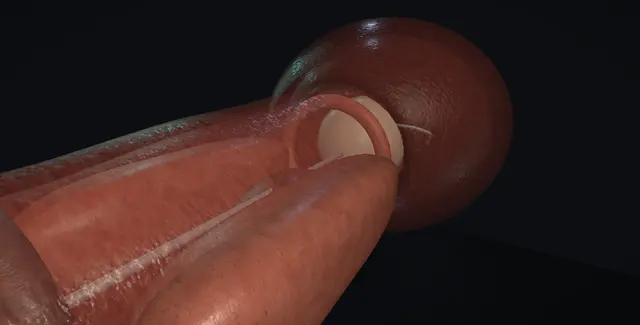
Two ideas in one device. A double-lobe balloon anchors in the bladder, locks on the bladder neck and dilates the prostatic urethra until the anterior commissure splits, and a paclitaxel coating is then pressed into that raw surface so the lobes do not fuse back together.
Nothing is resected and no current is used. This page is the seat, the split, the five minutes, and the catheter that follows.
Core tierFRCS core urology, BPH / LUTS and the minimally invasive optionsInteractive 3D
Along the prostatic urethra with the balloon straddling the bladder neck. Schematic, not to scale; relationships only.
The balloon straddles the bladder neck: the distal lobe inside the bladder as an anchor, the non-compliant neck locked on the bladder neck itself, and the working lobe lying in the prostatic urethra between the neck and a point short of the verumontanum.
Pressure in that working lobe splits the anterior commissure at twelve o'clock, so the channel opens anteriorly while the veru and the ejaculatory ducts at six and the membranous urethra beyond the veru are left alone.
›The distal lobe - inflated inside the bladder: the anchor, and the reason nothing migrates.
›The reinforced neck - non-compliant, locks on the bladder neck and sets the working length.
›The proximal lobe - the working lobe, inside the prostatic urethra.
›The anterior commissure - at twelve o'clock: where the split is meant to be.
›The verumontanum - the distal limit; the working lobe stays proximal to it.
›The external sphincter - never under the working lobe; continence depends on it.
›The paclitaxel coating - delivered into the split surface to prevent refusion, not to dilate.
Who gets a balloonThe man with bothersome symptoms and a prostate of about thirty to eighty grams with lateral lobe obstruction, who wants to keep ejaculation, prefers a single procedure to a week with a device in, and will accept a catheter for a few days. The gland, the median lobe and the length of the prostatic urethra are assessed before the day. He is told that early symptom improvement is good, that ejaculation is usually preserved, and that durability beyond the published trial years is the open question.
Consent and the roomThe consent names a catheter for two to three days; haematuria, which is expected because the split surface is raw and nothing has been coagulated; urgency and dysuria for a fortnight; infection; retention at the trial without catheter; and a drug coating whose long-term local effect is still being followed. The procedure is usually done under general or spinal anaesthetic. The room has a cystoscope, a guidewire, the pre-dilation catheter and the coated balloon in the sizes the measurement will call for.
Cystoscopy and sizingA cystoscopy first: the lateral lobes, the bladder neck, the verumontanum, and the length between the neck and the veru, which is what picks the balloon, thirty by thirty or thirty by thirty-five millimetres from the sizing guide. An obstructing median lobe changes the plan. A guidewire is then passed into the bladder and everything afterwards runs over it. where it bites: a balloon sized by eye rather than by the neck-to-veru length is the commonest route to a tear beyond the commissure.
Seat the pre-dilation balloonThe pre-dilation catheter goes over the wire. The distal lobe is inflated inside the bladder first, which is the anchor, and the catheter is then drawn back until the reinforced neck of the balloon locks against the bladder neck. That seat is confirmed before any pressure goes into the working lobe; once inflated, the device cannot migrate. where it bites: the working lobe seated too distally dilates the membranous urethra and the sphincter.
The commissurotomyThe proximal lobe, lying within the prostatic urethra, is then inflated per the instructions for use. It dilates until the anterior commissure gives way at twelve o'clock. That split is the operation. Nothing is resected, no current is used, and the split is anterior by design, away from the verumontanum and the ejaculatory ducts at six.
The coated balloonThe pre-dilation balloon is deflated and withdrawn and the drug-coated balloon is passed over the same wire and seated in the same way, anchored in the bladder and locked on the neck. It is inflated and held for at least five minutes, so that paclitaxel transfers into the raw surface of the split. The purpose is not further dilation but to stop the lobes refusing, which is what dilation alone has always failed to prevent.
The end of the caseThe balloon comes down, the catheter and the wire come out, and the channel is inspected: open from the bladder neck to the verumontanum, the split anterior, and no bleeding that needs anything done to it. A catheter is left for two to three days because the raw surface bleeds and swells before it settles. The note records both balloon sizes, both inflations, the split seen, the catheter and the date it comes out.
What it leaves behindAn anterior channel held open by a split that has not fused, with the lateral lobes themselves untouched and no implant left in the urethra. Symptoms and flow improve early rather than over months, and ejaculation is usually preserved because the bladder neck musculature is not divided or resected. Durability past the published follow-up is the honest uncertainty, and a further procedure remains possible.
The spatial relationships the animation is built to make automatic. Before you read each one, ask yourself: at this point in the operation, what is about to go wrong, and what is my first move? The save for each sits in the Complications tab.
RiskDistal to the veru - a working lobe seated too far down dilates the sphincter; continence is the cost and nothing undoes it.
RiskBeyond the commissure - an oversized balloon tears into periprostatic tissue and extravasates.
RiskSix o'clock - the veru and the ejaculatory ducts; the split is anterior by design.
RiskThe first days - a raw, uncoagulated surface with a catheter: bleeding and clot retention are the expected problems.
Trigger each of these live in the Animation tab, then read the save: the first move, the escalation trigger, and the line that goes in the op note.
Retention at the trial without catheter
he fails to void at day two or three: the split surface is oedematous and still obstructing.
The save
Recatheterise; it is the oedema, not the procedure, that has failed for now.first move
Continue the alpha-blocker and arrange a second trial in a week.
A second failure: flexible cystoscopy to exclude clot, a flap of split tissue or an untreated median lobe.escalation trigger
Note: the residual, the plan, and the date of the next trial.document
Haematuria and clot retention
the commissurotomy leaves a raw anterior surface with no coagulated bed, so blood in the first days is expected.
The save
Confirm the catheter is draining and irrigate; a blocked catheter behind a raw surface is the usual story.first move
Wash the clots out with a bladder syringe and keep him on free fluids.
Bleeding that does not clear, a falling haemoglobin, or repeated clot retention: flexible cystoscopy rather than continued observation.escalation trigger
Note: the degree, what was done, and the haemoglobin if it was checked.document
Over-dilation and extravasation
a balloon oversized for the gland, or seated wrongly, tears beyond the commissure into periprostatic tissue.
The save
Stop inflating and take the balloon down; do not reinflate to see what happens.first move
Look endoscopically at the channel and the neck, and catheterise to drain.
Signs of significant extravasation or an unwell patient: imaging, admission and senior review rather than discharge.escalation trigger
Note: the sizes used, the pressures, what was seen, and the drainage plan.document
Dilating across the sphincter
the working lobe was seated too distally and pressure crossed the membranous urethra.
The save
Deflate immediately and reseat against the veru before anything else happens.first move
No further inflation in that position; the seat is confirmed against the landmark for the coated balloon as well.
Leakage afterwards: pelvic floor physiotherapy from the start and a continence assessment at three months.escalation trigger
Note: the seat found, what was seen of the veru, and the continence plan.document
Urinary infection
instrumentation, a raw surface and a catheter for two to three days: fever or dysuria in the first fortnight.
The save
Culture the urine and start antibiotics that cover the likely organisms.first move
Check the catheter is draining and that he is not in retention behind clot.
Systemic sepsis: admit for intravenous antibiotics and imaging if he does not settle.escalation trigger
Note: the culture, the antibiotic and the response.document
When the case turns: the problem, then the next move.
ActionCannot see the veru to measure from - draw back until the sphincter and the veru are seen; the balloon is not sized until the distal limit is known.
ActionThe balloon will not seat on the neck - the distal lobe is not fully inflated or is not in the bladder: confirm position endoscopically before applying pressure.
ActionThe wire comes out during the exchange - stop and re-pass it under vision; everything runs over the wire and blind passage is how a false passage is made.
ActionThe split looks incomplete at the check - reassess the sizing against the neck-to-veru length rather than repeating the inflation at a higher pressure.
ActionThe catheter blocks on day one - clot from a raw surface: syringe washout and a fresh catheter, not a return to theatre.
ActionNo improvement at six weeks - review with a score and a flow, and look; an untreated median lobe or a failing bladder explains more of these than a failed split.
The examiner stems this scene prepares you for. Try to answer out loud first, then reveal, and learn the discriminator, the detail that turns a pass into a strong pass.
QWhat is the Optilume BPH catheter and how does it work?reveal answer
It is a drug-coated balloon system for benign prostatic obstruction that combines a mechanical and a pharmacological step.
The catheter carries a semi-compliant double-lobe balloon with a reinforced, non-compliant neck between the lobes.
The distal lobe is inflated inside the bladder and acts as an anchor, and the catheter is withdrawn until the reinforced neck locks against the bladder neck, so the working length is set and the device cannot migrate during inflation.
The proximal lobe, lying in the prostatic urethra, is then inflated until the anterior commissure separates.
That anterior commissurotomy is the mechanical part: the channel is opened by splitting the commissure rather than by removing tissue, and no electrical current is used.
The pharmacological part follows.
The pre-dilation balloon is exchanged over the same guidewire for a paclitaxel-coated balloon, seated identically, and held inflated for at least five minutes so that the drug transfers into the raw surface of the split.
The intention is to prevent the lateral lobes refusing, which is the failure mode that made simple balloon dilation of the prostate a historical treatment.
A catheter is left for two to three days because the split surface is uncoagulated.
The evidence base is the PINNACLE randomised sham-controlled trial and its follow-up, and durability beyond those years remains under study.
Strong pass
Say both
Explaining why the drug matters: dilation alone fails because the lobes refuse
The coating is aimed at that specific failure
Examiner note
Explaining why the drug matters: dilation alone fails because the lobes refuse, and the coating is aimed at that specific failure.
QDescribe the technique, step by step.reveal answer
The patient is anaesthetised, usually under general or spinal anaesthesia, and given antibiotic cover.
A cystoscopy is done first to confirm lateral lobe obstruction, to exclude an obstructing median lobe, and to identify the bladder neck and the verumontanum.
The length from the neck to the veru is measured, because that measurement selects the balloon from the sizing guide, thirty by thirty or thirty by thirty-five millimetres.
A guidewire is passed into the bladder and every subsequent device runs over it.
The pre-dilation catheter is advanced and its distal lobe inflated within the bladder, then withdrawn until the reinforced neck locks on the bladder neck;
the seat is confirmed before any pressure is applied to the working lobe.
The working lobe is inflated per the instructions for use until the anterior commissure splits.
The balloon is deflated and removed, and the drug-coated balloon is passed over the same wire, seated in the same way, and held inflated for at least five minutes.
It is then deflated and removed with the wire, the channel inspected endoscopically from the neck to the veru, and a catheter left for two to three days.
The operative note records both balloon sizes, both inflations, the split that was seen, the catheter and the date for its removal.
Strong pass
Say both
Confirming the seat against the bladder neck and the veru before each inflation
Treating the sizing measurement as a step rather than a detail
Examiner note
Confirming the seat against the bladder neck and the veru before each inflation, and treating the sizing measurement as a step rather than a detail.
QWhy was balloon dilation of the prostate abandoned, and what is different now?reveal answer
Balloon dilation of the prostate was used in the late nineteen eighties and early nineties and produced good early symptom relief, but the benefit was not durable.
The mechanism was a stretch, and in many men a split of the anterior commissure, but the split surfaces lay in apposition and healed back together, so the lateral lobes refused and obstruction returned within months to a couple of years.
Retreatment rates were high enough that the technique was abandoned in favour of resection.
The current system differs in two ways.
First, the balloon is engineered for the anatomy rather than borrowed from elsewhere: a double-lobe design with a non-compliant neck anchors in the bladder and locks on the bladder neck, so the working lobe is reliably positioned in the prostatic urethra and the commissurotomy is reproducible rather than incidental.
Second, and more importantly, a paclitaxel-coated balloon is then held against the split surface for at least five minutes.
Paclitaxel is an antiproliferative agent used in the same way in coronary and peripheral drug-coated balloons, and the intention is to prevent the fibroproliferative healing that caused refusion.
The randomised sham-controlled evidence supports symptomatic benefit maintained over the published follow-up, which is the claim the technique stands or falls on.
Strong pass
Say both
Naming refusion of the split commissure as the historical failure
The antiproliferative coating as the targeted answer to it
Examiner note
Naming refusion of the split commissure as the historical failure, and the antiproliferative coating as the targeted answer to it.
QA man is bleeding heavily on the first postoperative day. How do you manage him?reveal answer
I would treat this as clot retention until proven otherwise and manage it in a structured way.
First, assess the patient: pulse, blood pressure, whether he is in pain and distended, and whether the catheter is draining.
Bleeding after this procedure is expected in the first days, because the commissurotomy leaves a raw anterior surface that has not been coagulated, so the question is whether it is settling or obstructing.
I would irrigate the catheter by hand, wash out clot with a bladder syringe, and if the drainage does not clear I would exchange for a three-way catheter and run continuous irrigation.
Bloods go off, including a haemoglobin and a group and save, and I would cross-match if he is compromised.
Traction is a TURP manoeuvre and is not the answer here, because the bleeding is from a split surface rather than a resected bed at the neck.
If the urine does not clear with irrigation, if the haemoglobin falls, or if he re-blocks repeatedly, I would take him back for cystoscopy and washout under anaesthetic rather than persisting, and would look specifically at the split and the bladder neck.
Senior involvement is triggered by a falling haemoglobin, haemodynamic change, or failure to clear despite adequate irrigation.
The episode, the findings and the transfusion, if any, are documented and explained to the patient.
Strong pass
Say both
Knowing that catheter traction does not apply to a split commissure
Escalating on failure to clear rather than repeating washouts
Examiner note
Knowing that catheter traction does not apply to a split commissure, and escalating on failure to clear rather than repeating washouts.
Say it aloud, then reveal. Reading is not remembering.
01The relationshipSay the critical spatial relationship out loud, then reveal.reveal
Memory frame
The balloon straddles the bladder neck
Why?
The balloon straddles the bladder neck: the distal lobe inside the bladder as an anchor, the non-compliant neck locked on the bladder neck itself, and the working lobe lying in the prostatic urethra between the neck and a point short of the verumontanum. Pressure in that working lobe splits the anterior commissure at twelve o'clock, so the channel opens anteriorly while the veru and the ejaculatory ducts at six and the membranous urethra beyond the veru are left alone.
02The first moveRetention at the trial without catheter. Your first move?reveal
First move
Recatheterise; it is the oedema, not the procedure, that has failed for now.
03The escalation triggerRetention at the trial without catheter. What makes you call for help?reveal
Escalate when
A second failure: flexible cystoscopy to exclude clot, a flap of split tissue or an untreated median lobe.
04The discriminatorWhat turns a pass into a strong pass?reveal
Strong pass
Say both
Explaining why the drug matters: dilation alone fails because the lobes refuse
The coating is aimed at that specific failure
Examiner note
Explaining why the drug matters: dilation alone fails because the lobes refuse, and the coating is aimed at that specific failure.
05The pitfallWhere does this operation bite first?reveal
Pitfall
Distal to the veru
Why?
a working lobe seated too far down dilates the sphincter; continence is the cost and nothing undoes it.
Revision practice with self-marked answers, not an assessment of clinical competence. Kept in
this browser only; it does not sync between devices.