Operative Dictations in Urologic Surgery
Armenakas NA, Fracchia JA, Golan R. Laparoscopic Simple Nephrectomy. Chapter 108. Wiley, 2019
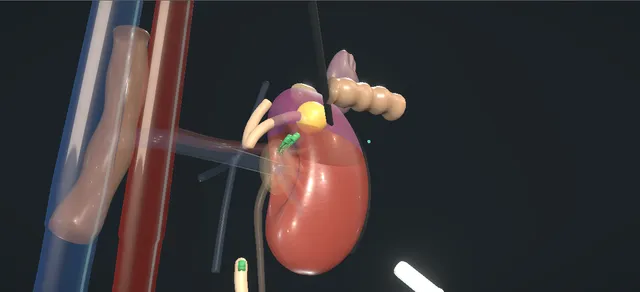
Adult chapter; the book has no paediatric nephrectomy or heminephrectomy chapter. Taken from it: the indications (a nonfunctioning kidney, infection), the six essential steps and their order (the colon reflected, adjacent organs mobilised, early hilar control with the tributary veins, the kidney mobilised within Gerota's fascia and off the adrenal, the ureter divided, inspection), the left-sided route along the gonadal vein and ureter to the hilum, the artery before the vein, the specimen bag, inspection at reduced pressure, the variations (Veress, open or optical entry; the retroperitoneal approach for prior surgery or vascular variation; subcapsular dissection; periumbilical extraction; fascial closure) and the complication list (bleeding, infection, intra-abdominal organ injury, pneumothorax, ileus). Departures: the chapter staples the renal vessels in the adult; the child's small vessels are clipped here, which is UK paediatric practice, and the chapter leaves the entry method open, so open entry at the umbilicus is shown as the UK paediatric standard. The heminephrectomy steps, the low division of a refluxing ureter and the first, escalate and document steps are general paediatric urological practice and the papers below.
Open guideline
European Association of Urology
EAU Guidelines on Paediatric Urology, 2026. Chapter 16, dilatation of the upper urinary tract (PUJ obstruction), section 16.3.2 and recommendations 16.4, read 19 October 2026
Surgery for impaired split renal function under 40 per cent or a fall of more than 10 percentage points on subsequent studies; the management of poorly functioning kidneys, arbitrarily defined as under 20 per cent differential function, is controversial and the chance of improvement appears limited; the options of primary pyeloplasty or nephrectomy should be discussed with the family. Read through a fetch tool that returns quotations from the page. The reflux chapter read the same day gives no threshold for nephrectomy; the multicystic dysplastic kidney is named among the indications from the hub data and general practice, not from these chapters.
Open guideline
European Association of Urology
EAU Guidelines on Paediatric Urology, 2026. Chapter 19, ureterocele and ectopic ureter, sections 19.1.4, 19.2.4 and 19.3, read 19 October 2026
Upper-approach options include partial nephroureterectomy; open, laparoscopic and robot-assisted approaches give comparable results; reconstruction should be considered where the upper moiety has function worth preserving; imaging to assess moiety function is a strong recommendation. The chapter gives no figure for loss of the lower pole.
Open guideline
Journal of Pediatric Urology
Jayram G, Roberts J, Hernandez A, et al. Outcomes and fate of the remnant moiety following laparoscopic heminephrectomy for duplex kidney: a multicenter review. J Pediatr Urol 2011;7:272-275
Abstract read 19 October 2026. 142 retroperitoneoscopic heminephrectomies across 4 institutions, median age 11.4 months; conversion in 11 (7.7%), 8 of them before 2000; postoperative urinoma in 7 (4.9%); 1 ureterectomy for urinary infection. At a median follow-up of 4.5 years, 7 children (4.9%) had significant loss of function in the remaining moiety, 6 of 7 after upper-pole heminephrectomy, 3 needing completion nephrectomy.
Open guideline
Journal of Pediatric Urology
Wadham B, DeSilva A, Connolly T, et al. The place of retroperitoneoscopic hemi-nephroureterectomy for duplex kidney in children; risk of damage to the remnant moiety and strategies to reduce the risk. J Pediatr Urol 2021;17:708.e1-708.e8
Abstract read 19 October 2026. 78 retroperitoneoscopic operations in 75 children, Manchester, 2005 to 2018; no conversions. Remnant moiety loss (postoperative function under 10%) in 4 of 78 (5.1%), all after upper-moiety surgery, all recorded as difficult because of a grossly dilated upper-moiety ureter and pelvis, two with a thinned lower moiety over the dilated pelvis; concern about damage to lower-moiety vessels in 3. Loss related to age under 1 year (2 of 8 under 1 year, 1 of 25 aged 1 to 2, 1 of 45 aged 2 or over). 7 needed further procedures, 5 for a ureterocele or ureteric stump.
Open guideline
Journal of Laparoendoscopic and Advanced Surgical Techniques
Golebiewski A, Losin M, Murawski M, Komasara L, Czauderna P. Laparoscopic versus open upper pole heminephroureterectomy for the treatment of duplex kidneys in children. J Laparoendosc Adv Surg Tech A 2013;23:942-945
Abstract read 19 October 2026. 27 children randomised to transperitoneal laparoscopic (15) or open retroperitoneal (12) upper-pole heminephroureterectomy, three or four ports. Operating time not significantly different; analgesic requirement and hospital stay shorter after laparoscopy; no conversions and no major complications; remnant pole function preserved in all.
Open guideline
International Journal of Medical Robotics and Computer Assisted Surgery
Di Fabrizio D, Cundy TP, Najmaldin AS. Paediatric robotic transperitoneal heminephroureterectomy in complete duplicated systems: early and long-term outcomes. Int J Med Robot 2025;21:e70082
Abstract read 19 October 2026. 32 heminephroureterectomies (28 upper, 4 lower), Leeds; no conversions and no remnant moiety function loss. 11 had a total ureterectomy and 21 were left with a ureteric stump; 3 girls with a residual stump later had surgery for recurrent infection.
Open guideline
Journal of Pediatric Urology
Kawal T, Srinivasan AK, Talwar R, et al. Ipsilateral ureteroureterostomy: does function of the obstructed moiety matter? J Pediatr Urol 2019;15:50.e1-50.e6
Abstract read 19 October 2026. States that ablative upper-pole surgery confers a risk of functional loss to the remnant moiety through vasospasm or vascular injury; used for that mechanism and for reconstruction as the alternative.
Open guideline