
Paediatric nephrectomy and heminephrectomy for benign disease
Open and minimally invasive excision of a non-functioning kidney or moiety, preserving contralateral and remnant renal tissue.
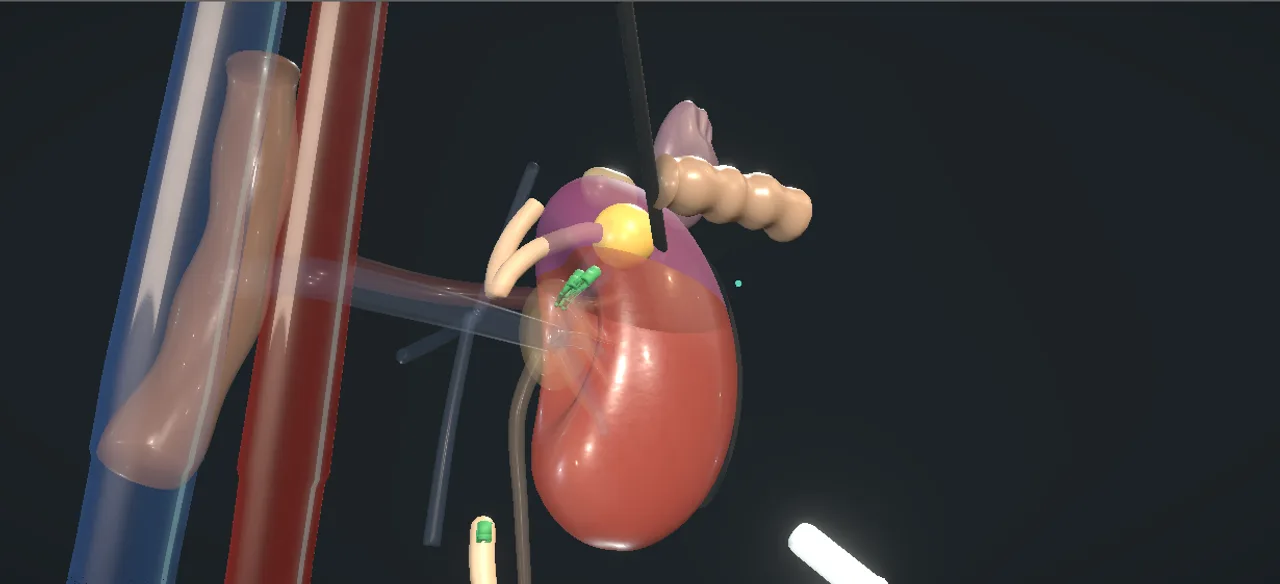 Interactive 3D Interactive paediatric nephrectomy and upper-pole heminephrectomy Open the 3D animation
Teaching catalogue only. This coverage record is not a patient pathway or operative instruction.
Typical place in practice
Selected poorly functioning symptomatic unit associated with infection, obstruction, ectopia, reflux or hypertension after confirming the contribution of the target tissue.
Alternatives and neighbouring procedures
Observation, drainage, reflux/obstruction reconstruction or nephron preservation where the unit retains useful function.
Same procedure family, explicit technique branches
These are variations of this canonical operation. Complication modules below identify whether they apply to all branches or only to named approaches.
Total simple nephrectomy
Removes the kidney for benign or congenital end-stage unilateral disease.
Upper-pole heminephrectomy
Removes a non-functioning upper duplex moiety while preserving the lower pole.
Lower-pole heminephrectomy
Removes a selected non-functioning lower moiety with careful vascular mapping.
Nephroureterectomy or distal ureter management
Addresses an infected, refluxing or ectopic residual ureter according to risk.
High-level sequence
Coverage outline only; not a step-by-step technical guide.
- Confirm target function and contralateral/remnant health
- Map renal, segmental and ureteric anatomy
- Control vessels and divide parenchyma without injuring preserved tissue
- Manage ureter according to reflux, ectopia and infection risk
- Monitor renal function, blood pressure, leak and recurrent infection
Every failure mode is its own module.
Timing and variation coverage are recorded for each module.
Bleeding or vascular injury
Small-calibre and variant vessels can retract or compromise preserved renal tissue.
Applies to: All variantsLoss of function in retained moiety or opposite kidney
Vascular or collecting-system injury can damage the tissue the operation intends to preserve.
Applies to: Upper-pole heminephrectomy · Lower-pole heminephrectomyUrinary leak or urinoma
A divided collecting system or ureteric stump can leak.
Applies to: All variantsResidual ureteric stump infection or symptoms
A retained refluxing or ectopic ureteric segment can remain symptomatic.
Applies to: All variantsAdjacent-organ or port injury
Upper abdominal and minimally invasive access can injure bowel, solid organs or pleura.
Applies to: All variantsHypertension or chronic kidney-function impact
Reduced nephron mass and the original renal disease require long-term surveillance.
Applies to: All variantsSources for this module
Common congenital, acute scrotal and paediatric reconstructive procedures.
Accessed 2026-08-03 · opens source British Association of Urological Surgeons Patient information leaflets by procedureUK patient-facing procedure, alternatives, recovery and complication framing.
Accessed 2026-08-03 · opens source