
Paediatric hypospadias and chordee reconstruction
Reconstruction of meatal position, urethra, curvature and penile skin, with distal, proximal, staged and redo techniques retained as distinct variants.
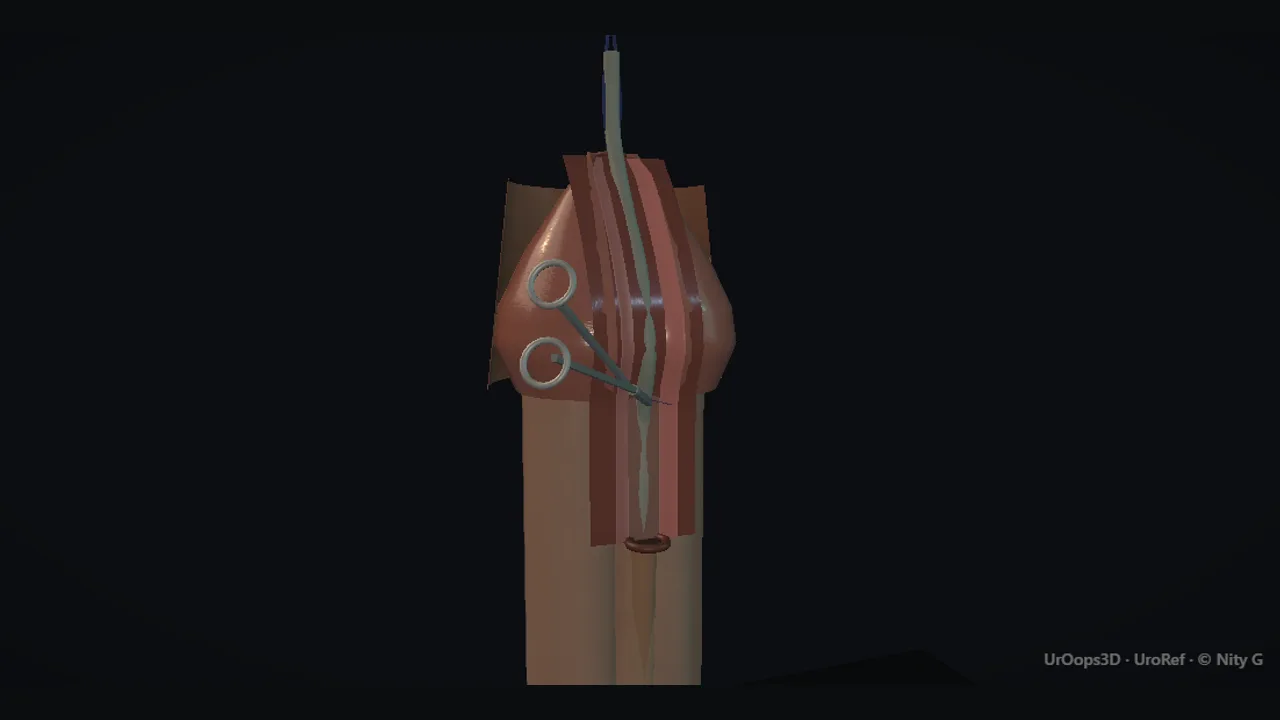 Interactive 3D Interactive operative model Open the 3D animation 3D Interactive MAGPI repair 3D Interactive onlay island flap repair
Teaching catalogue only. This coverage record is not a patient pathway or operative instruction.
Typical place in practice
Functionally or anatomically significant hypospadias after family-centred assessment of urinary, sexual, cosmetic and long-term goals.
Alternatives and neighbouring procedures
Observation for selected minor variants, limited meatoplasty or chordee correction, or deferred decision-making in complex anatomy.
Same procedure family, explicit technique branches
These are variations of this canonical operation. Complication modules below identify whether they apply to all branches or only to named approaches.
Tubularised incised plate repair
Uses and widens a suitable urethral plate, usually in distal or selected midshaft anatomy.
Onlay flap or tubularised flap repair
Adds tissue for a longer or less suitable native plate.
Two-stage graft repair
Separates complex proximal or redo reconstruction into healing stages.
Chordee correction without urethroplasty
Corrects curvature when urethral reconstruction is unnecessary or planned separately.
Redo hypospadias reconstruction
Addresses complications in previously operated and often scarred tissue.
High-level sequence
Coverage outline only; not a step-by-step technical guide.
- Define meatus, plate, curvature, glans and skin anatomy
- Preserve options while degloving and testing straightness
- Correct curvature using the least disruptive effective manoeuvre
- Construct urethra and glans with well-vascularised offset layers
- Provide drainage and long-term review through growth and puberty
Every failure mode is its own module.
Timing and variation coverage are recorded for each module.
Urethrocutaneous fistula
Breakdown of the neourethral closure can create an additional urinary opening.
Applies to: All variantsMeatal or urethral stenosis
Scarring at the meatus, glans or reconstructed segment can obstruct flow.
Applies to: All variantsGlans or wound dehiscence
Tension, infection or poor vascularity can separate the glans or skin closure.
Applies to: All variantsResidual or recurrent curvature
Curvature may be undercorrected or recur with healing and pubertal growth.
Applies to: All variantsUrethral diverticulum, hair or stone formation
Substitution tissue and a wide or poorly supported segment can cause stasis and later complications.
Applies to: Onlay flap or tubularised flap repair · Two-stage graft repair · Redo hypospadias reconstructionSkin, glans or flap ischaemia
Compromised penile or flap blood supply can cause partial tissue loss.
Applies to: All variantsAltered sensation, sexual function or cosmetic dissatisfaction
Long-term outcomes extend beyond childhood urinary-stream appearance.
Applies to: All variantsNeed for staged completion or revision
Complex repairs may require planned stages and additional unplanned corrections.
Applies to: Two-stage graft repair · Redo hypospadias reconstruction