
Paediatric neuro-urological bladder reconstruction
A goal-based hub combining safe storage, catheter access and continence operations for congenital neuro-urological bladder dysfunction.
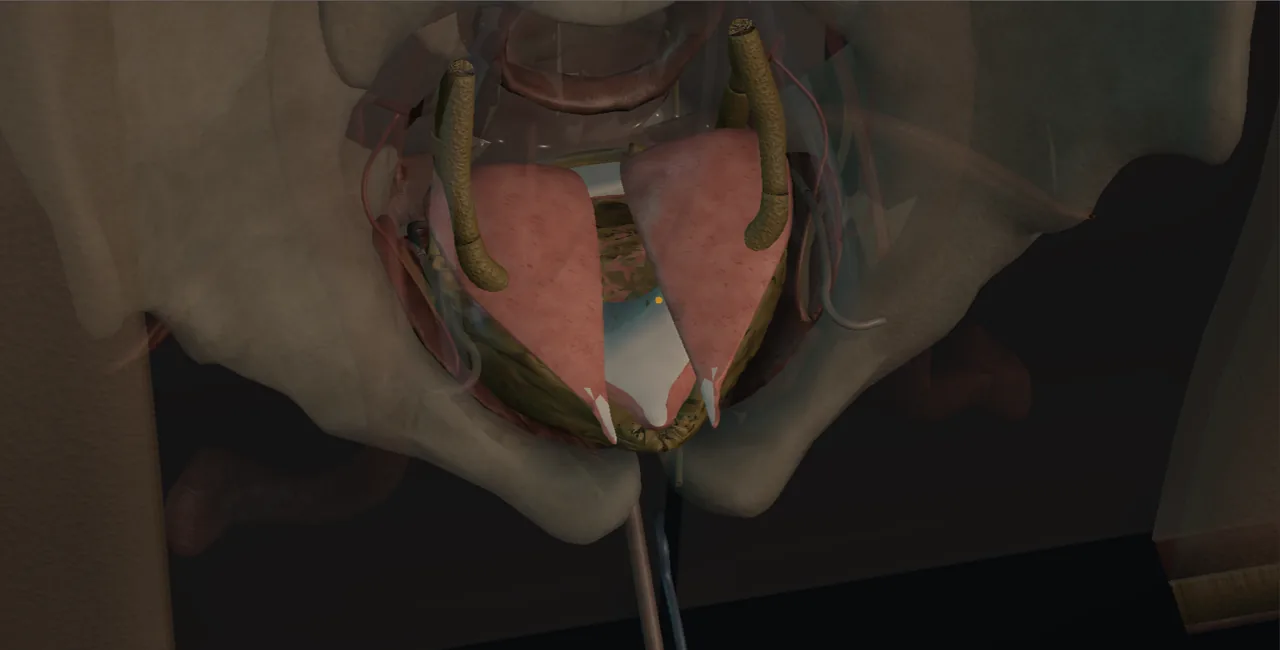 Interactive 3D Interactive clam ileocystoplasty Open the 3D animation 3D Interactive Mitrofanoff channel 3D Interactive bladder neck closure
Teaching catalogue only. This coverage record is not a patient pathway or operative instruction.
Typical place in practice
Unsafe storage pressures, refractory incontinence or inaccessible urethral catheterisation despite optimised conservative and minimally invasive treatment.
Alternatives and neighbouring procedures
Intermittent catheterisation, pharmacological treatment, botulinum toxin injection, overnight drainage, neuromodulation in selected patients or incontinent diversion.
Same procedure family, explicit technique branches
These are variations of this canonical operation. Complication modules below identify whether they apply to all branches or only to named approaches.
Augmentation cystoplasty
Increases capacity and compliance to protect upper tracts and improve storage.
Continent catheterisable channel
Creates an accessible route for intermittent catheterisation.
Bladder-neck reconstruction, sling or outlet closure
Increases outlet resistance or closes an irreparable outlet after ensuring dependable catheter drainage.
Composite reconstruction
Addresses several functional goals in one or staged operations.
Incontinent diversion
Provides low-pressure continuous drainage when continent reconstruction is unsuitable.
High-level sequence
Coverage outline only; not a step-by-step technical guide.
- Define renal-safety, continence and independence goals with the child and family
- Confirm catheterisation capability and lifelong follow-up resources
- Construct storage, outlet and access components in a coherent pressure-safe plan
- Test drainage and protect ureters and bowel anastomosis
- Support transition to adult metabolic, renal, stone and malignancy surveillance
Every failure mode is its own module.
Timing and variation coverage are recorded for each module.
Bowel leak, obstruction or intra-abdominal sepsis
Bowel isolation and anastomosis add immediate and late gastrointestinal risks.
Applies to: Augmentation cystoplasty · Composite reconstruction · Incontinent diversionUrinary leak or fistula
Multiple urinary anastomoses and high pressure can cause leakage.
Applies to: All variantsChannel stenosis, false passage or incontinence
Catheter access can become narrow, traumatised or leaky and may need revision.
Applies to: Continent catheterisable channel · Composite reconstructionRetention or upper-tract deterioration from outlet imbalance
Increasing resistance without reliable low-pressure catheter drainage can threaten kidneys.
Applies to: Bladder-neck reconstruction, sling or outlet closure · Composite reconstructionStones, infection and mucus obstruction
Reconstructed reservoirs and catheterisation promote mucus, bacteriuria and calculi.
Applies to: All variantsMetabolic, nutritional or growth consequences
Urine–bowel contact and bowel resection can affect acid-base status, vitamins, bone and growth.
Applies to: Augmentation cystoplasty · Composite reconstruction · Incontinent diversionReservoir perforation
A reconstructed bladder can rupture years later and requires lifelong recognition education.
Applies to: Augmentation cystoplasty · Composite reconstructionNeed for repeated revision through growth
Stomas, channels, outlets and reservoirs can require further procedures as the child grows.
Applies to: All variantsSources for this module
Common congenital, acute scrotal and paediatric reconstructive procedures.
Accessed 2026-08-03 · opens source European Association of Urology EAU Guidelines on Neuro-urologyBotulinum toxin, sphincterotomy, neuromodulation, augmentation and diversion.
Accessed 2026-08-03 · opens source