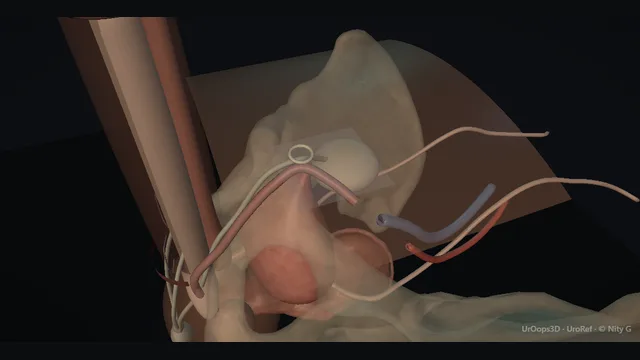
A three-piece inflatable implant taught through its anatomy: cylinders dilated and seated inside the paired corpora, a pump in the most dependent scrotum anterior to the testes, and a reservoir in the paravesical space lateral to the bladder, where bowel and iliac vessels make blind passes dangerous.
The dilatation step is the scene's danger moment, with the septum defining crossover and the ventral spongiosum and the distal dome defining perforation.
Advanced tierFRCS andrology, prosthetic surgery, sexual medicineInteractive 3D
Along the device, cylinder tip to reservoir. Schematic, not to scale; relationships only.
Follow the device from tip to tank: each cylinder lies inside a dilated corporal channel from the glans to the penoscrotal junction, the septum between the two channels thinning distally, the urethra travelling ventral to both throughout.
The pump hangs below, in the dependent scrotum in front of the testes, so its tubing rises to the cylinders through the corporotomies it sits beneath.
The reservoir sits highest and deepest of all, in the paravesical space lateral to the bladder and medial to the iliac vessels, bowel draped above: entered through the external ring, a pass that must be felt rather than forced.
The three pieces are one hydraulic circuit, and every danger of the operation, crossover, urethral and dome perforation, reservoir injury, lives at a specific point along it.
›Corpora cavernosa - the paired channels that are dilated and then house the cylinders; their septum is thin distally, which is why crossover happens there.
›Corpus spongiosum + urethra - ventral at 6 o'clock through the whole approach; perforation here changes or ends the operation.
›Scrotum + testes - the pump's home: most dependent, anterior to the testes, findable by the patient's own hand.
›Paravesical space - lateral to the bladder, behind the pubis; the reservoir's home and the site of the operation's deepest dangers.
›Iliac vessels + bowel - the neighbours of the paravesical space; injured by blind development of the pocket, not by deliberate technique.
Counselling: the last-option operationThe implant is offered when other options are exhausted or refused, and the consultation is treated as part of the operation rather than a preliminary to it. Expectations are set explicitly about length, girth, glans engorgement and the difference between a device-supported erection and a natural one, with the device demonstrated where possible. The patient describes the pump and the cycle back in his own words before a date is set, which is the first rehearsal of the teach-back. Concealed length loss is the commonest disappointment and is named aloud in clinic, because the consultation decides satisfaction more than the surgery does. where it bites: concealed length loss is the commonest disappointment; it is counselled before surgery or litigated after it.
Penoscrotal approachA urethral catheter is placed first, so the urethra is palpable throughout and the bladder is empty before the reservoir pass. A transverse incision is made at the penoscrotal junction and the dartos is divided to expose the deeper fascia. Buck's fascia is opened and each corporal body is delineated by blunt dissection until both cylinders can be identified and held from crus to glans. Longitudinal corporotomies are then made on the long axis of each corpus, kept centred and clear of the ventral surface where the spongiosum and urethra run. A corporotomy that drifts ventrally, or is extended carelessly, threatens a urethra that sits within a centimetre of this whole operation. where it bites: corporotomies ventral and careless threaten the spongiosum; the urethra is a centimetre from this whole operation.
Corporal dilatation: the danger momentDilatation sounds advance gradually, proximal first and then distal, each passage hugging the midline of the channel and steered along the natural curve of the crus. The feel of the sound is the feedback: a smooth glide means the channel, and a sudden give means the septum, the spongiosum or the distal dome has been breached. Lateral pressure at the thin distal septum crosses into the other corpus, ventral pressure perforates the urethra, and over-eager distal passage goes through the dome. Both channels are dilated and measured in both directions before sizing is discussed, and the measurements are written down as they are taken. where it bites: lateral pressure at the thin distal septum crosses over; ventral pressure perforates the urethra; over-eager distal passage perforates the dome.
Cylinder sizing + insertionCylinder length is chosen from the measured channels rather than from habit: a cylinder too long pistons against the distal tip and threatens erosion, and one too short leaves a sump that buckles and collects fluid. Each cylinder is seated fully to the distal tip of its own channel, with rear tip extenders added proximally to take up the measured gap at the corporotomy. The right measurement goes to the right side, spoken aloud and confirmed before insertion, because a cross-traded measurement sits exactly in the overlap of haste and assumption. Correctly sized cylinders support the glans rather than leaving it unsupported or driving into it. where it bites: a cross-traded measurement, right measured and left implanted, sits in the overlap of haste and assumption.
Pump in the dependent scrotumA dartos pocket is developed bluntly in the most dependent part of the scrotum, anterior to the testes, deep enough that the pump sits low and cannot retract upward. The tubing is routed to the corporotomies without twist or torque, and the whole circuit is filled, connected and test-cycled before closure begins. Position is the functional check: the pump is drawn down to the lowest scrotum so the patient can find it with his own hand without hunting for it. A pump placed too high is a device that works in theatre and fails at the teach-back, which is where the patient has to operate it. where it bites: a pump placed too high is a pump the patient cannot find; the device fails at the teach-back, not in theatre.
Reservoir: the paravesical spaceThe external ring is opened along the line of the cord and a pass is made with a finger or a blunt dilator into the paravesical space lateral to the bladder, medial to the iliac vessels and below the bowel. The pocket is developed by feel, and the pass stops at the first resistance or at any return of blood, urine or gas, because this is where bladder, bowel and vessel injuries happen. The reservoir is filled, seated in the pocket and its position confirmed before the tubing is brought to the pump. In the scarred or hostile pelvis the pass is made under direct vision or a reservoir-free configuration is chosen, never forced through the textbook space. where it bites: resistance or any return of blood, urine or gas stops the pass: this is where bladder, bowel and iliac injury happen.
Closure + cycling after healingThe wound is closed in layers over the connected device, a flat dressing is applied, and the device is left partly inflated to tamponade the corporotomies and hold the cylinders in position while they heal. Cycling is begun only after healing is complete, on a planned date, because early cycling on a fresh corporotomy stresses the repair. Before discharge the patient performs the teach-back: finding the pump, deflating it, and saying when the device may be used. Infection vigilance continues for months rather than weeks, and the patient is told to report redness or fixation early, because the salvage window is the early one. where it bites: early cycling on a fresh repair stresses the corporotomies; infection vigilance continues for months, not weeks.
The spatial relationships the animation is built to make automatic. Before you read each one, ask yourself: at this point in the operation, what is about to go wrong, and what is my first move? The save for each sits in the Complications tab.
RiskThe distal septum - thin and midline; lateral dilatation crosses into the other corpus and the cylinders end up side by side in one channel.
RiskVentral spongiosum at 6 o'clock - one centimetre of safety between the corporotomy and the urethra; ventral perforation may end the operation.
RiskThe paravesical neighbours - bladder, bowel and iliac vessels around the reservoir pocket; any return of blood, urine or gas stops the pass.
Trigger each of these live in the Animation tab, then read the save: the first move, the escalation trigger, and the line that goes in the op note.
Crossover / urethral or dome perforation
the sound crosses the septum into the other corpus, or perforates ventrally into the urethra or distally through the corporal dome;
crossover shows as both cylinders in one channel, urethral perforation as blood at the meatus or a visible tear.
The save
Recognise it at the moment it happens: a sudden loss of resistance, a deviated sound or blood at the meatus.first move
Crossover: re-dilate the crossed channel under vision and confirm both channels are separate before seating cylinders.
Urethral perforation: abandon that side, leave a catheter to drain the bladder, and close; both cylinders may have to wait for a second operation.
Dome perforation: do not seat a cylinder through it; repair or leave that side and reassess sizing.
Unrecognised crossover found after insertion, or a cylinder eroding into the urethra → removal and planned re-insertion, specialist input early.escalation trigger
Op note: channel findings at dilatation, the event, what was done to each side, and the catheter plan.document
Reservoir injury to adjacent structures
blind development of the paravesical pocket perforates the bladder or bowel, or tears an iliac vessel; the signs are unexpected returns of urine, gas or blood, or a reservoir that will not sit.
The save
Stop the pass at the first resistance or abnormal return; the pocket is developed gently or not at this sitting.first move
Bladder perforation: catheter drainage, confirm with imaging or cystoscopy, and place the reservoir elsewhere or leave it for a second stage.
Bowel injury is a laparotomy conversation with the general surgeons, not a urological afterthought.
Vascular injury or a expanding pelvic haematoma → immediate imaging, embolisation or open repair.escalation trigger
Note: the space entered, what returned, imaging done, and the reservoir's final position or absence.document
Infection: salvage or removal
pain, erythema and fixation around the pump or incision, from the early weeks to months after implantation; the decision is salvage washout in the early, stable patient or removal when established.
The save
Assess how early and how sick: early infection in a stable man is the salvage candidate; established infection with abscess or systemic upset is not.first move
Start antibiotics after cultures, but antibiotics alone do not rescue an infected prosthesis.
Salvage: removal of all components, aggressive washout with antiseptic solutions, and immediate exchange in selected cases.
Established or severe infection → removal of all components, drainage, and re-implantation delayed for months on the healed, soft penis.escalation trigger
Note: interval from implantation, organisms, what was removed and the plan for re-implantation timing.document
When the case turns: the problem, then the next move.
ActionSound will not pass proximally - redirect along the calibre of the crus rather than forcing; the proximal crus curves dorsally, and hugging the bone is the cue, not pressure.
ActionBoth sounds seem to be in one channel - stop, reassess with the scope or simultaneous sounds side by side; crossover is corrected by re-dilating under vision, never by seating the cylinders.
ActionDistal measurement differs between sides - size each cylinder to its own channel; symmetry is an outcome, not an instruction to average the measurements.
ActionScrotal pocket too shallow for the pump - develop the dependent dartos pocket bluntly before connection; a pump that sits high is a device the patient cannot operate.
The examiner stems this scene prepares you for. Try to answer out loud first, then reveal, and learn the discriminator, the detail that turns a pass into a strong pass.
QHow do you choose between a malleable and an inflatable prosthesis?reveal answer
The choice is a shared decision built on dexterity, expectations and risk, and I frame it as simplicity against performance.
The malleable device is a paired semi-rigid rod in each corporal body: no moving parts, no fluid, no pump, so it is nearly immune to mechanical failure, easier to teach to patients with limited dexterity or cognition, and the operation is smaller, which matters after complex urethral or pelvic surgery and in the frail.
Its cost is permanent concealment and a less natural erection, with rigidity always present and positioned rather than created.
The three-piece inflatable device gives rigidity on demand and a flaccid penis between uses, with girth and a more natural feel, which is why it dominates in motivated, fit men;
its prices are the mechanical complexity, pump dexterity, the reservoir and its paravesical dangers, and the need for patient training.
Both carry the shared risks of infection, erosion and the length conversation.
My selection pattern: the young, dexterous man with realistic expectations chooses inflatable;
the elderly frail man, the man with poor hand function, and the man whose priority is a single reliable operation choose malleable.
The wrong choice is made in silence: whichever device is implanted, satisfaction tracks the counselling more than the hardware.
Strong pass
Say both
Presenting the trade as simplicity and robustness against on-demand performance
With named populations for each rather than a single default
Examiner note
Presenting the trade as simplicity and robustness against on-demand performance, with named populations for each rather than a single default.
QTake me through the infection conversation before implantation.reveal answer
Infection is the complication that removes the device, so the conversation is explicit and the prevention is protocolised.
I tell the patient what it looks like: increasing pain, redness and swelling around the incision or the pump, discharge, or a device that becomes fixed and exposed, and that this window is wide, from the first days to months later.
I explain the stakes honestly: an established infection means the prosthesis comes out, and re-implantation waits for a healed, soft penis months later;
a small proportion of early infections in stable men can be salvaged with washout and exchange, but salvage is a chance, not a promise.
Prevention is where my practice lives: skin preparation and a protocolised theatre discipline with minimal implant air-time, antibiotic prophylaxis at induction and continued while drains or dressings dictate, the no-touch refinements that reduce contamination, and careful counselling about hygiene in the early weeks, urinary infections and delayed healing.
Diabetes control and any active infection, dental, urinary or skin, are addressed before the date.
I also tell him what I expect of him: report redness early, do not wait for pain, because the salvage window is the early one.
The documented conversation protects both sides: the man who understands removal is a real outcome is the man who presents early.
Strong pass
Making explicit that removal is the treatment of established infection and salvage is a time-limited chance, and that prevention is protocol, not hope.
QWhere does the reservoir go, and how do you manage the scarred pelvis?reveal answer
The reservoir belongs in the paravesical space, the potential space lateral to the bladder and behind the pubis, entered through the external ring along the line of the cord;
developed gently with the finger or a blunt dilator over the pubis, it sits below bowel and medial to the iliac vessels, which is exactly why the pass must be felt and never forced, with resistance, or any return of blood, urine or gas, stopping it.
The scarred pelvis changes the calculus.
After prostatectomy, cystectomy, pelvic irradiation or mesh repair, that space is obliterated or hostile, and blind development risks precisely the structures that make the space dangerous.
The options follow a ladder: first, careful percutaneous or open entry under direct vision, accepting a slower pass;
second, alternative spaces, the preperitoneal plane higher and lateral, or an ectopic position below the fascia in the groin, accepting a cosmetic trade-off and, rarely, compression issues;
third, a delayed reservoir placed secondarily after imaging maps the anatomy, or a decision for a two-piece or malleable configuration that needs no reservoir at all.
Imaging before the operation, and honest consent that the reservoir may not go where the textbook says, are part of the plan in these men.
The principle throughout is that the reservoir is the component with the dangerous address, and its placement is where patience is a technical skill.
Strong pass
Naming the alternatives for the hostile pelvis, ectopic or preperitoneal placement, delayed insertion, or a reservoir-free configuration, rather than forcing the textbook space.
QA man complains the penis is shorter with his new implant than he expected. What went wrong and what do you tell him?reveal answer
Some length change is physiology, some is counselling, and some is avoidable technique, so I take the complaint seriously and unpick all three.
Physiologically, the implant supports the corporal body it sits in;
it does not restore the glans engorgement or the tunical distension of a natural erection, and men with fibrosis after priapism or surgery, or with Peyronie disease, have lost tunical length that no cylinder gives back.
Prophylactically, this is exactly why the length conversation happens before surgery, with the device shown and the concealment and engorgement differences demonstrated, because the disappointed man is usually the man who expected his natural erection plus reliability.
Technically, sizing matters: undersized cylinders or proximal gas from crus under-dilatation shorten the functional unit, and distal under-dilatation robs the glans of support;
the fix at implantation is careful measurement in both directions and rear tip extenders chosen to fit, not to trim time.
After surgery, the answer is structured: cycling and rehabilitation after healing stretch the tissues and recover some apparent length over months, so reassessment waits for maturation.
Persistent, disabling dissatisfaction can be revised, and revision for length is honest, difficult surgery with modest returns.
My real answer is that the best operation for length is the consultation before it.
Strong pass
Say all three
Separating physiology
Counselling and technique as the three sources
Locating the durable solution in the pre-operative conversation
Examiner note
Separating physiology, counselling and technique as the three sources, and locating the durable solution in the pre-operative conversation.
Say it aloud, then reveal. Reading is not remembering.
01The relationshipSay the critical spatial relationship out loud, then reveal.reveal
Memory frame
Follow the device from tip to tank
Why?
Follow the device from tip to tank: each cylinder lies inside a dilated corporal channel from the glans to the penoscrotal junction, the septum between the two channels thinning distally, the urethra travelling ventral to both throughout. The pump hangs below, in the dependent scrotum in front of the testes, so its tubing rises to the cylinders through the corporotomies it sits beneath. The reservoir sits highest and deepest of all, in the paravesical space lateral to the bladder and medial to the iliac vessels, bowel draped above: entered through the external ring, a pass that must be felt rather than forced. The three pieces are one hydraulic circuit, and every danger of the operation, crossover, urethral and dome perforation, reservoir injury, lives at a specific point along it.
02The first moveCrossover / urethral or dome perforation. Your first move?reveal
First move
Recognise it at the moment it happens: a sudden loss of resistance, a deviated sound or blood at the meatus.
03The escalation triggerCrossover / urethral or dome perforation. What makes you call for help?reveal
Escalate when
Unrecognised crossover found after insertion, or a cylinder eroding into the urethra → removal and planned re-insertion, specialist input early.
04The discriminatorWhat turns a pass into a strong pass?reveal
Strong pass
Say both
Presenting the trade as simplicity and robustness against on-demand performance
With named populations for each rather than a single default
Examiner note
Presenting the trade as simplicity and robustness against on-demand performance, with named populations for each rather than a single default.
05The pitfallWhere does this operation bite first?reveal
Pitfall
The distal septum
Why?
thin and midline; lateral dilatation crosses into the other corpus and the cylinders end up side by side in one channel.
Revision practice with self-marked answers, not an assessment of clinical competence. Kept in
this browser only; it does not sync between devices.