
Penile prosthesis implantation, revision and salvage
Implantation of inflatable or malleable cylinders, including revision, explantation and selected infection-salvage pathways.
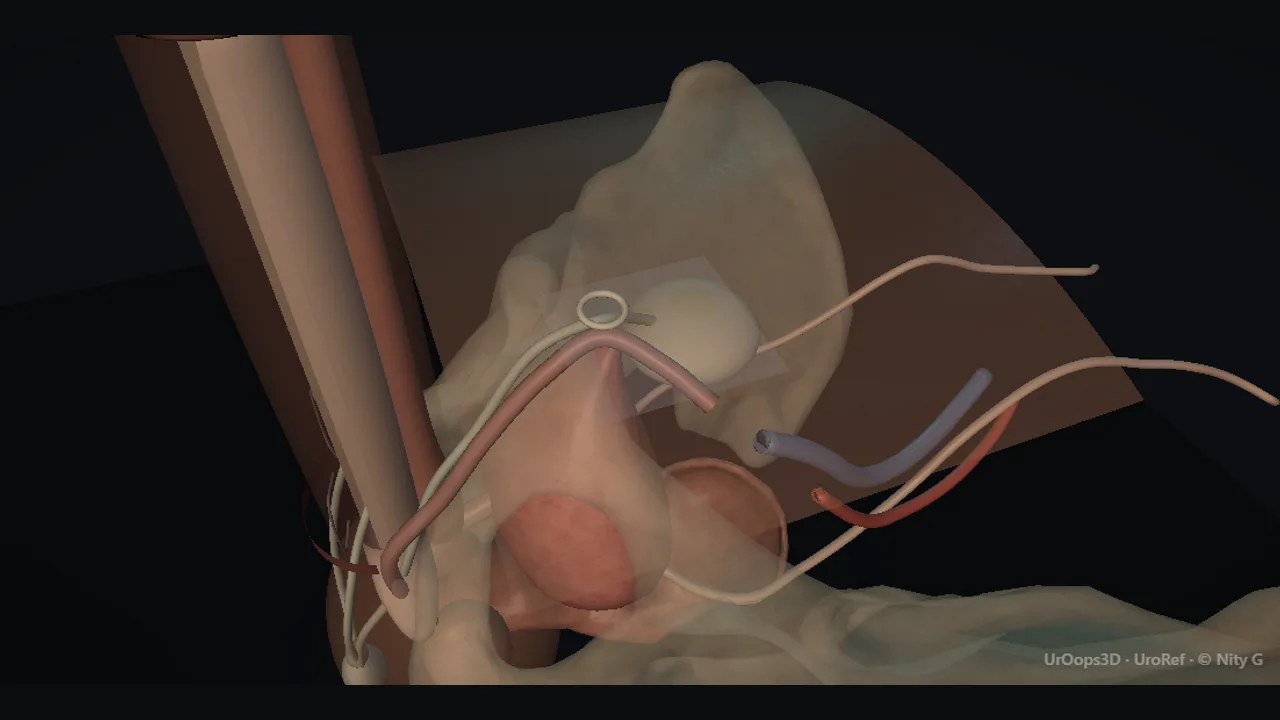 Interactive 3D Interactive operative model Open the 3D animation 3D Interactive malleable prosthesis
Teaching catalogue only. This coverage record is not a patient pathway or operative instruction.
Typical place in practice
Erectile dysfunction refractory to or unsuitable for less invasive treatment, after counselling about irreversible corporal surgery and future device revision.
Alternatives and neighbouring procedures
Lifestyle and psychosexual support, oral or intraurethral treatment, vacuum device, injection therapy, or no further intervention.
Same procedure family, explicit technique branches
These are variations of this canonical operation. Complication modules below identify whether they apply to all branches or only to named approaches.
Three-piece inflatable prosthesis
Provides inflatable rigidity with separate fluid reservoir and pump.
Two-piece inflatable prosthesis
Avoids a separate abdominal reservoir in selected anatomy.
Malleable prosthesis
Provides manual positioning with fewer mechanical components.
Revision, explantation or salvage
Addresses infection, erosion, mechanical failure, pain or unsatisfactory position.
High-level sequence
Coverage outline only; not a step-by-step technical guide.
- Confirm indication, expectations, anatomy and infection risk
- Expose and dilate the corporal spaces
- Size and place cylinders without crossover or perforation
- Position pump and reservoir components where applicable
- Test, close and teach device use after healing
Operative notes
Concise operative notes covering the key steps, landmarks and watch points, in the order you encounter them.
Penile prosthesis
What it does: implants to restore erections.
malleable rods
- Approach: above pubis, peno-scrotal, or under the glans. Lateral cut in the tunica, 2.5-4 cm.
- Dilate each corpus with Hegars.
- DANGER 1, far end: dilator tips onto the sitting bone. Commonest perforation site.
- DANGER 2, near end: advance SIDEWAYS. Straight-on = crooked rod (SST look).
- Hard to dilate? Wrong plane, cross-over, or perforation. Stop and think.
- Measure. Between sizes: take the SHORTER.
- Antibiotic wash. Rods in, rear tips on.
- Tunica closed 4/0.
inflatable, 3 pieces
- Same access. Cylinders via a glans needle tool.
- Pump in a scrotal pocket, dominant hand side.
- Balloon behind the rectus, via the groin floor: through the external ring, cord kept lateral, then transversalis. Bladder empty first. Space big enough: no more than 5 mL drains back, or it self-inflates.
- Cycle on the table. Leave empty.
- First activation 4-6 weeks.
Perforation rules
- Near-end perforation, 1st side: stop. Redo in 6 weeks.
- 2nd side: repair. Rod on the good side. Or abandon, wash out.
- 2026 update: Coated implants + no-touch: fewer infections.
- 2026 update: Classic numbers still quoted: infection up to 10% in diabetics. Satisfaction 79-92% inflatable.
From the UroRef Operative Quick Guide. Open the note page →
Every failure mode is its own module.
Timing and variation coverage are recorded for each module.
Corporal, urethral or visceral perforation
Dilatation, cylinder passage or reservoir placement can breach the corporal bodies, urethra, bladder, bowel or vascular structures.
Applies to: All variantsProsthesis infection
Infection can involve any component and may necessitate explantation or a specialist salvage strategy.
Applies to: All variantsErosion or extrusion
Cylinders, pump or rods can erode into urethra or through compromised skin.
Applies to: All variantsMechanical failure or fluid leak
Pump, tubing, reservoir or cylinder failure can prevent inflation or deflation.
Applies to: Three-piece inflatable prosthesis · Two-piece inflatable prosthesis · Revision, explantation or salvageCylinder malposition, crossover or deformity
Incorrect position or later migration can cause pain, poor rigidity, asymmetry or impaired penetration.
Applies to: All variantsGlans ischaemia or distal tissue compromise
Vascularly fragile tissue may become ischaemic after extensive dissection or oversizing.
Applies to: All variantsPersistent pain or dissatisfaction
Pain, perceived penile shortening, altered sensation or unmet expectations can remain despite a functioning device.
Applies to: All variantsSources for this module
Penile prosthesis, Peyronie disease, priapism and reproductive surgery.
Accessed 2026-08-03 · opens source British Association of Urological Surgeons Patient information leaflets by procedureUK patient-facing procedure, alternatives, recovery and complication framing.
Accessed 2026-08-03 · opens source