
Hydrocele surgery
Scrotal and inguinal hydrocele procedures, distinguishing adult sac surgery from repair of a patent processus vaginalis in children.
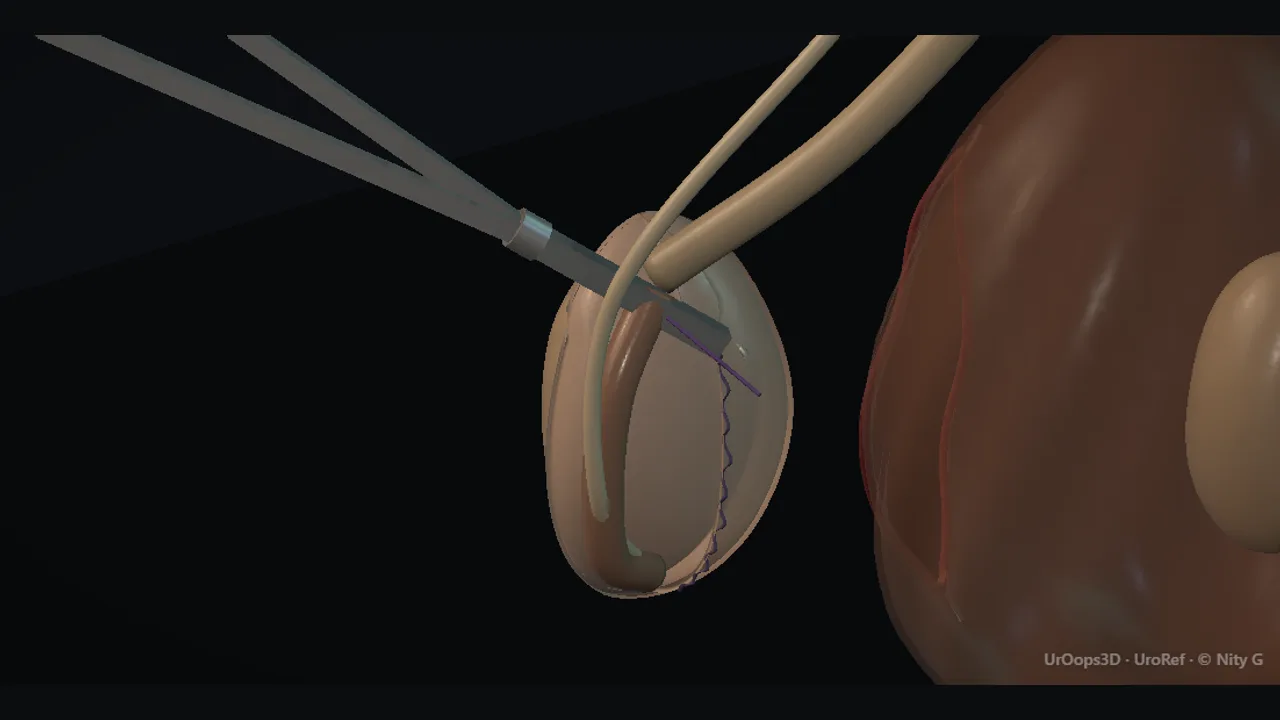 Interactive 3D Interactive operative model Open the 3D animation
Teaching catalogue only. This coverage record is not a patient pathway or operative instruction.
Typical place in practice
A symptomatic, enlarging or diagnostically concerning hydrocele after examination and imaging when needed.
Alternatives and neighbouring procedures
Observation; aspiration with or without sclerotherapy in selected adults; treatment of an underlying cause where appropriate.
Same procedure family, explicit technique branches
These are variations of this canonical operation. Complication modules below identify whether they apply to all branches or only to named approaches.
Excision and eversion
Opens and everts or excises the tunica vaginalis sac around the testis.
Lord plication
Reduces sac volume with less extensive dissection in selected thin-walled hydroceles.
Inguinal ligation of patent processus vaginalis
Treats a communicating hydrocele by closing the proximal communication.
Aspiration and sclerotherapy
Avoids open surgery but has material-specific risks and recurrence considerations.
High-level sequence
Coverage outline only; not a step-by-step technical guide.
- Confirm diagnosis and identify communicating or secondary causes
- Expose sac through scrotal or inguinal route
- Protect testis, epididymis, cord and blood supply
- Excise, evert, plicate or ligate the relevant sac
- Secure haemostasis and support the scrotal wound
Operative notes
Concise operative notes covering the key steps, landmarks and watch points, in the order you encounter them.
Hydrocele repair
What it does: fix a fluid sac round the testis.
Jaboulay, default
- Cut over the tense sac, through skin and dartos. Diathermy as you go.
- Deliver the testis in its tunica.
- Open the tunica away from the testis. Drain.
- Big thick sac: trim the excess tunica. Protect the cord.
- Evert the tunica round the testis.
- Continuous suture behind the testis and cord.
- Not tight round the cord: a little finger must pass along the cord into the everted tunica.
- Diathermy. Haemostasis. Bone dry.
- Testis back, cord untwisted. Close dartos, then skin. Scrotal support.
Lord's, the alternative for thin sacs
- Open the sac. Drain. Deliver the testis. Little dissection.
- Ring of 3/0 bites, 1 cm apart, edge to centre.
- Tie them all. The sac concertinas behind.
From the UroRef Operative Quick Guide. Open the note page →
Every failure mode is its own module.
Timing and variation coverage are recorded for each module.
Scrotal bleeding or haematoma
The dependent and compliant scrotum can conceal substantial postoperative bleeding.
Applies to: All variantsInfection or wound breakdown
Haematoma and oedema increase the risk of superficial or deeper infection.
Applies to: All variantsTesticular, epididymal or vas injury
Sac dissection can damage reproductive structures or compromise testicular blood supply.
Applies to: All variantsChronic scrotal pain or altered sensation
Nerve irritation, scarring or epididymal injury can cause persistent symptoms.
Applies to: All variantsRecurrent hydrocele or persistent swelling
Residual sac, continuing communication or lymphatic swelling can mimic or cause recurrence.
Applies to: All variantsSclerosant-related inflammation or tissue injury
Extravasation or an intense local reaction is specific to the percutaneous pathway.
Applies to: Aspiration and sclerotherapySources for this module
Common congenital, acute scrotal and paediatric reconstructive procedures.
Accessed 2026-08-03 · opens source British Association of Urological Surgeons Patient information leaflets by procedureUK patient-facing procedure, alternatives, recovery and complication framing.
Accessed 2026-08-03 · opens source