
Surgery for Peyronie disease and complex penile curvature
Straightening operations grouped by shortening, lengthening and prosthesis-based strategies, with erectile function and penile dimensions recorded separately.
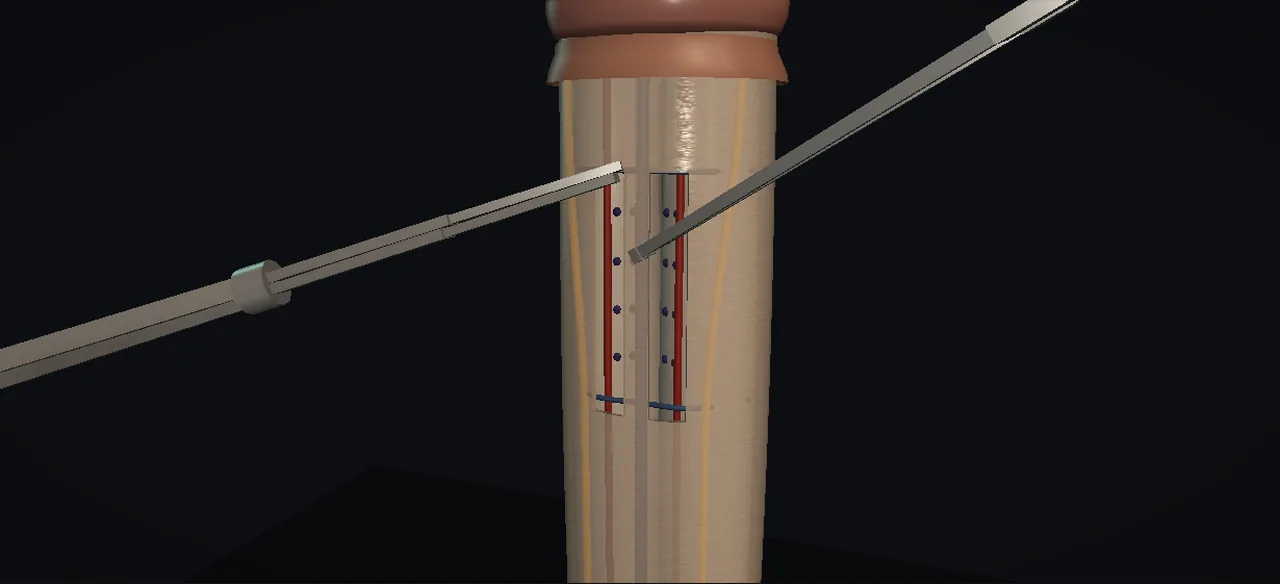 Interactive 3D Interactive operative model Open the 3D animation
Teaching catalogue only. This coverage record is not a patient pathway or operative instruction.
Typical place in practice
Stable function-limiting curvature or deformity after assessment of erectile quality, plaque anatomy, patient priorities and nonsurgical options.
Alternatives and neighbouring procedures
Observation, traction or vacuum strategies, intralesional treatment in suitable disease, erectile-dysfunction treatment, or acceptance of residual curvature.
Same procedure family, explicit technique branches
These are variations of this canonical operation. Complication modules below identify whether they apply to all branches or only to named approaches.
Tunical shortening or plication
Straightens by shortening the longer convex side.
Plaque incision or partial excision with graft
Releases a complex deformity and covers the defect with graft material.
Penile prosthesis with modelling or incision
Treats significant erectile dysfunction and curvature together.
High-level sequence
Coverage outline only; not a step-by-step technical guide.
- Document curvature, deformity, length and erectile function
- Induce and reassess erection in the operative setting
- Select and perform shortening, lengthening or prosthetic correction
- Protect urethra and neurovascular structures while testing straightness
- Close and review healing, function and residual deformity
Operative notes
Concise operative notes covering the key steps, landmarks and watch points, in the order you encounter them.
Nesbit and plaque surgery
What it does: straighten a bent penis (Peyronie's).
- Artificial erection: tourniquet + saline into a corpus. Marks the worst bend point.
- Nesbit: cut an ellipse in the tunica, OPPOSITE the bend. 1 mm width per 10 degrees.
- Close with 0 PDS, knots inside.
- Re-erect. Check straight.
- Plication variant: clamp to straighten, strong stitches, no excision. More recurrence.
- Plaque + graft: H-cut into the plaque. Vein patch sewn in, lining downwards.
- Watch: Some shortening in most. Consent for it.
From the UroRef Operative Quick Guide. Open the note page →
Every failure mode is its own module.
Timing and variation coverage are recorded for each module.
Neurovascular or urethral injury
Mobilisation and tunical incision can injure dorsal nerves, vessels or the urethra.
Applies to: All variantsBleeding, haematoma or wound infection
Penile dissection creates a confined space where bleeding and infection can compromise healing.
Applies to: All variantsRecurrent or residual curvature
Straightening can be incomplete or deformity can recur as tissues heal.
Applies to: All variantsPenile shortening, narrowing or altered sensation
Changes in dimensions and sensation vary by technique and should be distinguished from erectile function.
Applies to: All variantsNew or worsened erectile dysfunction
Tunical, neurovascular and veno-occlusive changes can impair erections, particularly after grafting.
Applies to: All variantsGraft contraction, bulge or aneurysmal change
A substitution graft can contract or stretch and change penile contour.
Applies to: Plaque incision or partial excision with graftDevice infection, erosion or failure
The prosthesis-based pathway adds the full set of implant-specific complications.
Applies to: Penile prosthesis with modelling or incisionSources for this module
Penile prosthesis, Peyronie disease, priapism and reproductive surgery.
Accessed 2026-08-03 · opens source British Association of Urological Surgeons Patient information leaflets by procedureUK patient-facing procedure, alternatives, recovery and complication framing.
Accessed 2026-08-03 · opens source