
Surgical sperm retrieval
Percutaneous, open and microsurgical retrieval of sperm from epididymis or testis, aligned with the cause of azoospermia and laboratory plan.
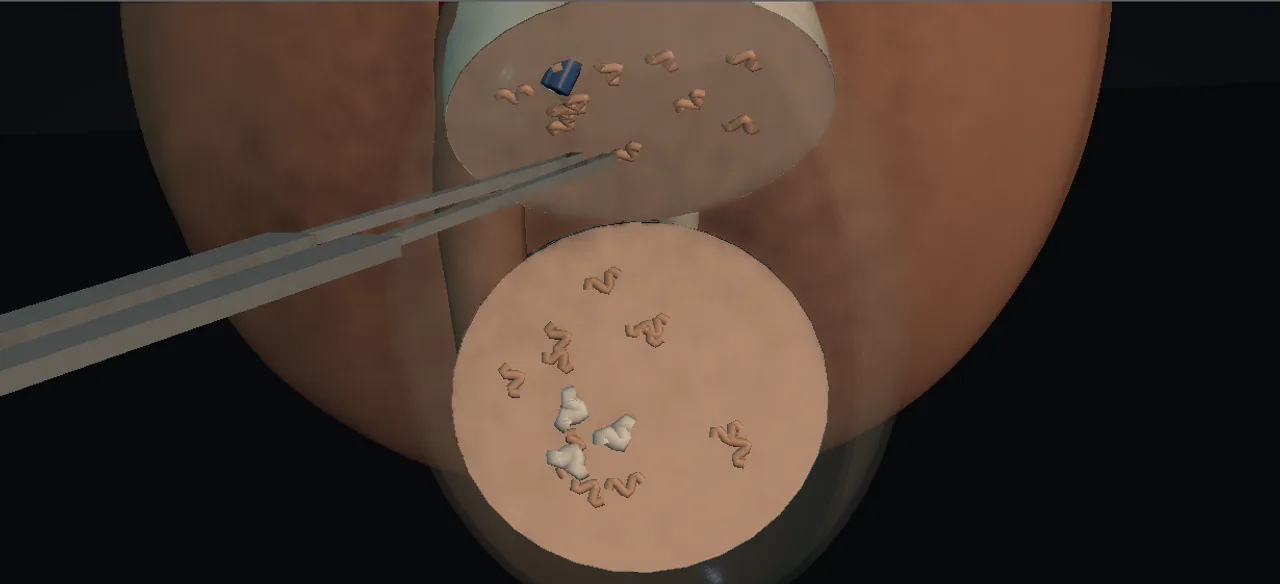 Interactive 3D Interactive microTESE, with conventional TESE and PESA compared Open the 3D animation
Teaching catalogue only. This coverage record is not a patient pathway or operative instruction.
Typical place in practice
Obstructive or non-obstructive azoospermia, ejaculatory failure or fertility preservation where retrieval is part of an assisted-reproduction pathway.
Alternatives and neighbouring procedures
Ejaculatory induction or collection, reconstructive surgery for obstruction, donor sperm, adoption or no treatment.
Same procedure family, explicit technique branches
These are variations of this canonical operation. Complication modules below identify whether they apply to all branches or only to named approaches.
PESA or TESA
Uses a needle-based retrieval with limited exposure.
MESA
Samples epididymal tubules under magnification, usually for obstructive disease.
Conventional TESE
Retrieves seminiferous tissue through a limited tunical opening.
Micro-TESE
Searches for promising seminiferous tubules in non-obstructive azoospermia while aiming to preserve testicular tissue.
High-level sequence
Coverage outline only; not a step-by-step technical guide.
- Confirm genetic, endocrine, couple and laboratory plan
- Select epididymal or testicular target and anaesthetic route
- Retrieve tissue or fluid with minimal vascular disruption
- Coordinate immediate laboratory assessment and cryopreservation plan
- Secure haemostasis and monitor pain, testicular function and retrieval outcome
Operative notes
Concise operative notes covering the key steps, landmarks and watch points, in the order you encounter them.
Fertility surgery
What it does: operations to find and fix blocked pipes, or to fetch sperm.
Varicocele (open routes; coils via radiology)
- Palomo (high, back of tummy): whole pedicle tied. Artery may go with it. Collaterals save the testis. Fewer veins. More hydroceles. ~15% back if the artery is spared.
- Ivanissevich (groin canal): cord lifted. Separate artery (papaverine, Doppler) and lymphatics from the ~3 veins. Artery NOT tied here. Cut the cremaster vein too, or it recurs.
- Marmar (below the canal, at the ring): no fascia opened. Many veins, branched artery. The confident microsurgeon's route.
Vasography (blocked vas, before repair)
- Transverse nick in the vas. Do not divide it.
- Fluid to a slide. No sperm = block is on the testis side.
- Saline flush runs free = open beyond. Or blue dye + catheter in bladder: blue urine.
- 0.5 mL X-ray contrast down the vas maps the level.
Vasovasostomy (rejoin the vas)
- Trim to healthy ends. Both bleed.
- 2-layer micro join: 3 x 10/0 stitches in the lining, turn 180, 3 more. 9/0 in the muscle. Then sheath layers.
Vaso-epididymostomy (join vas to epididymis)
- Fat-to-thin tube change marks the block.
- Open 1 tube. Sperm confirmed on a slide.
- Vas fixed to the sheath, 6/0. Lining joined 10/0.
- Sperm back in ~70%. Later narrowing common.
TURED (ejaculatory duct)
- Scan rectally first. Dye + contrast into ducts.
- Resect the veru. Spare neck and sphincter.
- Dye in the bed = in the duct.
- Sperm back ~50%. Risks: reflux, dry ejaculation.
MESA / PESA (sperm retrieval)
- MESA: open an epididymal tube. Pipette the fluid. Blocked system: best sperm sit HIGH (unusual).
- PESA: 27G butterfly into the head of the epididymis, held between fingers. Gentle pull. Press firmly 5 min after.
- 2026 update: micro-TESE is the standard for non-blocked azoospermia. Name it in vivas.
From the UroRef Operative Quick Guide. Open the note page →
Every failure mode is its own module.
Timing and variation coverage are recorded for each module.
Scrotal bleeding or intratesticular haematoma
Needle or open tissue sampling can cause local bleeding and pressure-related pain.
Applies to: All variantsInfection
Percutaneous and open access can introduce superficial, epididymal or testicular infection.
Applies to: All variantsTesticular tissue loss, atrophy or endocrine impact
Extensive sampling or vascular injury can reduce already limited testicular function.
Applies to: Conventional TESE · Micro-TESEPersistent pain or altered sensation
Scarring, inflammation or nerve injury may cause chronic symptoms.
Applies to: All variantsNo viable sperm retrieved
Retrieval can be technically complete without finding sperm suitable for planned treatment.
Applies to: All variantsLaboratory or chain-of-custody failure
Specimen identification, handling and coordination are safety-critical parts of the operative pathway.
Applies to: All variants