Operative Dictations in Urologic Surgery
Armenakas NA, Fracchia JA, Golan R. Microsurgical Testicular Sperm Extraction (MicroTESE). Chapter 40. Wiley, 2019
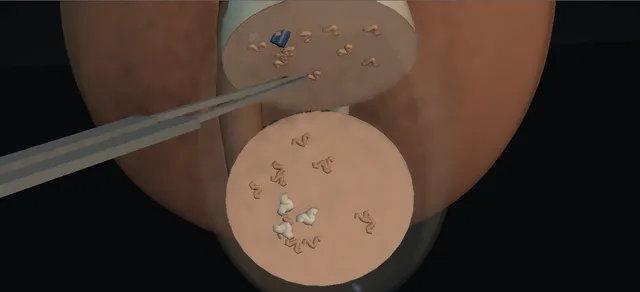
Followed for the indications, the four essential steps and the template dictation. Indications: non-obstructive azoospermia after assessment of Y chromosomal microdeletions, and failure to find sperm in the epididymis, or complete absence of the vas. The testis is delivered through an anterior scrotal incision, transverse through the anterior wall or the median raphe, after the tunica vaginalis is opened. Under the microscope a transverse incision is made in a relatively avascular area of the tunica albuginea at the midportion of the testis. Sperm-containing tubules are identified by their larger size and opaque colour, dissected and excised, and examined at once; if none is found the procedure is repeated at another location. Variations: percutaneous aspiration may be enough for some, and bilateral exploration may be needed. Haemostasis with microbipolar cautery, closure of the tunica albuginea, the testis returned within the tunica vaginalis, which is closed, and dartos and skin closure, a dressing and a support. Complications: bleeding, infection, inability to find sperm-laden tubules, epididymal or testicular injury, testicular atrophy and hypogonadism. General practice, not from the chapter: the median raphe chosen over a hemiscrotal incision, a general anaesthetic with a cord block, the right side first, the opening of the testis like a book on a posterior hinge, and every first, escalate and document step.
Open guideline
EAU
European Association of Urology. Guidelines on Sexual and Reproductive Health, chapter on male infertility, read online 19 October 2026
Hormonal evaluation including total testosterone, FSH and LH in all azoospermic men; karyotype and genetic counselling; Y chromosome microdeletion testing; no testicular sperm extraction with complete deletions of the AZFa and AZFb regions; testicular sperm found in 50 to 75 per cent of men with AZFc deletions. Non-obstructive azoospermia confirmed on two semen analyses after centrifugation, with a full assessment including a scrotal ultrasound. TESE is about two times more likely than TESA to succeed, and TESA is no longer recommended. Unadjusted retrieval rates of 35 per cent for conventional TESE and 52 per cent for microTESE in a meta-analysis of case-control studies; an overall rate of 47 per cent in another, with 46 per cent for each technique. Use microdissection TESE as the treatment of choice in non-obstructive azoospermia (weak). Preoperative variables do not reliably predict retrieval. In obstruction, MESA, PESA, TESA or TESE, and one MESA usually gives sperm for several ICSI cycles.
Open guideline
Fertility and Sterility
Bernie AM, Mata DA, Ramasamy R, Schlegel PN. Comparison of microdissection testicular sperm extraction, conventional testicular sperm extraction, and testicular sperm aspiration for nonobstructive azoospermia: a systematic review and meta-analysis. Fertil Steril 2015;104:1099-1103
Abstract read 19 October 2026. Fifteen studies, 1,890 men with non-obstructive azoospermia. In direct comparison microTESE was 1.5 times more likely than conventional TESE to retrieve sperm, and conventional TESE 2.0 times more likely than TESA. Pregnancy outcomes could not be assessed because of inconsistent reporting.
Open guideline
Human Reproduction Update
Corona G, Minhas S, Giwercman A, et al. Sperm recovery and ICSI outcomes in men with non-obstructive azoospermia: a systematic review and meta-analysis. Hum Reprod Update 2019;25:733-757
Abstract read 19 October 2026. 117 studies, 21,404 men. Overall sperm retrieval rate per procedure 47 per cent, with no difference between conventional TESE and microTESE (46 per cent each). Retrieval rose with testis volume and was independent of age and hormones. Live birth rate up to 28 per cent per ICSI cycle. A properly powered randomised trial is needed.
Open guideline