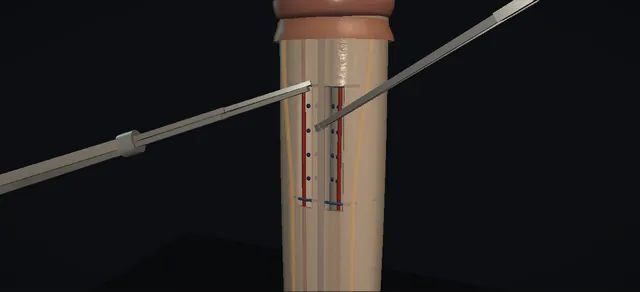
Book, chapter 29
Armenakas NA, Fracchia JA, Golan R. Operative Dictations in Urologic Surgery, first edition. Wiley, 2019. Chapter 29, Plication for Penile Curvature (Lue "16-Dot" Technique), printed pages 117 to 118
Indication (curvature of 60 degrees or less), the five essential steps, the variations (Nesbit, Yachia, penoscrotal or direct incision, more than two pairs for curvature over 30 degrees, a catheter to protect the urethra) and the template dictation: a 2-0 polypropylene glans traction suture, a circumferential incision 1 cm below the coronal sulcus, a 21-gauge butterfly for the saline erection, Buck's fascia elevated over the marking, two lateral sets of 2-0 non-absorbable polyester sutures each with two entry and two exit points taking about a 1 cm full-thickness segment of tunica, dartos and skin closed with 4-0 interrupted chromic sutures. These figures are book figures and appear nowhere else on this page.
Open guideline
EAU Guidelines
Sexual and Reproductive Health: penile curvature, sections on congenital penile curvature (8.1.3, 8.1.4) and on surgical treatment of Peyronie's disease, tunical shortening procedures (8.2.3.b, 8.2.3.b.1)
Congenital curvature: defer surgery until after puberty; Nesbit, Yachia or plication with or without bundle dissection as the operations. The 16-dot technique described as two pairs of parallel Essed-Schroeder plications; shortening as the commonest adverse outcome, palpable knots, measure length before and after. Read 8 October 2026.
Open guideline
J Urol 2002
Gholami SS, Lue TF. Correction of penile curvature using the 16-dot plication technique: a review of 132 patients. J Urol 2002;167(5):2066-2069
Abstract only, read 8 October 2026: multiple parallel plications under an induced erection, avoiding the neurovascular bundle; patients counselled about shortening and palpable knots. The full text, including the exact position of the dorsal sets relative to the dorsal arteries, has not been read.
Open guideline