Operative Dictations in Urologic Surgery
Armenakas NA, Fracchia JA, Golan R. Posterior urethral reconstruction. Chapter 64. Wiley, 2019
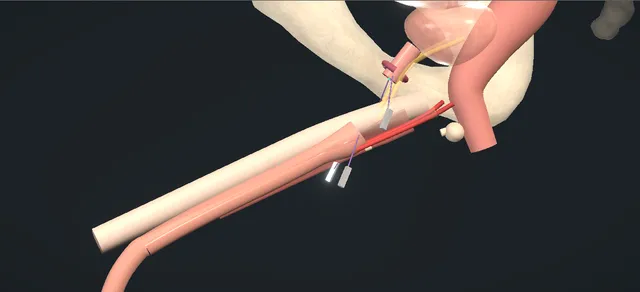
The source of the sequence drawn and of every step, danger and troubleshooting line: the ten essential steps, the template dictation, the three variations and the complication list. Book sizes kept off screen: the catheter and sound sizes, calibration to 28 or 30 Fr, 8 to 12 sutures, 5 cm of crural separation and a 2 cm pubic wedge. The chapter leaves the cystostomy to close by secondary intention and drains with a urethral catheter, so no suprapubic catheter is drawn at the end; many UK units also leave one, which is general practice and not shown. The chapter gives no catheter duration; the scene places eight sutures. Not in the chapter: the timing, the imaging, the outcome figures and the save steps for each complication, which come from the sources below or are general practice.
Open guideline
EAU Guidelines
Urethral Strictures: Disease Management in Males, section 6.3.5.b, post-traumatic posterior stenosis, read 18 October 2026
Deferred management at earliest three months after the trauma. Recommendations: progressive perineal excision and primary anastomosis for obliterative stenosis (strong); midline perineal incision (strong); no endoscopic treatment for obliterative stenosis (strong); no more than two urethrotomies or dilatations for a short nonobliterative recurrence (weak); abdominoperineal repair only for rectourethral fistula, prostatic or bladder neck injury (weak); no total pubectomy (strong); open repair in high-volume centres (weak). Overall patency 85.7%. Incontinence 6.8 to 8.5%, usually from bladder neck incompetence. Rectal injury 0 to 4.9%. Read through a summarising fetch tool.
Open guideline
EAU Guidelines
Urethral Strictures: Diagnostic Evaluation, sections 5.2.1.d, e and g, read 18 October 2026
Combine retrograde urethrography with voiding cystourethrography for pelvic fracture urethral injuries (strong). Combined retrograde urethroscopy and antegrade cystoscopy through the suprapubic tract as an adjunct (weak). Consider MRI urethrography in posterior stenosis (strong); MRI measures the length of a posterior stenosis more accurately than urethrography.
Open guideline
EAU Guidelines
Urological Trauma: Urogenital trauma, section 4.4, urethral trauma, read 18 October 2026
Erectile dysfunction occurs in about 34% of men after a pelvic fracture urethral injury, unrelated to urethroplasty. For a complete disruption: suprapubic diversion and deferred urethroplasty after at least three months (strong); no immediate urethroplasty within 48 hours (strong); no repeated endoscopic treatment after failed realignment (strong).
Open guideline
The Journal of Urology
Kizer WS, Armenakas NA, Brandes SB, Cavalcanti AG, Santucci RA, Morey AF. Simplified reconstruction of posterior urethral disruption defects: limited role of supracrural rerouting. J Urol 2007;177:1378-81
Abstract read through PubMed, 18 October 2026. Retrospective, five centres, 142 patients with more than a year of follow-up. Excision and mobilisation alone in 67%, corporal splitting in 17%, inferior pubectomy in 10%, supracrural rerouting in 3% (three of four recurred), abdominoperineal approach in 4%. Overall success 92%.
Open guideline
The Journal of Urology
Cooperberg MR, McAninch JW, Alsikafi NF, Elliott SP. Urethral reconstruction for traumatic posterior urethral disruption: outcomes of a 25-year experience. J Urol 2007;178:2006-10
Abstract read through PubMed, 18 October 2026. 134 men, single surgeon. Partial pubectomy in 22%, abdominoperineal approach in 4%; pubectomy needed in 34% with a closed bladder neck on imaging against 7% with an open one. Recurrence 14%; success 93% allowing one urethrotomy.
Open guideline
Arab Journal of Urology
Blaschko SD, Sanford MT, Schlomer BJ, et al. The incidence of erectile dysfunction after pelvic fracture urethral injury: a systematic review and meta-analysis. Arab J Urol 2015;13:68-74
Abstract read through PubMed, 18 October 2026. 24 studies. Erectile dysfunction after the injury 34%; delayed urethroplasty added 3%.
Open guideline
The Journal of Urology
Webster GD, Ramon J. Repair of pelvic fracture posterior urethral defects using an elaborated perineal approach: experience with 74 cases. J Urol 1991;145:744-8
Abstract read through PubMed, 18 October 2026. 74 patients, one-stage perineal anastomosis in all; 66 needed added manoeuvres, used in sequence as needed: distal mobilisation, corporal separation, inferior pubectomy, supracrural rerouting. Excellent results in 96%.
Open guideline
BJU International
Fu Q, Zhang J, Sa YL, Jin SB, Xu YM. A retrospective series of 573 transperineal bulboprostatic anastomoses after pelvic fracture. BJU Int 2013;112:E358-63
Abstract read through PubMed, 18 October 2026 (the title here describes the paper). Success 88%; an intraoperative rectal injury was repaired primarily in 28. Cited for primary repair of a rectal injury found at operation. Interposing tissue and the threshold for diversion are general practice, supported by the EAU recommendation of a local flap after a concomitant rectourethral fistula is corrected (weak).
Open guideline