
Posterior urethral and vesicourethral reconstruction
Tertiary reconstruction for pelvic-fracture distraction defects or refractory posterior stenosis, with continence and rectal risk foregrounded.
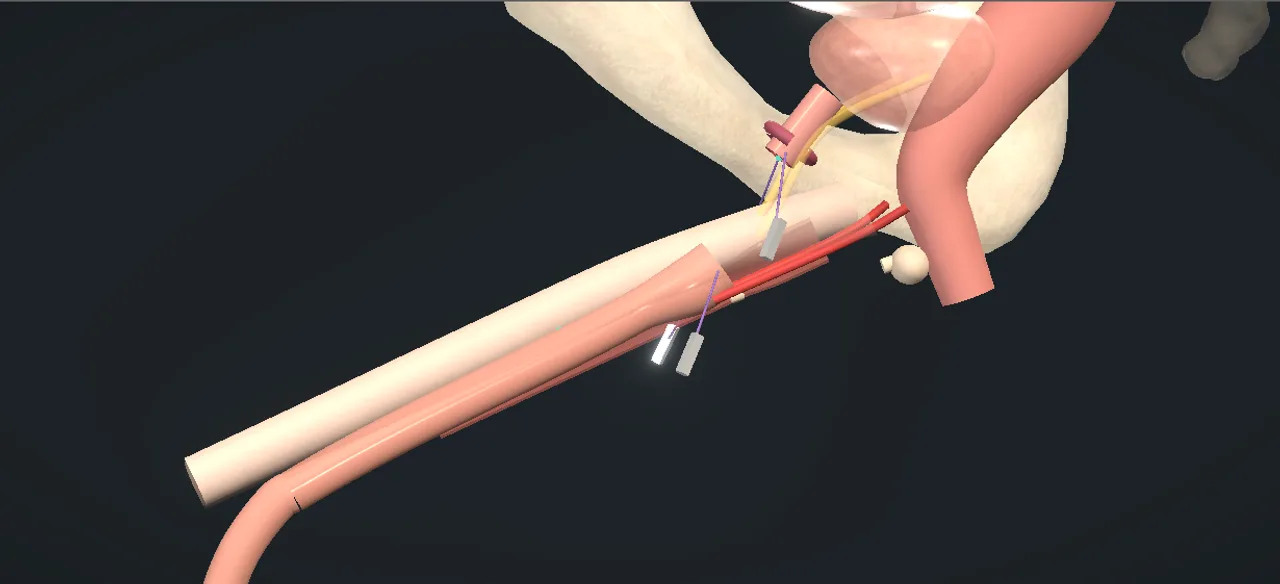 Interactive 3D Interactive posterior urethral reconstruction Open the 3D animation
Teaching catalogue only. This coverage record is not a patient pathway or operative instruction.
Typical place in practice
Established posterior distraction defect or obliterative/recurrent vesicourethral stenosis after imaging, endoscopy and continence assessment.
Alternatives and neighbouring procedures
Suprapubic diversion, selected endoscopic treatment, chronic catheterisation, or urinary diversion in a devastated outlet.
Same procedure family, explicit technique branches
These are variations of this canonical operation. Complication modules below identify whether they apply to all branches or only to named approaches.
Perineal anastomotic posterior urethroplasty
Bridges a pelvic-fracture-related posterior defect using the least extensive manoeuvres needed.
Abdominoperineal reconstruction
Adds proximal exposure for complex, long or previously failed defects.
Robotic or open vesicourethral reconstruction
Reconstructs refractory stenosis after prostate treatment, sometimes combined with later continence surgery.
High-level sequence
Coverage outline only; not a step-by-step technical guide.
- Define defect length, continence mechanism and adjacent injuries
- Establish distal and proximal urethral landmarks
- Mobilise only as required for a viable tension-free join
- Protect rectum and reconstruct the lumen
- Drain, test healing and stage continence management when needed
Every failure mode is its own module.
Timing and variation coverage are recorded for each module.
Rectal injury or fistula
Dense posterior scarring can obscure the rectal plane; an unrecognised injury can present later as pelvic sepsis or fistula.
Applies to: All variantsBleeding from pelvic or corporal structures
Deep pelvic exposure and ancillary manoeuvres can cause difficult-to-compress bleeding.
Applies to: All variantsRecurrent stenosis
A recurrent narrowing may reflect tension, ischaemia or the underlying scar process.
Applies to: All variantsNew or worsened urinary incontinence
Reconstruction may unmask or impair an already compromised continence mechanism and can require staged treatment.
Applies to: All variantsErectile or ejaculatory dysfunction
Neurovascular trauma from the original injury, prior treatment and reconstruction may all contribute.
Applies to: All variantsUreteric injury
Abdominal dissection close to the trigone or reconfigured bladder neck places the distal ureters at risk.
Applies to: Abdominoperineal reconstruction · Robotic or open vesicourethral reconstructionSources for this module
Dilatation, DVIU, anastomotic, graft, flap, staged and perineal procedures.
Accessed 2026-08-03 · opens source European Association of Urology EAU Guidelines on Urological TraumaRenal, ureteric, bladder, urethral and genital trauma and reconstruction.
Accessed 2026-08-03 · opens source