
Pelvic organ prolapse repair in urological practice
Native-tissue vaginal and abdominal apical repair pathways, linked to urinary symptoms, voiding function and urinary-tract injury surveillance.
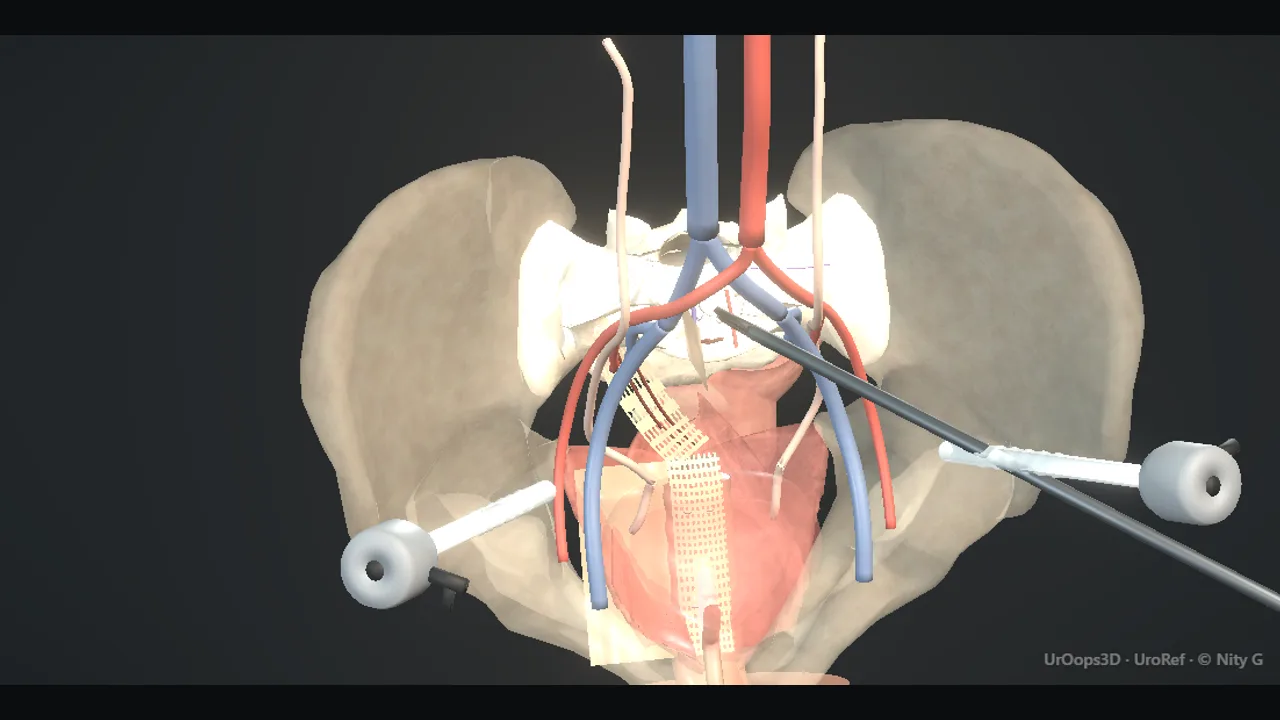 Interactive 3D Interactive operative model Open the 3D animation 3D Interactive anterior repair 3D Interactive rectocele repair (posterior colporrhaphy) 3D Interactive uterosacral vault suspension
Teaching catalogue only. This coverage record is not a patient pathway or operative instruction.
Typical place in practice
Symptomatic pelvic organ prolapse after assessment of compartments, apical support, continence, voiding and patient preferences.
Alternatives and neighbouring procedures
Observation, pelvic-floor therapy, pessary management or another compartment-specific reconstructive approach.
Same procedure family, explicit technique branches
These are variations of this canonical operation. Complication modules below identify whether they apply to all branches or only to named approaches.
Anterior native-tissue colporrhaphy
Repairs anterior vaginal-wall support without synthetic mesh.
Apical vaginal suspension
Restores apical support using vaginal access and native ligaments.
Abdominal sacrocolpopexy
Suspends the vault or cervix to the sacral promontory using a graft in an abdominal plane.
Obliterative repair
Closes the vaginal canal in selected patients who do not wish to retain vaginal intercourse.
High-level sequence
Coverage outline only; not a step-by-step technical guide.
- Map prolapse compartments and urinary function
- Select reconstructive or obliterative goals
- Mobilise the target vaginal wall or apex
- Restore support while protecting bladder, ureters, bowel and nerves
- Confirm urinary-tract integrity and reassess voiding after repair
Every failure mode is its own module.
Timing and variation coverage are recorded for each module.
Bladder, ureteric or bowel injury
Dissection and fixation near pelvic organs can cause recognised or delayed injury and obstruction.
Applies to: All variantsBleeding or pelvic haematoma
Vaginal pedicles, presacral vessels or pelvic sidewall structures may bleed.
Applies to: All variantsVoiding dysfunction or urinary retention
Changed anatomy, swelling or concurrent continence surgery can impair emptying.
Applies to: All variantsNew or worsened urinary incontinence
Reduction of prolapse can reveal occult stress leakage or alter urgency symptoms.
Applies to: All variantsRecurrent prolapse
Failure can occur in the treated or a different vaginal compartment.
Applies to: All variantsGraft exposure, infection or pain
Implanted graft can become exposed, infected or associated with pelvic pain.
Applies to: Abdominal sacrocolpopexyDyspareunia or vaginal narrowing
Scarring and altered vaginal dimensions may affect sexual function; vaginal closure intentionally precludes penetrative intercourse.
Applies to: All variantsSources for this module
UK governance and shared-decision requirements for female continence surgery.
Accessed 2026-08-03 · opens source European Association of Urology EAU Guidelines on Non-neurogenic Female LUTSFemale continence, bulking, sling, colposuspension and related procedures.
Accessed 2026-08-03 · opens source