
Sacral neuromodulation testing, implantation and revision
Staged testing and implantation of a sacral neuromodulation system, including device revision and explantation pathways.
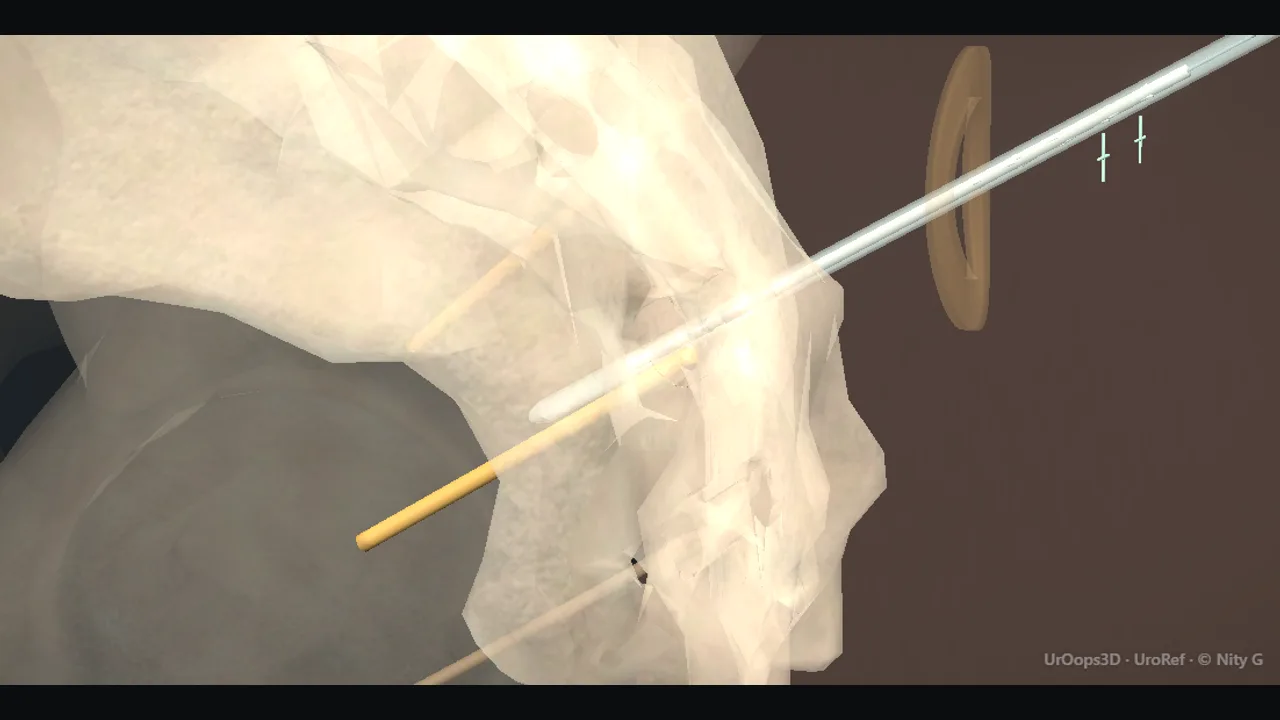 Interactive 3D Interactive operative model Open the 3D animation
Teaching catalogue only. This coverage record is not a patient pathway or operative instruction.
Typical place in practice
Selected refractory urgency symptoms, non-obstructive retention or other approved pelvic-floor indications after specialist assessment.
Alternatives and neighbouring procedures
Conservative and pharmacological management, botulinum toxin injection, catheter strategies or other condition-specific surgery.
Same procedure family, explicit technique branches
These are variations of this canonical operation. Complication modules below identify whether they apply to all branches or only to named approaches.
Percutaneous nerve evaluation
Uses a short trial to assess symptom response before permanent implantation.
Staged tined-lead trial
Tests a secured lead before connecting an implanted pulse generator.
Permanent generator implantation
Creates the complete implant after a satisfactory trial.
Lead or generator revision/explant
Addresses loss of efficacy, pain, infection, depletion or device incompatibility.
High-level sequence
Coverage outline only; not a step-by-step technical guide.
- Confirm indication and baseline symptom measures
- Localise the selected sacral foramen and test responses
- Place and secure the lead
- Evaluate trial response before generator implantation
- Programme, educate and monitor device performance
Operative notes
Concise operative notes covering the key steps, landmarks and watch points, in the order you encounter them.
Functional bladder surgery
What it does: rebuild or control a difficult bladder.
Augmentation (ileocystoplasty)
- 20-25 cm ileum, opened along its far border.
- Bladder split front to back. The halves must not pull together again.
- Patch sewn in, 2 running 3/0 threads.
- Supra + urethral catheters + drain.
- Washouts 3x a day, against mucus.
- Supra out day 13. Urethral day 14. Cystogram if any doubt.
Detrusor myectomy
- Blue dye in the bladder.
- Inverted-U muscle cut over the dome.
- Muscle peeled OFF the lining underneath.
- Hole in the lining ~50%. Close 6/0. Drain.
- Never over-fill after.
Artificial sphincter (AUS)
- Obsession with clean technique. Minimal traffic. Double gloves. Wash the field.
- Bulbar cuff after prostate surgery. Bladder neck cuff: women, children, catheterisers.
- ContiClassic balloon 60-69 (bulbar) or 70-79 (neck) cmH2O. Redo for wear: higher balloon, or cuff 0.5 cm smaller. Irradiated: lower balloon.
- Pump in a dependent scrotal pouch in front of the LEFT testis. Button forward.
- Off for 6 weeks. Activate in clinic. Teach cycling.
- 2026 update: Device by approach: Rigicon ContiClassic for the perineal incision, AMS 800 for the penoscrotal. Erosion 3-10%. Infection 1-5%.
- 2026 update: Penoscrotal approach: before the incision, pull the shaft straight up off the scrotum. Hold it on the pubic region with a stay stitch through the glans.
- 2026 update: Sacral neuromodulation: 2 stages. Test wire. Over 50% better on a diary = permanent wire.
- 2026 update: Botox 100 U in 10 mL: 20 x 0.5 mL, into the bladder wall, spare the trigone. Effect 6-9 months. Teach self-catheterisation first.
From the UroRef Operative Quick Guide. Open the note page →
Every failure mode is its own module.
Timing and variation coverage are recorded for each module.
Bleeding or unintended neural injury
Needle or lead placement can injure local vessels, stimulate unintended roots or travel beyond the intended plane.
Applies to: All variantsWound or device infection
Infection can involve the lead tract or generator pocket and may jeopardise the implant.
Applies to: All variantsPain or unwanted stimulation
Lead position or programming can cause buttock, leg, pelvic or sensory symptoms.
Applies to: All variantsLead migration, fracture or connection failure
Mechanical change can cause loss or alteration of therapeutic response.
Applies to: All variantsFailure of trial or loss of efficacy
A test may not reach the predefined benefit, and an established response can later diminish.
Applies to: All variantsGenerator-pocket problem
Pocket pain, skin compromise or generator movement can require reassessment or revision.
Applies to: Permanent generator implantation · Lead or generator revision/explantSources for this module
Female continence, bulking, sling, colposuspension and related procedures.
Accessed 2026-08-03 · opens source European Association of Urology EAU Guidelines on Neuro-urologyBotulinum toxin, sphincterotomy, neuromodulation, augmentation and diversion.
Accessed 2026-08-03 · opens source British Association of Urological Surgeons Patient information leaflets by procedureUK patient-facing procedure, alternatives, recovery and complication framing.
Accessed 2026-08-03 · opens source