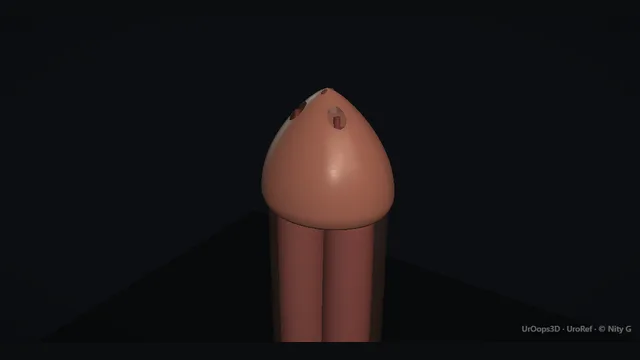
A compartment syndrome of the corpora taught by what is and is not engorged: rigid, tender, dark corpora cavernosa with a soft glans and spongiosum, because the glans drains separately.
The ladder runs from corporal aspiration and irrigation through sympathomimetic instillation under cardiac monitoring to distal corporoglanular shunts, and the honesty of the outlook is set by how many hours have passed.
Core tierFRCS andrology, emergency, sexual medicineInteractive 3D
Along the penis, glans to penoscrotal junction. Schematic, not to scale; relationships only.
The corpora cavernosa are two parallel cylinders of smooth muscle wrapped in tunica albuginea, filling under arterial inflow and emptying when the venous outflow reopens.
In ischaemic priapism that outflow is trapped, the cylinders become a closed, acidotic compartment, and the glans and spongiosum, which drain separately, stay soft beside them.
The therapeutic ladder follows the anatomy: a needle anywhere into the corporal body taps the same trapped compartment, and a fistula at the corporoglanular junction, from glans into corporal tip, gives the blood the exit the physiology refuses.
Proximal shunts move that exit to the penoscrotal junction, where corporal body meets spongiosum.
›Corpora cavernosa - the compartment: rigid, tender and dark with trapped deoxygenated blood; everything on the ladder is aimed at emptying them.
›Glans penis - soft and uninvolved in ischaemic priapism; its separate drainage is the examination finding that separates the phases.
›Corpus spongiosum + urethra - spared in the ischaemic phase but at risk from proximal shunts and repeated instrumentation.
›Corporoglanular junction - the distal meeting of corporal tip and glans; the working site of the Winter and T shunts.
›Penoscrotal junction - the proximal working site for corpus-spongiosal shunts when the distal ladder has failed.
Ischaemic vs arterial: the phasesThe history separates the phases before any needle is used: painful, fully rigid corpora with a soft glans is ischaemic priapism, while painless partial tumescence after a perineal or penile trauma is arterial. The soft glans is the bedside discriminator, because the glans and spongiosum drain separately from the corpora and stay uninvolved in the ischaemic compartment. When the story is atypical the aspirate settles it: dark deoxygenated blood is ischaemic, bright red well-oxygenated blood is arterial, and the sample goes for gas analysis where doubt remains. The distinction is made first and made correctly, because the treatments are opposites and the ischaemic compartment is dying while it is debated. where it bites: the soft glans is the bedside discriminator; ultrasound is for the atypical case, not the classic one.
Corporal aspiration + irrigationAfter analgesia and preparation, a needle or butterfly is introduced into the lateral aspect of the corporal body, away from the dorsal bundle at 12 o'clock and away from the urethra ventrally. Dark blood is aspirated steadily until it brightens and the corpora begin to soften, working through the communicating septum so both sides are emptied. Saline irrigation follows, flushing out the thick residual blood that aspiration alone leaves behind. When the diagnosis is in doubt the first aspirate is sent for gas analysis, and its appearance is documented either way, because the colour of that first blood is a finding worth recording. where it bites: aspiration is a therapeutic procedure and a diagnostic one; the appearance of the blood is a finding worth documenting.
Sympathomimetic instillationPhenylephrine is injected into the corporal body through the established access in small measured doses, repeated at short intervals while aspiration and irrigation continue as needed, until detumescence is achieved stepwise; the drug is not left to dwell and aspirated back. The endpoint is judged in the examining hand: a softening, shrinking corporal body returning a springy feel rather than a board-hard cylinder. Cardiac monitoring and blood pressure observation run throughout, because phenylephrine instilled into richly vascular tissue reaches the circulation. The drug is stopped at the first rise in pressure or change in rhythm and aspirated back out, and the physiology is treated before the urology resumes. where it bites: phenylephrine is systemic: cardiac monitoring and blood pressure observation are part of the procedure, not an optional extra.
Distal shunt: corporoglanularThe Winter shunt passes a tru-cut needle from the glans into each corporal tip in turn, punching cores that leave a fistula through which the trapped blood can drain. The T-shunt uses the same geometry but opens the tract with a blade passed from the glans into each corporal tip, giving a lumen that stays open. Old dark blood is milked from the tracts until fresh red blood appears, which is the on-table sign that the compartment finally has an exit. The failure mode is a fistula too small to last: a tract that seals lets the penis re-engorge, and rigidity returning on the ward is the finding. where it bites: the tract must stay patent; too small a fistula seals and the penis re-engorges.
When distal fails: proximal shuntsRigidity that persists despite adequate distal shunting brings the proximal shunts into the conversation: an anastomosis is created between the corporal body and the spongiosum at the penoscrotal junction, moving the drainage exit from the tip of the compartment to its base. The approach is through a scrotal or perineal incision, and the anatomy is less forgiving than the distal operation. The urethra travels inside the spongiosum, so the structure now being opened is the one the disease never touched. Proximal shunts belong to the experienced surgeon, and the referral conversation happens before the operation is begun, not after it has failed. where it bites: proximal shunts carry urethral and spongiosal risk and belong to the experienced surgeon; the referral conversation happens before the operation, not after.
Aftercare + honest counsellingDetumescence is the beginning of follow-up, not the end of the problem: the corpora have endured a compartment insult, and the longer the episode lasted, the greater the risk of smooth muscle necrosis, fibrosis and permanent erectile dysfunction. Follow-up is arranged as a defined review of erectile function rather than an open door, because the outcome declares itself over the months that follow. Counselling about the erectile outcome happens before discharge and is documented in plain terms of duration driving risk. The patient who was warned at discharge is the patient who returns early when function falters, and that is what the documentation buys. where it bites: counselling about erectile outcome is documented at discharge, because the patient who was not warned is the one who returns angry.
The spatial relationships the animation is built to make automatic. Before you read each one, ask yourself: at this point in the operation, what is about to go wrong, and what is my first move? The save for each sits in the Complications tab.
RiskThe trapped compartment - time is tissue: hours of ischaemia kill corporal smooth muscle and replace it with fibrosis, whatever the later salvage.
RiskThe systemic drug route - phenylephrine instilled into richly vascular corpora reaches the circulation; the monitor is as important as the syringe.
RiskThe spongiosum at proximal shunting - the urethra travels inside it; proximal shunt surgery risks the structure that was never involved in the disease.
Trigger each of these live in the Animation tab, then read the save: the first move, the escalation trigger, and the line that goes in the op note.
Shunt failure
the Winter tracts seal or were too small, and the penis re-engorges after a brief detumescence; rigidity returning is the finding.
The save
Recognise it: the penis re-hardens after apparent detumescence, with returning pain.first move
Re-aspirate the corpora and repeat the sympathomimetic while preparing the next rung.
Convert to a T-shunt on the same side, opening the corporoglanular tract with a blade for a lumen that stays.
Persistent rigidity despite distal shunts → proximal shunt surgery or transfer to a centre that performs it.escalation trigger
Note: shunt sites created, response to each rung of the ladder, and the time from presentation to detumescence.document
Phenylephrine: cardiovascular effects
the instilled sympathomimetic reaches the circulation: hypertension, reflex bradycardia, arrhythmia and cardiac events in the vulnerable.
The save
Prevent it: cardiac monitoring and blood pressure observation for every instillation, and dose discipline in the frail.first move
Stop further doses at the first rise in pressure or change in rhythm; continue aspiration and treat the physiology before any further dose.
Sit the patient up, observe continuously, and treat the physiology before continuing the urology.
Cardiovascular history, recent cardiac events or uncontrolled hypertension → the drug conversation changes before the first dose.escalation trigger
Note: drug, instillation and aspiration times, monitoring used, and any cardiovascular observations that deviated.document
Permanent fibrosis after prolonged episode
corporal smooth muscle dies under hours of ischaemia and is replaced by fibrosis: a stiff penis that no longer fills, the complication the whole ladder exists to prevent.
The save
Name the risk at the first assessment: the erectile outcome depends on duration, and honesty is part of the treatment.first move
Achieve detumescence by the shortest workable route; every hour of delay adds to the fibrotic burden.
Arrange structured follow-up of erectile function with a defined interval, not an open door.
Phosphodiesterase inhibition is used cautiously after significant fibrosis; rehabilitation is specialist-supervised.
Established erectile dysfunction after fibrosis → penile prosthesis discussion, delayed until the fibrosis has matured.escalation trigger
Note: duration of the episode, intervention times, and the counselling given about erectile recovery.document
When the case turns: the problem, then the next move.
ActionAspiration returns nothing from one needle - the needle tip is against septum or tunica; reposition through the same skin puncture or move to the other corporal body.
ActionDiagnosis genuinely uncertain - send the aspirate for gas analysis and arrange colour Doppler ultrasound; ischaemic blood is dark and acidotic, arterial blood is bright and well oxygenated.
ActionRecurrent stuttering priapism - treat the acute episode on the ladder, then plan suppression; identify the underlying cause, sickle cell disease in particular, with the haematologists.
ActionShunt tract bleeds or the glans oozes - a brief pressure dressing; the tract still needs patency, so do not over-compress for long periods.
The examiner stems this scene prepares you for. Try to answer out loud first, then reveal, and learn the discriminator, the detail that turns a pass into a strong pass.
QDefine the phases of priapism and tell me how you distinguish them at the bedside.reveal answer
Priapism is an erection persisting beyond the intended duration, and it comes in two pathophysiological phases.
Ischaemic priapism is a veno-occlusive compartment problem: the venous outflow from the corpora is trapped, the trapped blood becomes deoxygenated and acidotic, and the corpora are fully rigid, tender and progressively painful.
Arterial priapism is a flow problem, usually after perineal or penile trauma: an arteriocavernosal fistula floods the corpora with well-oxygenated blood, so the penis is partly tumescent, painless and compressible.
The bedside tells them apart in three questions.
Pain: ischaemic hurts, arterial does not.
Rigidity: ischaemic is board-hard, arterial is partial.
The glans: in ischaemic priapism the glans and spongiosum, draining separately, stay soft, which is one of the most reliable signs available.
Confirmation when the story is atypical is a needle: dark deoxygenated blood is ischaemic, bright red is arterial, and the aspirate can be sent for gas analysis.
Doppler ultrasound settles the remainder by showing high flow in the arterial form and absent flow in the ischaemic form.
The distinction matters immediately because the treatments are opposites: the ischaemic penis needs emptying, the arterial fistula needs embolisation, and confusing them harms both.
Strong pass
Say both
Using the soft glans and the aspirate appearance as the two decisive signs
Stating that the two phases need opposite treatments
Examiner note
Using the soft glans and the aspirate appearance as the two decisive signs, and stating that the two phases need opposite treatments.
QTalk me through your corporal aspiration technique.reveal answer
Aspiration is both the treatment and the diagnostic test, so I do it properly.
Consent and monitoring first: the patient is warned about bruising, recurrence and the sympathomimetic that may follow, and the monitoring is attached if phenylephrine is planned.
A dorsal penile block or ring block gives analgesia, the skin is prepared, and a needle is introduced into the lateral corporal body away from the dorsal bundle and the urethra, usually with a butterfly so aspiration and irrigation run without chasing the hub.
The first blood withdrawn is looked at: dark, deoxygenated blood confirms ischaemic priapism, and in a genuinely atypical case it goes to the laboratory for gas analysis.
Aspiration continues until the aspirate brightens and the corpora soften, alternating sides because the corpora communicate.
Irrigation with saline helps evacuate the last of the viscous blood.
If detumescence is incomplete or recurs, phenylephrine is instilled through the same access, dwelled, aspirated back and repeated, with blood pressure and rhythm watched throughout because the drug is systemic.
The end point is a soft penis and a stable patient, documented with times, because duration drives prognosis.
Failure of this ladder is the trigger for shunt surgery, not for repetition until everyone is tired.
Strong pass
Say all three
Describing the butterfly
Alternating sides through the communicating corpora
Watching the aspirate change colour as the end point
Examiner note
Describing the butterfly, alternating sides through the communicating corpora, and watching the aspirate change colour as the end point.
QWhen does interventional radiology enter the management of priapism?reveal answer
Interventional radiology is the definitive treatment of arterial priapism and has no routine role in the ischaemic phase.
In arterial priapism, after trauma, the lesion is an arteriocavernosal fistula, and selective arterial embolisation, guided by angiography or computed tomographic angiography to map the injured branch, closes the fistula while preserving erectile arterial supply.
It is not an emergency in the way ischaemic priapism is, because the corporal tissue is perfused with oxygenated blood and is not dying;
embolisation is planned, with the fistula given a chance to close spontaneously in selected cases first.
In ischaemic priapism the problem is drainage, not inflow, so the urological ladder, aspiration, sympathomimetic, shunts, is the pathway, and radiology contributes only selectively: occasional imaging when the phase is unclear, and support if a shunt or a surgical manoeuvre bleeds unexpectedly.
One further honest mention: recurrence and stuttering priapism are managed with the underlying cause, sickle disease in particular, in partnership with haematology, and that is medical, not radiological.
The summary the examiner wants is that radiology treats the high-flow phase and the surgeon treats the low-flow phase.
Strong pass
Say both
Stating that arterial priapism is not a compartment emergency and that embolisation is selective and planned
In contrast with the urgent surgical ladder
Examiner note
Stating that arterial priapism is not a compartment emergency and that embolisation is selective and planned, in contrast with the urgent surgical ladder.
QA man is detumescent after twelve hours of ischaemic priapism. What do you tell him about the future?reveal answer
I tell him the truth in structure: what has happened, what may follow, and what will be done about it.
The erection has been emptied, but the corpora have endured a significant ischaemic insult, and the risk to future erections rises with the duration of the episode, so twelve hours sits in the range where a substantial proportion of men have permanent impairment.
I explain fibrosis in plain terms: the smooth muscle that fills the penis dies under prolonged ischaemia and is replaced by scar, and a scarred corporal body does not fill, which can present as reduced rigidity, shortening or deformity.
I make follow-up concrete: a defined interval review of erectile function rather than an open invitation, because the natural history declares itself over months.
If function recovers, nothing further is needed;
if it does not, the pathway is stepwise, first medical rehabilitation where viable smooth muscle remains, and ultimately a penile prosthesis for established fibrosis, an operation that is more demanding in a fibrosed penis and is therefore delayed until the scarring matures.
I also address recurrence, since stuttering episodes herald longer ones, and I arrange cause investigation with haematology where sickle disease is plausible.
The documented counselling matters: the man warned at discharge is a partner in follow-up.
Strong pass
Say both
Quantifying nothing but being explicit that duration drives risk
Converting the warning into a structured follow-up plan rather than reassurance
Examiner note
Quantifying nothing but being explicit that duration drives risk, and converting the warning into a structured follow-up plan rather than reassurance.
Say it aloud, then reveal. Reading is not remembering.
01The relationshipSay the critical spatial relationship out loud, then reveal.reveal
Memory frame
The corpora cavernosa are two parallel cylinders of smooth muscle wrapped in tunica albuginea, filling under arterial inflow and emptying when the venous outflow reopens.
Why?
In ischaemic priapism that outflow is trapped, the cylinders become a closed, acidotic compartment, and the glans and spongiosum, which drain separately, stay soft beside them. The therapeutic ladder follows the anatomy: a needle anywhere into the corporal body taps the same trapped compartment, and a fistula at the corporoglanular junction, from glans into corporal tip, gives the blood the exit the physiology refuses. Proximal shunts move that exit to the penoscrotal junction, where corporal body meets spongiosum.
02The first moveShunt failure. Your first move?reveal
First move
Recognise it: the penis re-hardens after apparent detumescence, with returning pain.
03The escalation triggerShunt failure. What makes you call for help?reveal
Escalate when
Persistent rigidity despite distal shunts → proximal shunt surgery or transfer to a centre that performs it.
04The discriminatorWhat turns a pass into a strong pass?reveal
Strong pass
Say both
Using the soft glans and the aspirate appearance as the two decisive signs
Stating that the two phases need opposite treatments
Examiner note
Using the soft glans and the aspirate appearance as the two decisive signs, and stating that the two phases need opposite treatments.
05The pitfallWhere does this operation bite first?reveal
Pitfall
The trapped compartment
Why?
time is tissue: hours of ischaemia kill corporal smooth muscle and replace it with fibrosis, whatever the later salvage.
Revision practice with self-marked answers, not an assessment of clinical competence. Kept in
this browser only; it does not sync between devices.