
Procedures for ischaemic priapism
A stepped emergency procedural hub from corporal aspiration and irrigation through distal/proximal shunts and selected early prosthesis pathways.
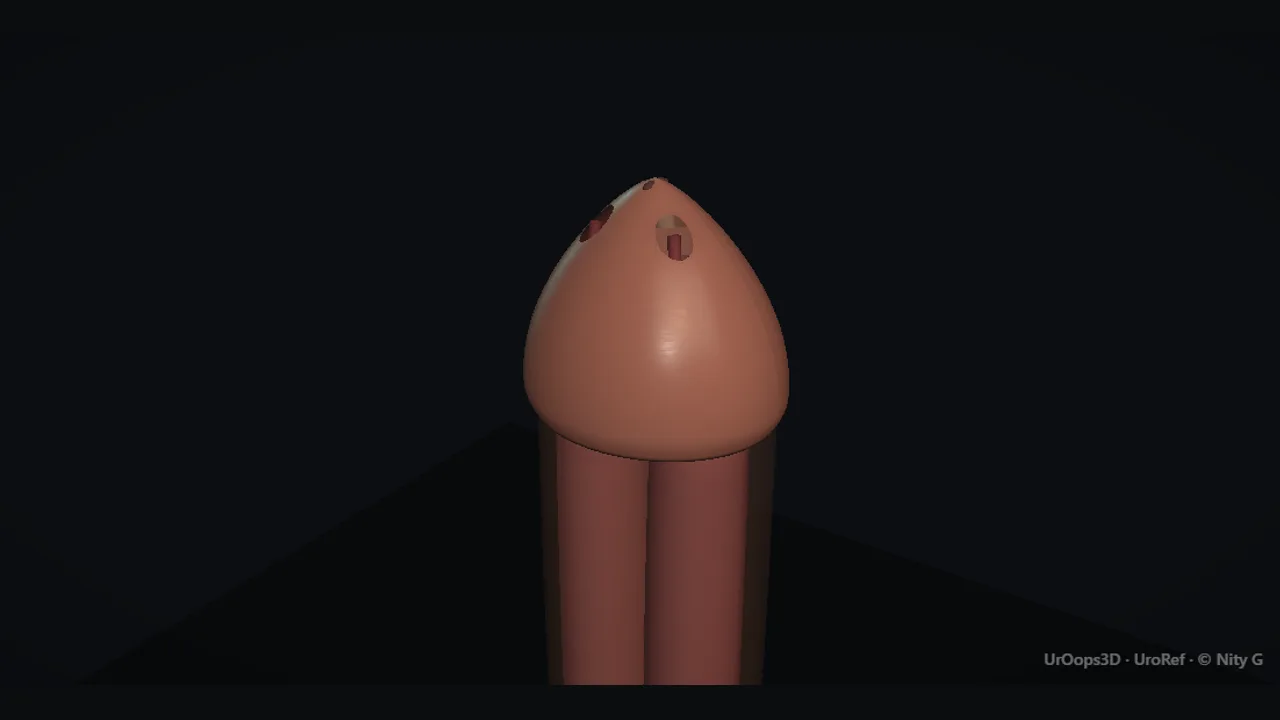 Interactive 3D Interactive operative model Open the 3D animation 3D Interactive Al-Ghorab open distal shunt
Teaching catalogue only. This coverage record is not a patient pathway or operative instruction.
Typical place in practice
Confirmed ischaemic priapism requiring urgent corporal decompression, with escalation guided by response, duration, tissue state and specialist assessment.
Alternatives and neighbouring procedures
Condition-specific conservative measures apply mainly before established ischaemia; non-ischaemic priapism follows a different diagnostic and treatment pathway.
Same procedure family, explicit technique branches
These are variations of this canonical operation. Complication modules below identify whether they apply to all branches or only to named approaches.
Corporal aspiration and irrigation
Evacuates hypoxic corporal blood and assesses return of perfusion.
Distal shunt
Creates distal egress when aspiration-based treatment is unsuccessful.
Proximal shunt
A specialist escalation option after failed distal approaches.
Early penile prosthesis pathway
Addresses irreversible erectile-tissue damage in carefully selected cases.
High-level sequence
Coverage outline only; not a step-by-step technical guide.
- Confirm ischaemic physiology and address underlying cause in parallel
- Decompress corporal blood through controlled access
- Reassess detumescence and perfusion
- Escalate to the least invasive effective shunt when needed
- Plan erectile-function, fibrosis and recurrence follow-up
Operative notes
Concise operative notes covering the key steps, landmarks and watch points, in the order you encounter them.
Priapism shunts
What it does: operations to drain a stuck erection.
2026 FIRST
- Shunts are LAST resort.
- Over 4 h: aspirate the penis AND inject phenylephrine 100-500 mcg into the corpus. Repeat. Monitor BP. Try this before any surgery.
Quackels, penis-to-sponge
- Catheter in first. Protects the urethra.
- Cut at the peno-scrotal bend.
- Sew corpus walls together, 5/0.
- Cut both lengthways. Sew the edges together.
- Both sides if still erect.
Grayhack, saphenous vein
- Vein freed via groin crease cut.
- Tunnelled under skin to a corporal window.
- Sewn 5/0.
Barry, dorsal vein
- Deglove. Dorsal vein tied far, then joined to one corpus, 7/0.
- NO tight dressings after.
Stuttering type
- Oral phenylephrine. Self-injection 500 mcg.
- Or hormone switch, where ED is acceptable.
From the UroRef Operative Quick Guide. Open the note page →
Every failure mode is its own module.
Timing and variation coverage are recorded for each module.
Bleeding, haematoma or urethral injury
Needle and shunt trajectories can injure vessels or enter the urethra.
Applies to: All variantsInfection
Repeated corporal access, open shunting and implants increase infectious risk.
Applies to: All variantsGlans or penile skin ischaemia
Distal dissection or compromised circulation can threaten glans and skin viability.
Applies to: Distal shunt · Early penile prosthesis pathwayPersistent or recurrent priapism
Inadequate drainage or continuing pathophysiology may require reassessment and further intervention.
Applies to: All variantsErectile dysfunction and corporal fibrosis
The ischaemic episode itself and the invasiveness of treatment both influence later erectile function.
Applies to: All variantsShunt-related penile deformity or sensory change
Tunical and glanular incisions can heal with scarring, altered sensation or deformity.
Applies to: Distal shunt · Proximal shuntProsthesis infection, erosion or mechanical failure
Acute implantation adds device-specific risks in already injured tissue.
Applies to: Early penile prosthesis pathwaySources for this module
Penile prosthesis, Peyronie disease, priapism and reproductive surgery.
Accessed 2026-08-03 · opens source British Association of Urological Surgeons Patient information leaflets by procedureUK patient-facing procedure, alternatives, recovery and complication framing.
Accessed 2026-08-03 · opens source