Operative Dictations in Urologic Surgery
Armenakas NA, Fracchia JA, Golan R. Autologous pubovaginal sling. Chapter 92. Wiley, 2019
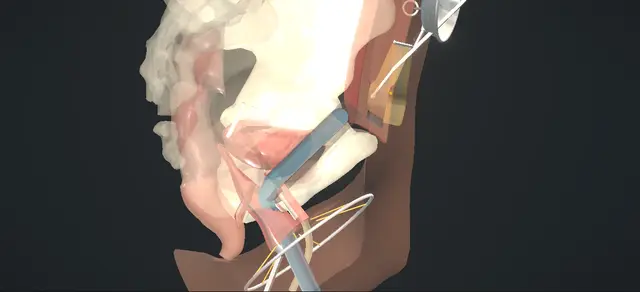
The indications, the nine essential steps and their order, the template dictation followed step by step here, the variations (other sling materials, fascia lata harvest, a midline vertical vaginal incision, intravenous dye before cystoscopy, a suprapubic catheter, a vaginal pack) and the complication list: bleeding, infection, bladder perforation, ureteric injury, urinary retention, urgency, recurrent incontinence, dyspareunia, fistula and erosion. The chapter describes a “longitudinal” incision just above the symphysis and also calls it a modified Pfannenstiel, and takes the strip from the inferior fascial leaf. A fascial leaf below the incision exists only if the incision is transverse, so it is drawn as a low transverse incision with the strip cut along it. The scene is schematic: the abdominal wall is a patch over the pelvis and the sling is drawn on a model, not to the chapter's sizes. The chapter lists complications without their management; the first, escalate and document steps are general surgical practice.
Open guideline
EAU Guidelines
Non-neurogenic Female LUTS, 2026: Disease management, sections 4.2.4.c.2.b, 4.2.4.c.3.a and 4.2.4.c.3.d, read 14 October 2026
Offer autologous sling placement to women seeking surgery for stress incontinence after a thorough discussion of risks and benefits against other operations (strong). Summary of evidence: high cure rates; more effective than colposuspension; adverse events similar to colposuspension with more voiding dysfunction and urinary infection and fewer bladder or urethral perforations. The network meta-analysis estimate favoured autologous slings over open colposuspension, very low-quality evidence, not statistically significant. Voiding difficulty 15.4% against 10.2% for retropubic mid-urethral slings. For complicated stress incontinence: secondary synthetic sling, bulking, Burch colposuspension, autologous sling or artificial sphincter as options (weak); second-line outcomes generally inferior (weak); experienced centres (strong).
Open guideline
NICE
Urinary incontinence and pelvic organ prolapse in women: management. NICE guideline NG123, recommendation 1.5.2, read 14 October 2026
If non-surgical management has failed and the woman wishes to consider surgery, offer the choice of colposuspension (open or laparoscopic) or an autologous rectus fascial sling, also including the option of a retropubic mid-urethral mesh sling, subject to that guideline's mesh recommendations.
Open guideline