
Non-mesh surgery for female stress urinary incontinence
A comparison hub for colposuspension and autologous fascial sling procedures, preserving their different abdominal, harvest-site and voiding risks.
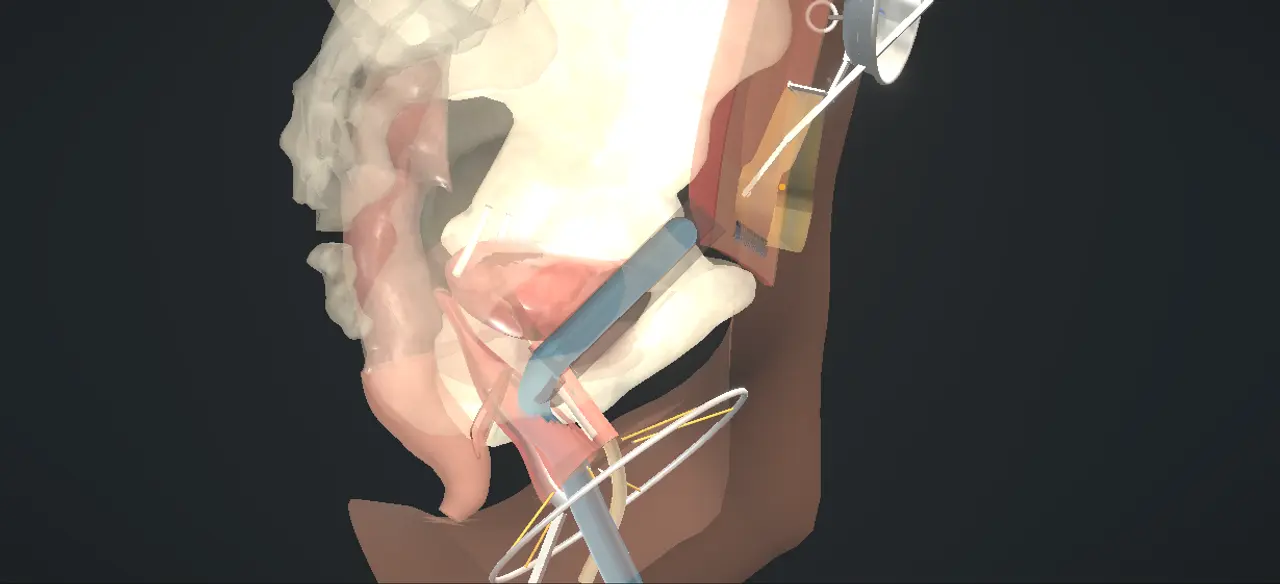 Interactive 3D Interactive operative model Open the 3D animation
Teaching catalogue only. This coverage record is not a patient pathway or operative instruction.
Typical place in practice
Stress urinary incontinence when a non-mesh operation is preferred and the patient is suitable for the selected reconstructive approach.
Alternatives and neighbouring procedures
Conservative care, pessary, urethral bulking, mid-urethral sling where appropriate, or continued observation.
Same procedure family, explicit technique branches
These are variations of this canonical operation. Complication modules below identify whether they apply to all branches or only to named approaches.
Open Burch colposuspension
Suspends peri-urethral vaginal tissue to retropubic support structures.
Laparoscopic or robotic colposuspension
Recreates the suspension through an abdominal minimally invasive approach.
Autologous fascial sling
Uses the patient’s own fascia to support the urethra or bladder neck.
High-level sequence
Coverage outline only; not a step-by-step technical guide.
- Confirm stress mechanism and assess prolapse and voiding
- Expose the retropubic space or harvest fascia
- Protect bladder, urethra and ureters
- Place suspension sutures or the fascial sling without excessive obstruction
- Close and monitor voiding, wound recovery and continence
Every failure mode is its own module.
Timing and variation coverage are recorded for each module.
Bladder or ureteric injury
Retropubic dissection or suture placement can injure the urinary tract or distort a ureteric orifice.
Applies to: All variantsBleeding or haematoma
Retropubic vascular injury or fascial harvest can cause concealed bleeding.
Applies to: All variantsVoiding dysfunction or retention
Excess support or impaired detrusor function can prevent complete emptying.
Applies to: All variantsPersistent or recurrent incontinence
Failure can reflect support, tissue, bladder or diagnostic factors.
Applies to: All variantsPelvic organ prolapse or de novo urgency
Change in vaginal axis and outlet function may be followed by prolapse or urgency symptoms.
Applies to: Open Burch colposuspension · Laparoscopic or robotic colposuspensionHarvest-site pain, hernia or wound morbidity
Fascial harvest creates an additional abdominal wound with specific recovery risks.
Applies to: Autologous fascial slingSources for this module
UK governance and shared-decision requirements for female continence surgery.
Accessed 2026-08-03 · opens source European Association of Urology EAU Guidelines on Non-neurogenic Female LUTSFemale continence, bulking, sling, colposuspension and related procedures.
Accessed 2026-08-03 · opens source British Association of Urological Surgeons Patient information leaflets by procedureUK patient-facing procedure, alternatives, recovery and complication framing.
Accessed 2026-08-03 · opens source