Operative Dictations in Urologic Surgery
Armenakas NA, Fracchia JA, Golan R. Midurethral retropubic sling. Chapter 94. Wiley, 2019
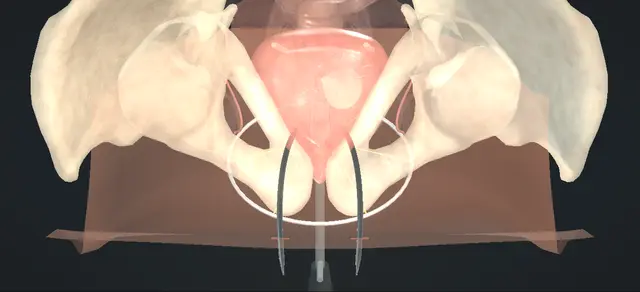
Followed here: the catheter and the empty bladder, the weighted speculum and self-retaining retractor, the infiltration, the midline anterior vaginal incision, the flap dissected off the periurethral fascia and laterally to the ischiopubic rami to the endopelvic fascia, the rule of keeping on the posterior surface of the pubic symphysis to avoid the bladder, the paired skin incisions over the symphysis, the cystoscopy with the catheter out (30-degree and 70-degree lenses, bladder and proximal urethra intact, efflux from both sides), the closure, the variations (an inverted-U incision, an intravenous dye before cystoscopy, a suprapubic catheter, a vaginal pack) and the complication list, from which the three error states are taken: bladder perforation, bleeding, urinary retention. Where this module differs from the chapter's dictation: the dictation passes a needle from the suprapubic incisions down to the vagina, draws the sling's sutures up, performs cystoscopy before those sutures are tied, and positions the sling at the bladder neck and proximal urethra. Here the trocars are passed from the vagina upward, the tape lies under the mid-urethra and is left loose over a spacer, and the bladder is inspected with the trocars in place before the tape is drawn through; the next three entries give the reasons. The chapter does not describe a catheter guide, a spacer, plastic sheaths or how far from the midline the skin incisions lie; those are drawn generically. It lists complications without their management: the first, escalate and document steps, most of the danger lines and the troubleshooting entries on a lost tip, a missed exit and a tight tape are general surgical practice. The scene is schematic: the bones, bladder and rectum are those of the atlas, the female soft tissue is drawn on them, the cystoscopy is shown as the scope in a translucent bladder with the trocars seen outside its wall, and no figure in the scene is a measurement.
Open guideline
NICE
Urinary incontinence and pelvic organ prolapse in women: management. NICE guideline NG123, recommendations 1.5.1 to 1.5.16, read 13 October 2026
Use the patient decision aid and discuss all recommended procedures (1.5.1); offer the choice of colposuspension, an autologous rectus fascial sling or a retropubic mid-urethral mesh sling (1.5.2), with bulking agents where those are unsuitable or unacceptable (1.5.3); record procedures in a national registry (1.5.6); advise that the sling is a permanent implant and complete removal might not be possible (1.5.7); give written information about the implant (1.5.8); use a type 1 macroporous polypropylene mesh device (1.5.9); do not offer a transobturator approach unless the retropubic approach should be avoided (1.5.10); do not use the top-down retropubic approach or a single-incision sling except in a clinical trial (1.5.11); follow-up within 6 months, with a vaginal examination for exposure or extrusion after a retropubic sling (1.5.15, 1.5.16). Recommendation 1.5.11 is the reason the pass is drawn from the vagina upward.
Open guideline
NICE
Urinary incontinence and pelvic organ prolapse in women: management. NICE guideline NG123, overview page (last reviewed 3 July 2026), read 14 October 2026
NICE notes that in July 2018 the Government announced a period of high vigilance restriction in England on the use of a group of procedures to treat stress urinary incontinence and pelvic organ prolapse, and that the restriction period was extended in March 2019. The page gives no later change.
Open guideline
EAU Guidelines
Non-neurogenic Female LUTS, 2026: Disease management, section 4.2.4.c.2.e Mid-urethral slings and its summary of evidence and recommendations, read 13 October 2026
Summary of evidence: the retropubic route carries a higher intraoperative risk of bladder perforation and a higher rate of voiding dysfunction than the transobturator route (level 1a); the top-to-bottom direction in the retropubic approach carries a higher risk of postoperative voiding dysfunction (level 1b); patient-reported cure in the longer term is higher with the retropubic route (level 1b). Recommendations, all strong: offer a mid-urethral sling after a thorough discussion of risks and benefits; perform cystoscopy to check for intraoperative bladder perforation when inserting a synthetic mid-urethral sling; inform women that long-term outcomes are better with the retropubic route; inform women of the complications and discuss the alternatives. The guideline asks for the cystoscopy but does not say at which moment; doing it with both trocars in place, before the tape is drawn through, is this module's fixed choice.
Open guideline
Cochrane Database of Systematic Reviews
Ford AA, Rogerson L, Cody JD, Aluko P, Ogah JA. Mid-urethral sling operations for stress urinary incontinence in women. Cochrane Database Syst Rev 2017;7:CD006375
Abstract read 13 October 2026. Eighty-one trials, 12,113 women. Transobturator against retropubic route: similar subjective cure up to one year; bladder perforation 0.6% against 4.5% (40 trials, 6,372 women); postoperative voiding dysfunction less frequent after the transobturator route (relative risk 0.53); major vascular or visceral injury lower with the transobturator route; groin pain 6.4% against 1.3%; tape erosion, exposure or extrusion 24 against 21 per 1,000; repeat incontinence surgery in the long term more likely after the transobturator route (4 trials, low-quality evidence). A retropubic bottom-to-top route was more effective for subjective cure than a top-to-bottom route (3 trials, 477 women), with less voiding dysfunction and fewer bladder perforations and vaginal tape erosions. The source of every figure in the viva.
Open guideline
International Urogynecology Journal
Ulmsten U, Henriksson L, Johnson P, Varhos G. An ambulatory surgical procedure under local anesthesia for treatment of female urinary incontinence. Int Urogynecol J Pelvic Floor Dysfunct 1996;7:81-85
Abstract read 13 October 2026. The first report of the tension-free mid-urethral tape, as a modified intravaginal slingplasty in 75 women followed for two years. The abstract does not describe the pass, so it supports the origin of the operation only and no statement of technique on this page.
Open guideline