Operative Dictations in Urologic Surgery
Armenakas NA, Fracchia JA, Golan R. Extracorporeal shock wave lithotripsy. Chapter 126. Wiley, 2019
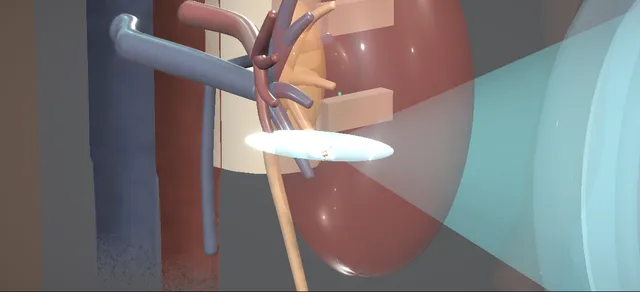
The page follows the indication, essential steps and template dictation of the chapter: the stone confirmed first, supine or prone, strapped and padded, the head below the patient, the stone in the crosshairs, a low setting and slow rate increased, periodic imaging, the head lowered and the flank examined. Its variations: shock number by site and manufacturer, and sonographic targeting. Its complications: haematuria, parenchymal injury or haematoma, pain, ureteral obstruction and steinstrasse, failure to fragment. Its shock counts are kept off the page. The contraindications, the ramp and rate, the coupling, the failure predictors and the comparison with other treatments are general practice taken from the EAU guideline and the papers below.
Open guideline
EAU Guidelines on Urolithiasis, 2026
Sections 3.4.5 (shock wave lithotripsy), 3.4.8 (contraindications, antithrombotic treatment, stone composition) and Table 3.9 (complications), read 18 October 2026
Contraindications: pregnancy, bleeding disorders (corrected 24 hours before and 48 hours after), uncontrolled urinary infection, skeletal deformity or obesity preventing targeting, arterial aneurysm near the stone, obstruction distal to the stone; hazard ratio for perinephric haematoma up to 4.2 on antithrombotics. Optimal frequency 1.0 to 1.5 Hz; ramping, stone-free rates 96% against 72% in one trial; air pockets deflect 99% of shock waves. Steinstrasse 4%, sepsis 0.15%, symptomatic haematoma 0.21%.
Open guideline
EAU Guidelines on Urolithiasis, 2026
Sections 3.4.2 (sepsis in the obstructed kidney), 3.4.10 (renal stones) and 3.4.12 (steinstrasse), read 18 October 2026
Strong: urgently decompress the collecting system in sepsis with obstructing stones, by percutaneous drainage or ureteral stenting, and delay definitive treatment until sepsis resolves. Strong: PCNL first-line for stones larger than 2 cm; PCNL or retrograde intrarenal surgery for the lower pole even for stones larger than 1 cm. Stones above 1,000 HU less likely to break. Weak: steinstrasse with infection or fever preferably by nephrostomy.
Open guideline
Urology
Perks AE, Schuler TD, Lee J, et al. Stone attenuation and skin-to-stone distance on computed tomography predicts for stone fragmentation by shock wave lithotripsy. Urology 2008;72:765-769
Abstract read 18 October 2026. Retrospective review of 111 patients with a solitary renal stone. Attenuation, skin-to-stone distance and composition predicted the outcome independently of size, location and body mass index; success 91% with both attenuation and distance favourable and 41% with both unfavourable.
Open guideline
Journal of Urology
Albala DM, Assimos DG, Clayman RV, et al. Lower pole I: a prospective randomized trial of extracorporeal shock wave lithotripsy and percutaneous nephrostolithotomy for lower pole nephrolithiasis. J Urol 2001;166:2072-2080
Abstract read 18 October 2026. Randomised multicentre trial, 128 patients with lower-pole stones. Stone-free at three months 95% after percutaneous removal against 37% after lithotripsy; lithotripsy results fell with stone burden; morbidity 22% and 11%, not significantly different.
Open guideline