
Revision sheet
Extracorporeal shock wave lithotripsy
8 steps, each one the authored title and caption from the interactive animation, with the frame captured from that step. Read it before the case, or print it and work through the steps in order.
Teaching only, not for diagnosis or treatment decisions. The text on this sheet is the animation's own step copy, reproduced verbatim.
UrOops3D · UroRef · © Nity G
- 01
Confirm the stone and the patient
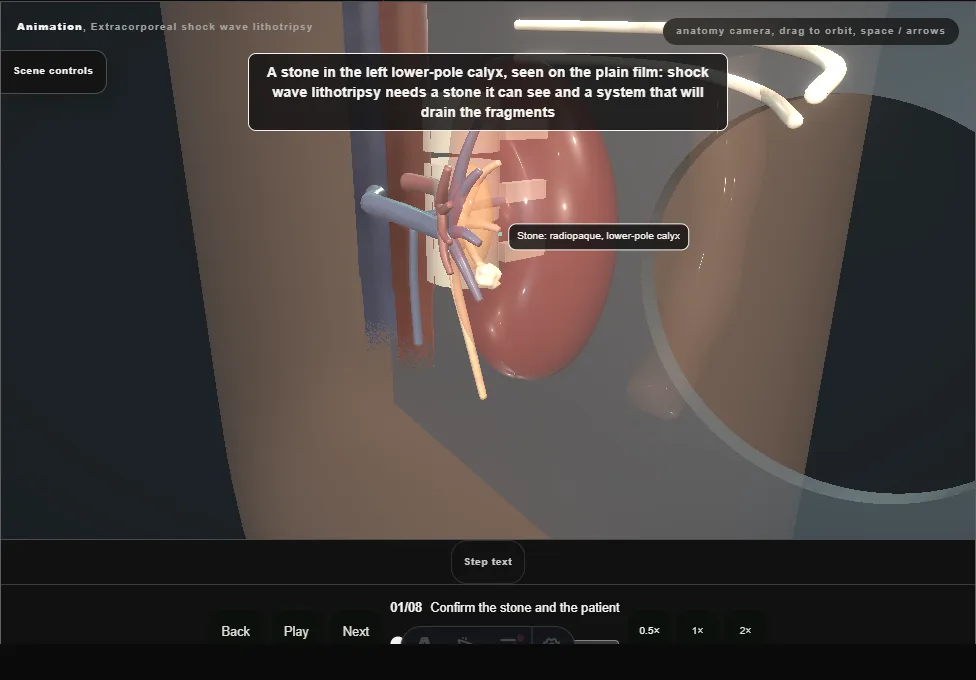
- The stone, its side and its site confirmed on imaging before the time-out: radiopaque, in the lower-pole calyx.
- Not in pregnancy, with uncorrected bleeding or untreated infection, beside an arterial aneurysm, or with an obstruction below the stone.
- 02
On the table
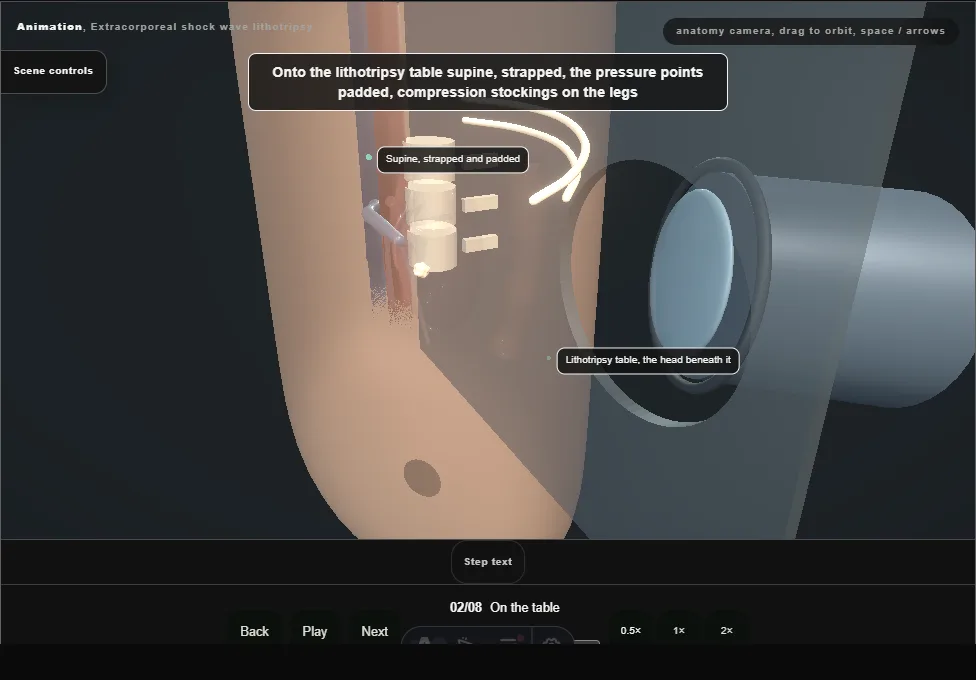
- Supine on the lithotripsy table, strapped, the pressure points padded and compression devices on the legs; analgesia or an anaesthetic.
- The time-out with the images in the room: the patient, the side and the exact stone.
- 03
Couple the head to the flank
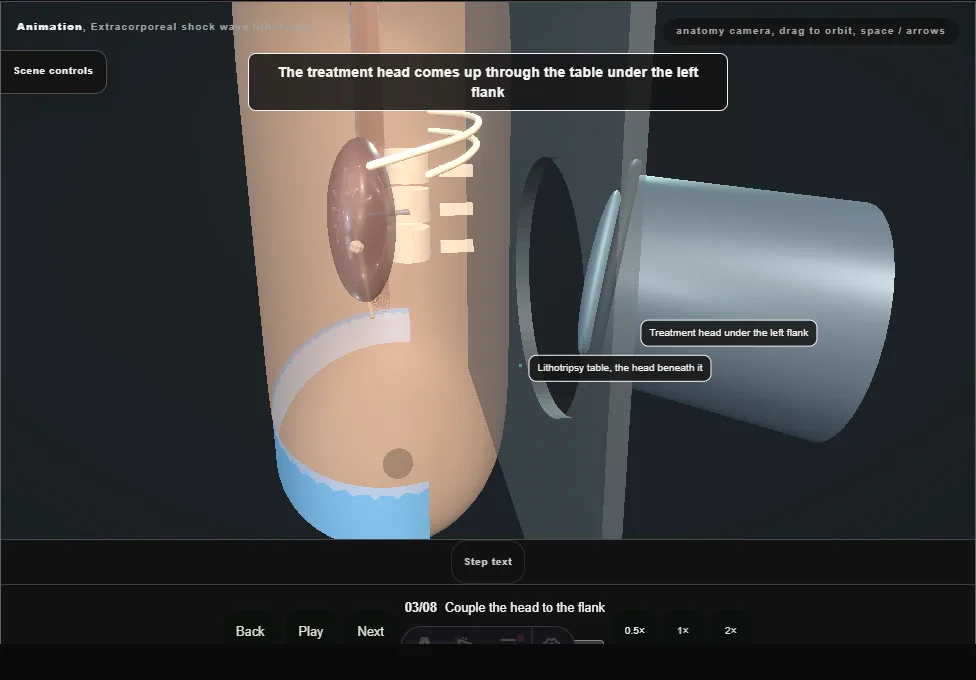
- The treatment head is brought up beneath the left flank and its water cushion pressed to the skin through gel.
- An air pocket in the gel deflects the shock wave, so the bubbles are swept out before the first shock.
- 04
Localise the stone
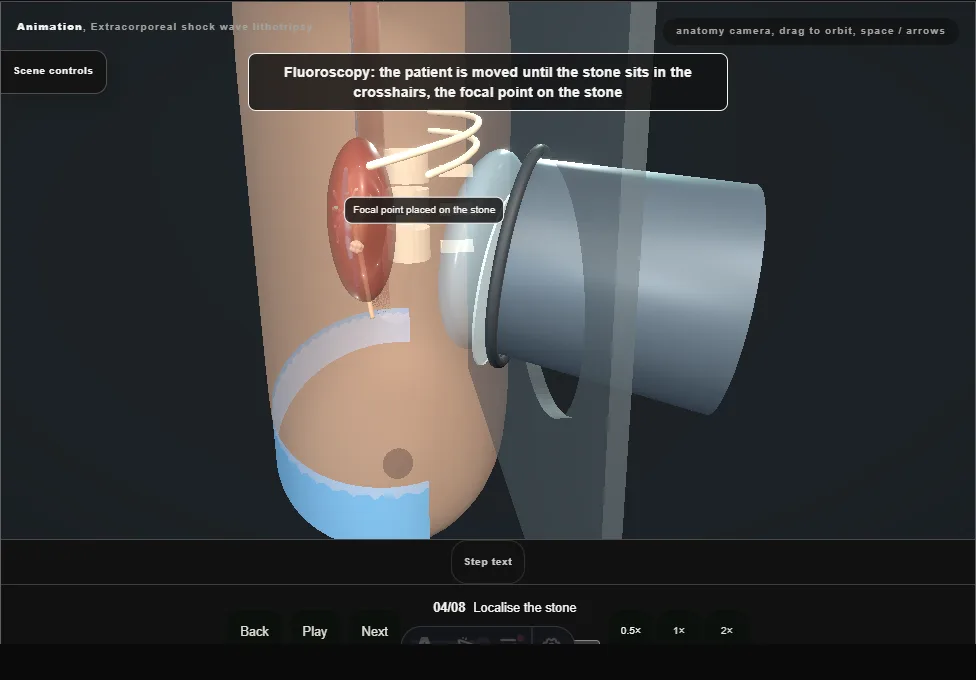
- Limited fluoroscopy, and the patient moved until the stone sits in the crosshairs: the focal point is on the stone.
- The path from skin to stone stays below the rib and the pleura and clear of bowel, and its length, the skin-to-stone distance, is one reason a stone does not break.
- 05
Ramp the energy
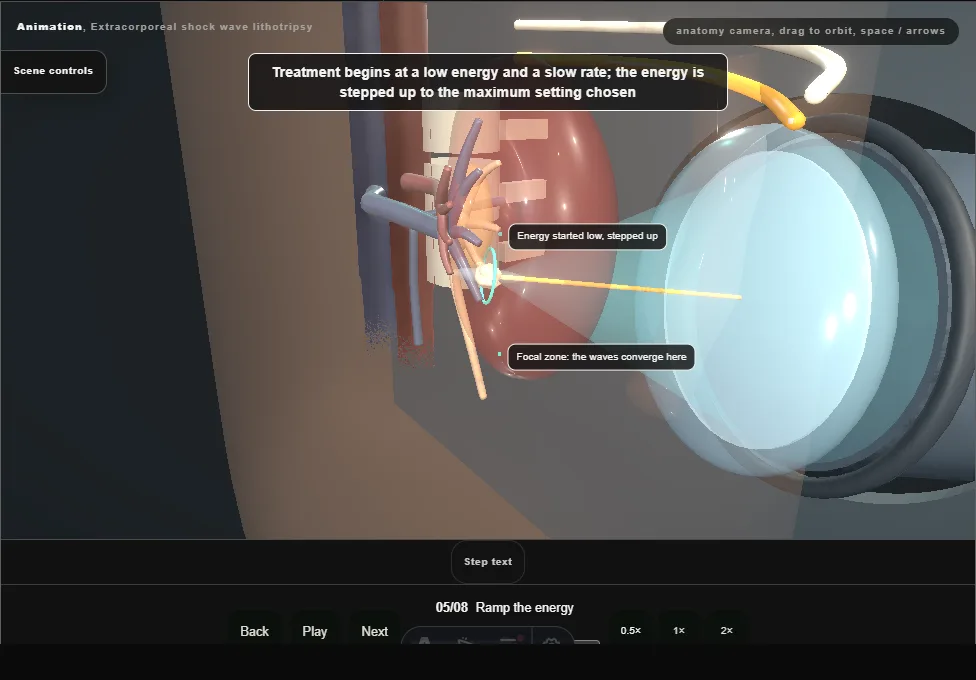
- Treatment begins at a low energy and a slow rate, and the energy is stepped up to the maximum setting chosen.
- Each wave converges through the kidney on the focal zone; a slower rate breaks more stone and the ramp spares the kidney.
- 06
Fragmentation
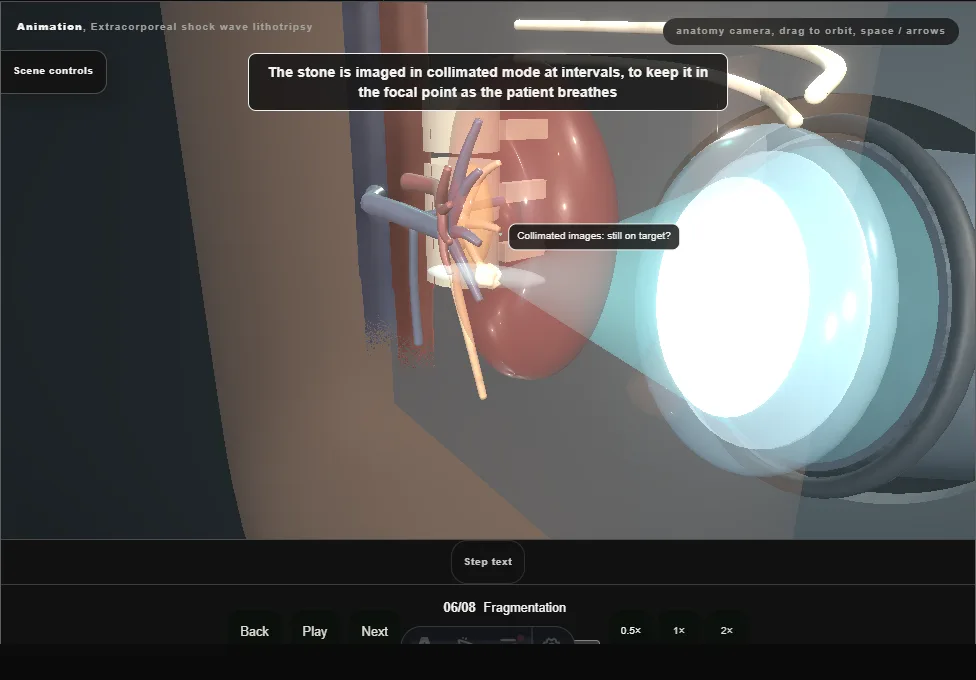
- The stone is imaged in collimated mode at intervals and the focal point kept on it as the patient breathes, and the heart rhythm is watched.
- It breaks into fragments over the treatment, which runs to the number of shocks allowed for its site.
- 07
The end check
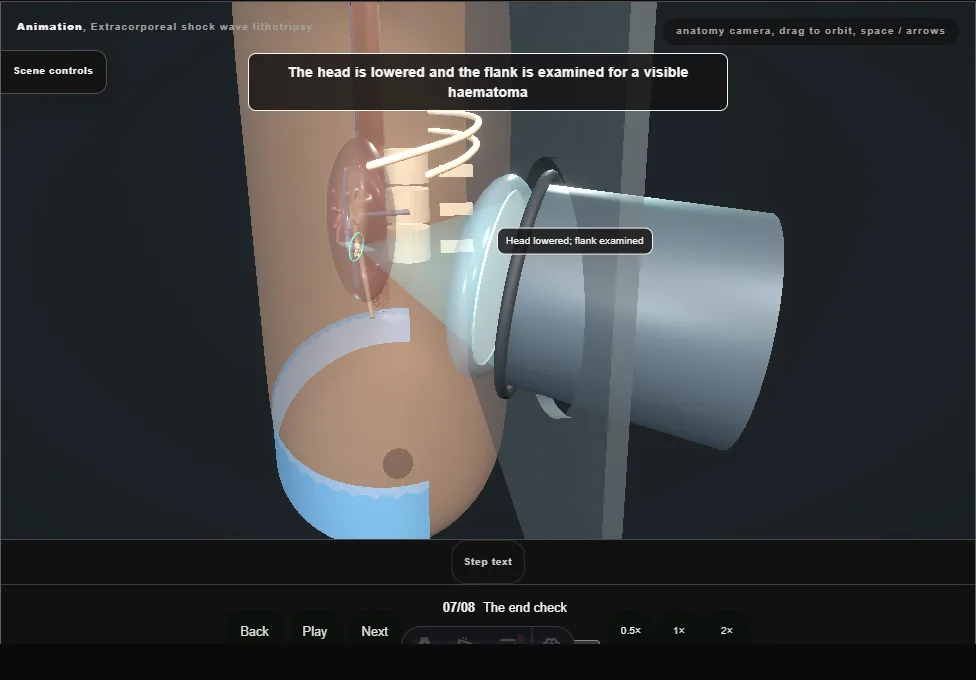
- The treatment ends at the allowed number of shocks.
- The head is lowered and the flank examined for a visible haematoma; the final image shows the fragments lying in the lower pole, where they must drain uphill to leave.
- 08
Fragments and follow-up
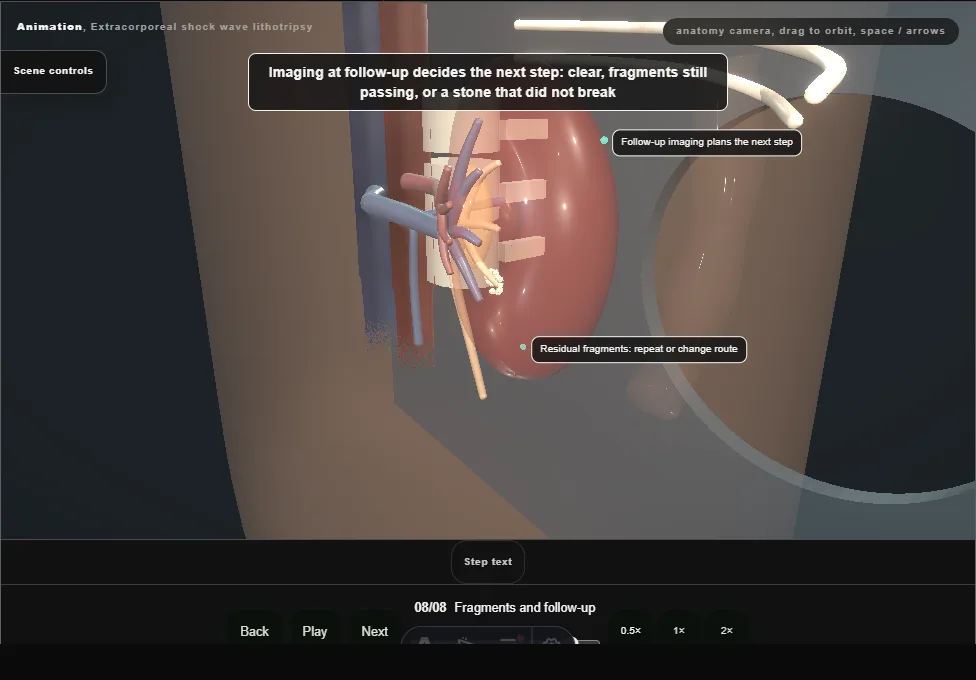
- Home the same day with analgesia and advice to return with a fever or pain that does not settle.
- Imaging at follow-up decides the next step: clear, fragments still passing, a second session, or another route for a stone that did not break.
Derived from kidney/ShockWaveLithotripsyScene.tsx at build time: every step title and caption above is the authored
ProcedureDef text, reproduced verbatim, and this page shares its readable-points renderer with the animation
itself. 8 of 8 steps have a captured frame.
Text fingerprint 12fba7380b35014a. A caption edit without a re-capture fails the production
check, so the sheet and the animation cannot drift apart silently.