UrOops3D, danger-zone atlas

Schematic model.

Operative animation, Testicular prosthesis

Testicular prosthesis: high scrotal insertion, dependent pouch and fixation

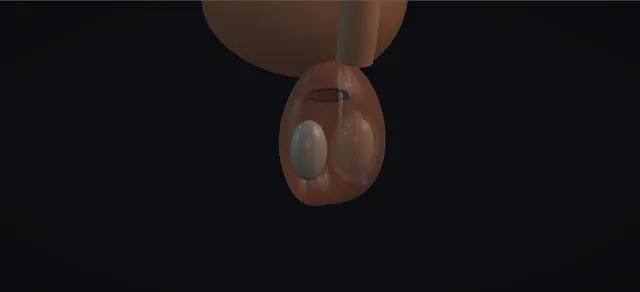
A prosthesis for a man whose testis is absent or was removed, inserted through a high incision in the empty hemiscrotum.

The size is matched to the other testis, a dependent pouch is made bluntly down to the bottom of the scrotum, the implant is stitched to the inner wall by its loop and the neck is closed above it. The lesson is the pouch: too small or too high, and the implant rides high.

Advanced tier FRCS andrology, scrotal surgery and device complications Interactive 3D

Operative visualisation

Schematic scene preview: Testicular prosthesis
Preparing the 3D anatomy…

UrOops3D · UroRef · © Nity G

How to use this module. Play through the seven steps, or use Back and Next. Watch the empty hemiscrotum, the pouch developed to the bottom, the base inverted for the stitch, the implant taken down and the neck closed above it. The triggers show an exposed implant, a high-riding one and a haematoma.

Click me next Section 2 of 8 Anatomy The structures this operation works between, and the one it must not cross.

The structures in the scene

Testicular prosthesis: how the structures relateThe pouch in the empty hemiscrotum, and what lies round it. Dependent pouch for the prosthesis: incised high, never over the implant Thin scrotal skin and dartos (danger). Dependent pouch for the prosthesis: across the septum; matched to, never touched Contralateral testis and cord (danger). Dependent pouch for the prosthesis: behind and below; blunt dissection stays lateral Perineum and urethra in a scarred field (danger). Dependent pouch for the prosthesis: made lateral to it Scrotal septum. Dependent pouch for the prosthesis: closed above the implant by a purse-string Neck of the scrotum. Dependent pouch for the prosthesis: reached by two fingers; takes the loop stitch Base of the scrotum.Dependent pouch for theprosthesis!Thin scrotal skinand dartos!Contralateral testisand cord!Perineum and urethrain a scarred fieldScrotal septumNeck of the scrotumBase of the scrotumincised high, neverover the implantacross the septum;matched to, nevertouchedbehind and below;blunt dissectionstays lateralmade lateral to itclosed above theimplant by apurse-stringreached by twofingers; takes theloop stitchTargetDangerLandmarkContext
The pouch in the empty hemiscrotum, and what lies round it. Schematic, not to scale; relationships only.
  • Seen from in front of a supine patient, the empty right hemiscrotum lies beside the left testis, separated from it by the septum.
  • The incision is high on its anterior wall, so the closed wound ends up above the implant rather than over it.
  • The pouch runs from the incision down to the bottom of the hemiscrotum, and the implant hangs at its foot, level with the left testis, held by a stitch at its lower pole and kept down by the purse-string at the neck.
  • ›Empty hemiscrotum - after an orchidectomy it is contracted and its wall is thin; the pouch restores the space.
  • ›Dartos - the smooth muscle layer of the scrotal wall; divided at the incision and closed over the neck.
  • ›Scrotal septum - the midline partition; the pouch is made lateral to it.
  • ›Contralateral testis and cord - the size the implant is matched to, and the structure that must not be injured.
  • ›Neck of the scrotum - where the purse-string closes the pouch above the implant.
  • ›Base of the scrotum - the dependent inner wall, inverted to take the fixation stitch.
  • ›Prosthesis - a smooth ovoid shell with a loop at one pole, placed with the loop dependent.
  • ›Perineum and urethra - behind and below the scrotum; at risk in a scarred or previously operated field.
Click me next Section 3 of 8 Steps The operation in order, with the landmark that guards each move.

Operative steps

  1. Consent and sizing He has chosen a prosthesis, knowing that it restores appearance and not function, and that size, feel and position never match exactly. Supine, intravenous antibiotics, preparation, draping and a time-out. The other testis is felt and the size that matches its volume is chosen.
    where it bites: the remaining testis and its cord are the one thing that must not be harmed; they lie just across the septum.
  2. High scrotal incision A transverse incision is made through the superior anterior wall of the empty hemiscrotum, above where the implant will lie, and the dartos is divided with diathermy. A low inguinal incision is the alternative, and the usual route at the time of an inguinal orchidectomy.
    where it bites: thin scrotal skin: an incision over the dependent wall would sit on the implant and is where extrusion starts.
  3. Dependent pouch A scrotal pouch is created bluntly with two fingers, right down to the bottom of the hemiscrotum, keeping lateral to the septum. The pouch is made large enough for the implant to hang freely at the level of the other testis.
    where it bites: medially the septum and the other testis and cord; behind and below, the perineum and, in a scarred field, the urethra.
  4. Base inverted, fixation stitch The prosthesis is taken out of its antibiotic solution and handled as little as possible. The base of the scrotum is inverted toward the wound with an Allis clamp, and an absorbable stitch is passed through the inner scrotal wall at the bottom and through the dependent loop of the prosthesis.
    where it bites: a needle or a sharp instrument against the shell can damage it; the stitch goes through the loop only.
  5. Prosthesis placed The prosthesis is guided down through the incision into the pouch as the base is let go, so that the stitch takes the loop to the bottom of the scrotum, where it is tied. It should sit comfortably, low and level with the other testis, with no tension on the stitch.
    where it bites: an implant that will not reach the bottom means the pouch is not finished; it is not forced.
  6. Neck purse-string A purse-string is run round the neck of the scrotum above the prosthesis and tied, closing the pouch so that the implant cannot migrate upward. This is a variation in the operative text and is described in the BAUS leaflet.
    where it bites: the purse-string closes the neck, not the cord of the other side; it stays in the operated hemiscrotum.
  7. Closure, no drain The wound is irrigated and inspected, and haemostasis is secured with diathermy. The dartos is closed with a running absorbable stitch and the skin with a subcuticular one, reinforced with adhesive strips. A dressing and a scrotal support are applied. No drain is placed.
    where it bites: blood left round the implant is a haematoma tonight and an infected implant later.
Click me next Section 4 of 8 Danger zones Where this operation bites, and why it bites there.
Critical relationship

Danger zones

The spatial relationships the animation is built to make automatic. Before you read each one, ask yourself: at this point in the operation, what is about to go wrong, and what is my first move? The save for each sits in the Complications tab.

  • RiskThin scrotal skin - the incision is placed high and the implant low, so that the wound never lies on the shell.
  • RiskUrethra and perineum in scarred fields - behind and below the pouch; blunt dissection stays in the hemiscrotum after earlier surgery.
  • RiskContralateral testis and cord - across the septum; the pouch, the stitches and the diathermy stay on the operated side.
  • RiskA pouch too small or too high - the commonest cause of a high-riding implant.
  • RiskHaemostasis before closure - a haematoma round a foreign body invites infection.
Practise it Take me into the scene Opens the animation at a danger moment and asks you to predict the mechanism and your first move before it reveals.
Click me next Section 5 of 8 Complications The save for each one: the first move, the escalation trigger, the op-note line.

Complications and immediate saves

Trigger each of these live in the Animation tab, then read the save: the first move, the escalation trigger, and the line that goes in the op note.

Infection and extrusion

  • weeks later the wound is red and has broken down, and the implant shows through it.
  • Prosthesis infection and erosion are listed complications of the operation.
The save
  1. An exposed implant is an infected implant: plan its removal rather than trying to close skin over it. first move
  2. Remove the implant, send swabs, wash out the space and close the wound, with antibiotics guided by culture.
  3. Spreading cellulitis, an abscess or systemic illness is a senior review and theatre the same day. escalation trigger
  4. Offer a new prosthesis later, once the scrotum has fully healed, through fresh tissue and with a high incision.
  5. Record the findings, the cultures, the removal and the plan for reinsertion, and tell him. document

High-riding implant

  • the implant sits at the neck of the scrotum and the lower hemiscrotum is empty: the pouch was made too small and too high, or it was not fixed at the bottom and the neck was not closed.
The save
  1. Examine him standing: confirm the position, and ask whether it troubles him. first move
  2. In the first weeks, gentle downward traction on the implant may let it settle lower, as the BAUS leaflet advises.
  3. If it stays high and he wants it corrected, redevelop the pouch to the bottom, fix the loop there and close the neck above it.
  4. A high implant with pain, skin thinning or a wound problem needs a senior review now. escalation trigger
  5. Record the position and his view of it; he was warned that a higher level is common. document

Scrotal haematoma

  • that evening the right hemiscrotum is swollen, tense and bruised, with blood round the implant; bleeding is a listed complication.
The save
  1. Examine him: a soft, stable swelling is managed with a support, ice and analgesia, and reviewed. first move
  2. Check the blood count and clotting, and review any anticoagulant with whoever prescribed it.
  3. A tense, expanding or very painful haematoma needs a senior and exploration; an implant contaminated by a large clot may have to come out. escalation trigger
  4. Record the size and progress of the swelling, the plan, and what would bring him back. document
Click me next Section 6 of 8 Troubleshooting When the case turns: the problem, then the next move.

Intra-operative troubleshooting

When the case turns: the problem, then the next move.

  • ActionUnhappy with the size or feel - the commonest late complaint. Firmness is the feature men most often find wrong. Counselling before surgery, with sizers in the hand, is the main defence; exchange for another size is possible but is a second operation.
  • ActionThe implant will not go down - the pouch is not finished: take the fingers back to the bottom of the hemiscrotum, lateral to the septum, rather than pushing the implant.
  • ActionScarred, thin or irradiated scrotal skin - a higher risk of erosion; consider a smaller implant, an inguinal route through healthier tissue, or a delay until the skin has recovered.
  • ActionAt the time of orchidectomy for cancer - insertion through the same inguinal incision is safe in a large regional audit, and avoids a second operation; the cancer treatment comes first and must not be delayed by it.
  • ActionThe stitch can be felt - the BAUS leaflet warns that the fixation stitch may be felt at one end of the implant; reassurance, and it is part of the consent.
  • ActionChoice of incision - the operative text uses a superior anterior scrotal incision and lists a low inguinal one as the alternative; the BAUS leaflet describes the groin route. Either keeps the wound away from the dependent wall.
Click me next Section 7 of 8 FRCS viva Say it out loud, then mark yourself against the model answer.

FRCS viva questions

The examiner stems this scene prepares you for. Try to answer out loud first, then reveal, and learn the discriminator, the detail that turns a pass into a strong pass.

QA young man is about to have a radical orchidectomy for a testicular tumour. Should he be offered a prosthesis, and when should it go in?reveal answer
  • Yes.
  • I would offer every man a prosthesis, and record that I have done so, because many are not asked.
  • It can go in at the orchidectomy, through the same inguinal incision, or later as a separate operation.
  • The argument against doing it at once is that the cancer diagnosis and the infection risk of a foreign body might complicate the first operation or delay treatment.
  • The evidence is reassuring: Robinson and colleagues audited 904 men having radical orchidectomy in the North West of England, and those who had a prosthesis inserted at the same time had no more re-admissions or returns to theatre, with one of 236 implants removed, 0.4 per cent.
  • So I would offer it at the time if he wants it, but I would not let the decision delay the orchidectomy.
  • A man who is undecided can have it later, when the wound and the diagnosis have settled, through a high scrotal or inguinal incision.
Strong pass

Say both

  • Quoting the regional audit showing that immediate insertion does not add complications
  • While putting the cancer treatment first
Examiner note
Quoting the regional audit showing that immediate insertion does not add complications, while putting the cancer treatment first.
QTalk me through a delayed insertion through the scrotum.reveal answer
  • With antibiotics given and a time-out done, I choose the size by matching the volume of the other testis, using sizers.
  • I make a transverse incision through the superior anterior wall of the empty hemiscrotum, above where the implant will lie, and divide the dartos with diathermy.
  • I develop a pouch bluntly with two fingers right down to the bottom of the scrotum, keeping lateral to the septum.
  • I take the implant from its antibiotic solution, touching it as little as possible.
  • I invert the base of the scrotum with an Allis clamp and pass an absorbable stitch through the inner wall and the dependent loop of the implant, then guide the implant down into the pouch and tie the stitch.
  • I close the neck of the scrotum with a purse-string so that it cannot migrate upward, irrigate, secure haemostasis, close the dartos and the skin in layers, and apply a support.
  • I do not use a drain.
Strong pass

Say all three

  • A dependent pouch to the bottom
  • Fixation at the lower pole and closure of the neck
  • With the incision kept high
Examiner note
A dependent pouch to the bottom, fixation at the lower pole and closure of the neck, with the incision kept high.
QSilicone gel or saline: what is the difference, and how do you choose the size?reveal answer
  • Both have a silicone elastomer shell.
  • A saline-filled implant is filled with saline and its feel depends on how it is filled; it can deflate.
  • A gel-filled or solid silicone implant keeps its shape and is the type described in the BAUS leaflet and used in the UK;
  • saline-filled implants have been the norm in the United States, and the operative text I follow uses one.
  • For counselling I would say that the leaflet lists rupture or leaking and unknown long-term risks of silicone among the uncommon risks.
  • For size, I match the volume of the other testis, holding sizers beside it, and I would rather go slightly smaller than too large in thin skin.
  • The patient-reported outcomes matter here: in a 2026 meta-analysis, 76 per cent of men thought the size appropriate, but only 58 per cent thought the consistency right, firmness being the commonest complaint, so I warn him that it will feel firmer than a testis.
Strong pass

Knowing that firmness, not size, is the commonest complaint, and warning him before he chooses.

QWhat do you tell him about the risks before he consents?reveal answer
  • I would use the BAUS leaflet.
  • It replaces appearance, not function: it makes no hormone and no sperm.
  • Swelling, discomfort and bruising happen to almost everyone.
  • The prosthesis may lie higher or be a slightly different size from the other testis in between 1 in 2 and 1 in 10 men, and he may feel the fixation stitch at one end in a similar proportion.
  • Up to 1 in 5 men are dissatisfied with the final appearance.
  • Bleeding needing further treatment, infection needing antibiotics or drainage, and pain, chronic infection, rupture or leaking needing removal each occur in between 1 in 50 and 1 in 250 men, and any of these may mean the implant comes out.
  • Across published series, the 2026 meta-analysis put overall satisfaction at 84 per cent and decision regret at 10 per cent.
  • I would tell him to pull the implant gently downward each day for the first few weeks, and to avoid heavy lifting for six weeks.
Strong pass

Giving the dissatisfaction figure and the high position as expected outcomes, not rare events.

QFour weeks later the implant is visible through his wound. What do you do?reveal answer
  • An exposed implant is infected, whatever the culture shows, and I would not try to close skin over it.
  • I would examine him for cellulitis, an abscess and systemic illness, send swabs and start antibiotics.
  • I would then remove the implant in theatre, wash out the space and close the wound, and send the implant and tissue for culture.
  • Salvage by washout and immediate exchange has been described for selected penile implant infections, but for a testicular implant, where the operation is cosmetic, removal is the safe course.
  • Once the scrotum has completely healed, usually after some months, I would offer a new implant through fresh tissue, with a high incision so that the wound does not lie on the shell, and I would look for what went wrong: a low incision, a haematoma, thin skin or an implant that was too large.
Strong pass

Say all three

  • Treating exposure as infection
  • Removing the implant
  • With reinsertion offered later
Examiner note
Treating exposure as infection and removing the implant, with reinsertion offered later.
Click me next Section 8 of 8 Evidence The guidance each of these answers is built on.

Evidence and guidance

Operative Dictations in Urologic Surgery
Armenakas NA, Fracchia JA, Golan R. Testicular prosthesis insertion. Chapter 44. Wiley, 2019
Followed for the indication, the three essential steps and the template dictation. Intravenous antibiotics, supine, preparation and a time-out. The implant is chosen on the approximate volume of the contralateral testis. A skin incision through the superior anterior scrotal wall, the dartos divided with diathermy, and a scrotal pouch created bluntly with two fingers. The inferior base of the scrotum is inverted with an Allis clamp and an absorbable stitch placed through the inner scrotal wall and the dependent loop of the implant, which is manoeuvred to fit comfortably without damage. Irrigation, haemostasis, the dartos closed with a running stitch, the skin with a subcuticular stitch and adhesive strips, a dressing and an athletic supporter; no drain is described. Variations used: the antibiotic soak and the purse-string at the neck of the scrotum against cranial migration. The low inguinal incision is the listed alternative. The complication list (bleeding, swelling, prosthesis infection or erosion) supplies the states. The template uses a saline implant. General practice, not from the chapter: the sizers, the order of the closure stitches, the high-riding state and every first, escalate and document step.
Open guideline
BAUS
British Association of Urological Surgeons. Insertion of a testicular prosthesis: information about your procedure. Leaflet A24/128, published September 2024, read 19 October 2026
A silicone implant, usually through a groin incision; cosmetic and psychological only, no hormone or sperm production. Up to 1 in 5 men (20%) unhappy with the final appearance. Swelling, discomfort and bruising in almost all. A higher level or a slightly different size, and a palpable fixation stitch, each in between 1 in 2 and 1 in 10. Bleeding needing treatment, infection needing antibiotics or drainage, and pain, chronic infection, rupture or leaking needing removal, each between 1 in 50 and 1 in 250. A single fixation stitch, and closure of the neck of the scrotum against upward migration. Daily downward traction for the first few weeks; no heavy lifting for at least six weeks. Insertion at orchidectomy or later.
Open guideline
BJU International
Robinson R, Tait CD, Clarke NW, Ramani VA. Is it safe to insert a testicular prosthesis at the time of radical orchidectomy for testis cancer: an audit of 904 men undergoing radical orchidectomy. BJU Int 2016;117:249-252
Abstract read 19 October 2026. 904 men in the North West of England; 413 offered a prosthesis, 55.2% of whom accepted. No difference in length of stay, re-admission or return to theatre between orchidectomy with and without synchronous insertion; one of 236 prostheses removed (0.4%). Concerns about complications should not constrain the offer at the primary operation.
Open guideline
The Journal of Sexual Medicine
Roessler N, Vetterlein MW, Ludwig TA, Dahlem R, Fisch M, Janisch F. Patient-reported outcomes following testicular prosthesis implantation: a systematic review and meta-analysis. J Sex Med 2026;23(9)
Abstract read 19 October 2026. 22 studies, 2320 patients. Pooled overall satisfaction 84% and decision regret 10%. Shape judged appropriate by 83%, weight 86%, size 76%, position 75%, but consistency by only 58%, firmness often felt suboptimal. Reintervention and major complications uncommon but inconsistently reported.
Open guideline

Curriculum. Supports learning relevant to the ISCP Urology Curriculum syllabus topic Andrology. Not a workplace-based assessment and not evidence of competence.

Two minutes

Close the lap: recall it before you leave.

Say it aloud, then reveal. Reading is not remembering.

  1. 01 The relationship Say the critical spatial relationship out loud, then reveal. reveal
    Memory frame

    Seen from in front of a supine patient, the empty right hemiscrotum lies beside the left testis, separated from it by the septum.

    Why?
    The incision is high on its anterior wall, so the closed wound ends up above the implant rather than over it. The pouch runs from the incision down to the bottom of the hemiscrotum, and the implant hangs at its foot, level with the left testis, held by a stitch at its lower pole and kept down by the purse-string at the neck.
  2. 02 The first move Infection and extrusion. Your first move? reveal
    First move

    An exposed implant is an infected implant: plan its removal rather than trying to close skin over it.

  3. 03 The escalation trigger Infection and extrusion. What makes you call for help? reveal
    Escalate when

    Spreading cellulitis, an abscess or systemic illness is a senior review and theatre the same day.

  4. 04 The discriminator What turns a pass into a strong pass? reveal
    Strong pass

    Say both

    • Quoting the regional audit showing that immediate insertion does not add complications
    • While putting the cancer treatment first
    Examiner note
    Quoting the regional audit showing that immediate insertion does not add complications, while putting the cancer treatment first.
  5. 05 The pitfall Where does this operation bite first? reveal
    Pitfall

    Thin scrotal skin

    Why?
    the incision is placed high and the implant low, so that the wound never lies on the shell.

Revision practice with self-marked answers, not an assessment of clinical competence. Kept in this browser only; it does not sync between devices.