Emergency exploration of the suspected torted testis: one midline raphe incision, deliver and untwist, judge viability against the clock, remove the dead testis, and fix both sides because the bell-clapper anomaly is bilateral.
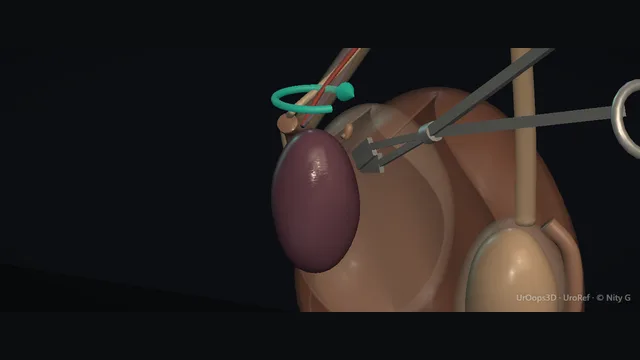
Both hemiscrota through one midline incision, torted side free. Schematic, not to scale; relationships only.
Both testes sit in one translucent scrotum: the healthy side anchored posteriorly in a tunica that stops at the cord, the torted side hanging free inside a bell-clapper tunica that wraps cord and testis together, its cord coiled on itself and the testis congested and high-riding.
›Bell-clapper tunica vaginalis - the tunica encircles cord and testis high, so the testis hangs free and can twist; the anomaly is bilateral.
›Spermatic cord - the twist itself: two to three turns, usually lateral to medial; derotation restores inflow first.
›Epididymis - posterolateral on the testis; a torted appendix testis at the upper pole mimics the whole diagnosis.
›Midline raphe - the avascular line: one incision gives access to both hemiscrota.
The clinical pictureSudden severe pain, vomiting and a scrotum too tender to examine: the history is the diagnosis and it is heard before any investigation is ordered. Examination confirms the picture, with a high-riding testis lying transversely, an absent cremasteric reflex and a cord tender up to the external ring. The diagnosis is clinical and time is tissue: the salvage window is about six hours, and every investigation ordered before theatre spends it. Where the picture is compatible, the next move is the anaesthetist and the table, not more imaging. where it bites: a normal Doppler does not exclude torsion; hours spent imaging are testis lost.
Scrotal incisionA single incision is made on the midline raphe, the avascular line between the hemiscrota, and deepened through skin and dartos with haemostasis taken as each layer opens. From that one wound either tunica can be opened and either testis delivered, so both sides are explored and both are fixed through the same incision. The layers are taken in turn down to each tunica vaginalis, because a scrotum that oozes quietly at closure fills its dependent dead space by morning. where it bites: a hemiscrotal incision tempts you to leave the contralateral side unfixed.
Delivery + derotationThe testis is delivered through the opened tunica into the hand, which alone often unwinds much of the twist. The cord carries two to three turns, usually twisted inward (lateral to medial), so derotation is performed outward, medial to lateral, like opening a book: for a left testis clockwise and for a right testis anticlockwise viewed from the patient's feet; the testis is watched, and if congestion deepens rather than drains the direction is reversed. As the cord uncoils, colour returns over minutes rather than seconds, and warm packs buy that time while the viability judgement is prepared.
Viability assessmentThe save or lose decision rests on two findings: the colour of the testis after derotation, and the behaviour of a short incision made in the tunica albuginea. The incision is the decisive test, because fresh bleeding from its edge means perfusion has returned while a dry, darkly congested cut means it has not. The testis is given minutes with warm packs before the verdict, not seconds, since a dusky testis can recover. When in doubt the testis is fixed and reviewed rather than removed. where it bites: the decision is visual and temporal: hours from onset decide it.
Orchidectomy if non-viableA clearly necrotic testis is removed through the same incision: the cord is clamped high, ligated and divided between ties, and the testis delivered whole. Haemostasis is revisited before closure, because the scrotal floor oozes and the space is dependent. Standard teaching is that retained non-viable tissue risks inflammation and immunological sequelae, so a dead testis is never left for cosmesis; a prosthesis can be discussed later, once recovery is complete. where it bites: retaining a dead testis for cosmesis is the wrong trade.
Bilateral orchidopexyBoth testes are fixed, not one. The contralateral testis is fixed first, while the affected testis waits in warm saline gauze; the salvaged testis is fixed after its reassessment. Each is anchored to the scrotal wall with non-absorbable sutures, placed to avoid cord and vessels. The contralateral side is fixed because the bell-clapper anomaly is bilateral: the testis that has never caused pain carries the same anatomy and the same risk as the one on the table. The wound is closed in layers over the fixed testes and a support dressing applied.
The spatial relationships the animation is built to make automatic. Before you read each one, ask yourself: at this point in the operation, what is about to go wrong, and what is my first move? The save for each sits in the Complications tab.
RiskTime to theatre - the salvage window is about six hours; delay, not technique, is what loses testes.
RiskThe bell-clapper anomaly is bilateral - fix both sides: the contralateral testis carries the same anatomy and the same risk.
RiskThe high transverse lie - a horizontal testis sitting high in the scrotum is the cord already twisted.
Trigger each of these live in the Animation tab, then read the save: the first move, the escalation trigger, and the line that goes in the op note.
Delayed exploration: non-viable testis
hours lost to imaging or referral; the testis arrives necrotic at exploration.
The save
Treat the clinical picture as the diagnosis: with a compatible history the first move is theatre, not more imaging.first move
Alert theatre and the anaesthetist at the moment of decision; consent including orchidectomy runs in parallel.
Document time of onset and time to theatre explicitly: it drives the viability decision and the audit.
A clearly non-viable testis is removed; when viability is genuinely uncertain, fix and review rather than resect.
A tense, swollen scrotum with deterioration after surgery → return to theatre for haematoma evacuation or ischaemia review.escalation trigger
Op note: onset and theatre times, turns of torsion found, viability, orchidectomy or fixation, contralateral fixation.document
Appendix testis torsion / epididymitis confusion
the diagnostic trap: mimic presentations that delay or deflect exploration.
The save
If torsion cannot be excluded on clinical grounds, explore: a safe-default exploration of the acutely swollen scrotum is the correct destination.first move
Use the discriminators: appendix torsion is focal and point tender, often with a blue-dot sign; epididymitis is more gradual, with fever and pyuria.
Imaging, where used, must add no delay: Doppler findings are adjunctive, never gatekeeping.
At exploration a torted appendix testis is excised at its base, and the testis is fixed while the scrotum is open.
Systemic sepsis, or a patient genuinely unfit for theatre → senior review and a time-bound imaging plan, not open-ended observation.escalation trigger
Op note: findings on cord, testis and appendix; what was removed; what was fixed.document
Post-operative swelling / haematoma
a tense, swelling scrotum after orchidectomy or fixation.
The save
Assess early: a tense, expanding, exquisitely tender scrotum is a haematoma until proven otherwise.first move
Scrotal elevation, support and ice; simple observation for a stable, non-expanding collection.
Monitor for pressure effects on the wound and for signs of ongoing blood loss.
An expanding haematoma or skin compromise → theatre: evacuation, haemostasis and drainage.escalation trigger
Op note: timing of the swelling, conservative or operative management, drains placed.document
When the case turns: the problem, then the next move.
ActionTestis still dusky after derotation - warm packs and patience over minutes; the tunica albuginea incision decides, not the first look.
ActionDirection of twist unclear - derotate outward, medial to lateral, like opening a book; if colour worsens, go the other way: the testis tells you.
ActionTorted appendix testis found at exploration - excise it at the base and fix the testis while the scrotum is open.
ActionBleeding from the cord after orchidectomy - transfix and ligate, then dartos haemostasis before closure; a drain for persistent ooze.
The examiner stems this scene prepares you for. Try to answer out loud first, then reveal, and learn the discriminator, the detail that turns a pass into a strong pass.
QA teenager with five hours of sudden scrotal pain, vomiting and a high-riding testis: ultrasound or theatre?reveal answer
This is a clinical diagnosis, and the clinically suspected torsion goes to theatre; imaging must not delay exploration.
The history is the diagnostic instrument: sudden severe pain, vomiting, a high-riding testis lying transversely and an absent cremasteric reflex.
Doppler ultrasound can support the diagnosis, but a normal or equivocal Doppler does not exclude torsion: an incomplete or intermittent twist can still show flow, and a late miss shows changes that cannot be separated from established necrosis.
The salvage window is about six hours from onset, and every imaging step spends it.
Ultrasound has a role when the presentation is genuinely atypical, for example a longer indolent history suggesting epididymitis, provided it delays nothing.
A negative exploration is an acceptable outcome: the cord is inspected, the appendix testis is checked and the contralateral side is fixed.
Strong pass
Say both
Naming the falsely reassuring Doppler
A negative exploration as the acceptable price of never missing torsion
Examiner note
Naming the falsely reassuring Doppler, and a negative exploration as the acceptable price of never missing torsion.
QConsent for emergency scrotal exploration: what must be discussed before incision?reveal answer
Consent covers the realistic range of findings and operations.
First, orchidectomy: if the testis is non-viable at exploration it will be removed, and this must be agreed before the incision because the decision cannot wait for a conversation mid-operation.
Second, orchidopexy: the affected testis, if salvaged, and the contralateral testis are fixed to the scrotal wall with non-absorbable sutures, because the underlying bell-clapper anomaly is bilateral.
Third, the routine operative risks: bleeding and haematoma, wound infection, chronic or recurrent pain, and the possibility of atrophy despite successful fixation.
Fourth, fertility is discussed honestly: most men retain fertility after unilateral torsion, but semen parameters can be affected, and no guarantees are given.
For a child the conversation is held with the parent or guardian and, where appropriate, the young person; a delayed prosthesis is offered as an option after orchidectomy.
Strong pass
Say both
Orchidectomy and contralateral fixation are consented before the incision
Not after the findings
Examiner note
Orchidectomy and contralateral fixation are consented before the incision, not after the findings.
QThe parents ask what an orchidectomy means for future fertility.reveal answer
The honest answer is reassuring with boundaries.
Most men who lose one testis to torsion retain normal fertility and normal testosterone production, because the remaining testis carries both functions.
There is evidence that some men have reduced semen quality after torsion, and immunological mechanisms such as antisperm antibodies have been proposed, but the majority still father children and no confident individual prediction can be made.
The most important fertility intervention in that theatre is fixation of the contralateral testis: the bell-clapper anomaly is bilateral, and protecting the second testis is what protects fertility.
A prosthesis can be offered later for cosmesis, usually after growth is complete.
Routine long-term follow-up is not required after a single orchidectomy, but the young man should know to report any further acute scrotal pain, and to consider semen analysis later if fertility becomes a concern.
Strong pass
Tying fertility protection to contralateral fixation rather than to the fate of the salvaged testis.
QAt exploration the cord is untwisted but a torted appendix testis is found. What is the management?reveal answer
The torted appendix testis, the hydatid of Morgagni, is excised or ligated at its base, which removes the source of the pain and prevents recurrence.
The important judgement is the cord: if the appendix alone is torted and the testis is well perfused with a normal lie, the cord has not twisted, but fixation of the testis is still standard once the scrotum is open, because the exploration was performed for a reasonable suspicion of torsion and the bell-clapper anatomy may still be present.
When the diagnosis is confident before theatre, a torted appendix testis can equally be managed conservatively with analgesia, rest and reassurance, as it infarcts and settles; the blue-dot sign points to it clinically.
The wrong moves are dismissing an acute scrotum without excluding torsion, or leaving a necrotic appendix in situ during an exploration performed for pain.
Strong pass
Say both
Fixing the testis even when only the appendix was torted
Naming conservative management as legitimate only when the diagnosis is already confident
Examiner note
Fixing the testis even when only the appendix was torted, and naming conservative management as legitimate only when the diagnosis is already confident.
Say it aloud, then reveal. Reading is not remembering.
01The relationshipSay the critical spatial relationship out loud, then reveal.reveal
Memory frame
Both testes sit in one translucent scrotum
Why?
Both testes sit in one translucent scrotum: the healthy side anchored posteriorly in a tunica that stops at the cord, the torted side hanging free inside a bell-clapper tunica that wraps cord and testis together, its cord coiled on itself and the testis congested and high-riding.
02The first moveDelayed exploration: non-viable testis. Your first move?reveal
First move
Treat the clinical picture as the diagnosis: with a compatible history the first move is theatre, not more imaging.
03The escalation triggerDelayed exploration: non-viable testis. What makes you call for help?reveal
Escalate when
A tense, swollen scrotum with deterioration after surgery → return to theatre for haematoma evacuation or ischaemia review.
04The discriminatorWhat turns a pass into a strong pass?reveal
Strong pass
Say both
Naming the falsely reassuring Doppler
A negative exploration as the acceptable price of never missing torsion
Examiner note
Naming the falsely reassuring Doppler, and a negative exploration as the acceptable price of never missing torsion.
05The pitfallWhere does this operation bite first?reveal
Pitfall
Time to theatre
Why?
the salvage window is about six hours; delay, not technique, is what loses testes.
Revision practice with self-marked answers, not an assessment of clinical competence. Kept in
this browser only; it does not sync between devices.