
Emergency scrotal exploration for suspected testicular torsion
Time-critical exploration, detorsion and bilateral fixation, with orchidectomy reserved for a testis judged non-viable in the operative context.
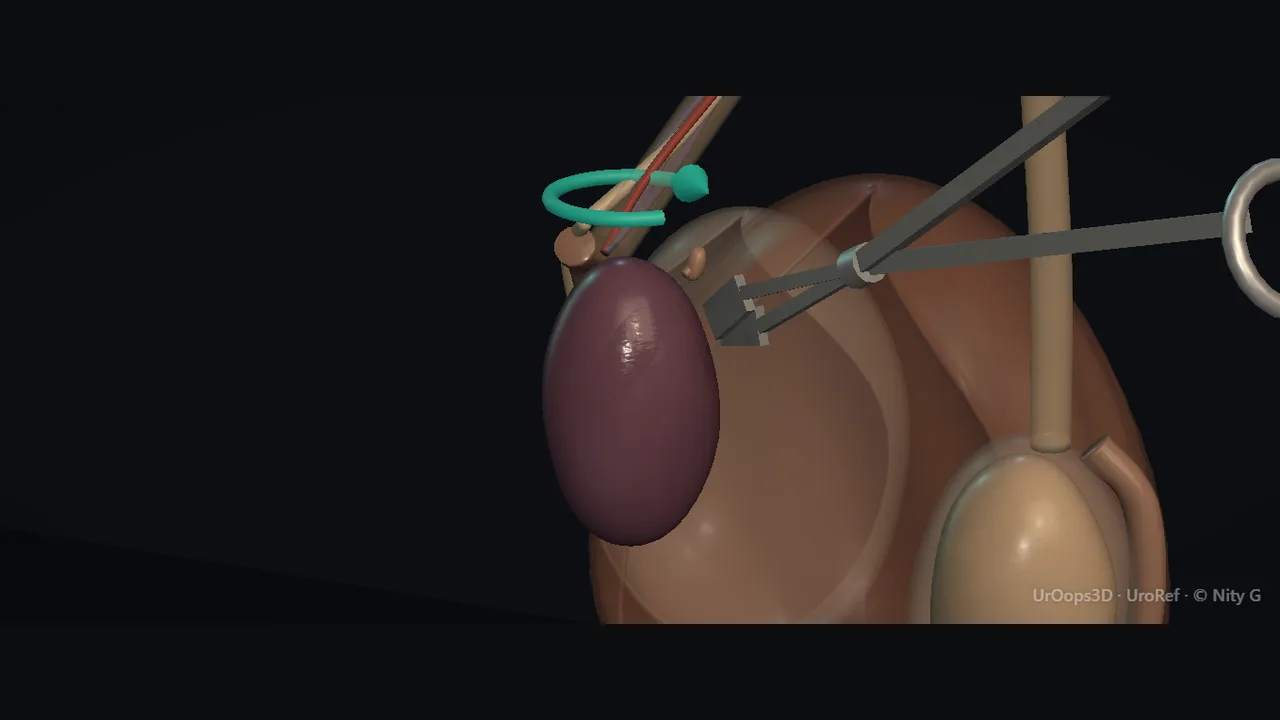 Interactive 3D Interactive operative model Open the 3D animation
Teaching catalogue only. This coverage record is not a patient pathway or operative instruction.
Typical place in practice
A clinical diagnosis of spermatic-cord torsion or unresolved acute scrotal concern where delay threatens testicular viability.
Alternatives and neighbouring procedures
No imaging or observation pathway should delay indicated exploration; manual detorsion is a temporising manoeuvre rather than definitive fixation.
Same procedure family, explicit technique branches
These are variations of this canonical operation. Complication modules below identify whether they apply to all branches or only to named approaches.
Detorsion with bilateral orchidopexy
Preserves a viable affected testis and fixes the contralateral side because the predisposing anatomy is often bilateral.
Orchidectomy with contralateral orchidopexy
Removes irreversibly ischaemic tissue and protects the remaining testis.
Neonatal torsion exploration
Uses a specialist pathway because timing, bilateral risk and operative goals differ from older children and adults.
High-level sequence
Coverage outline only; not a step-by-step technical guide.
- Treat torsion as a time-critical clinical diagnosis
- Expose the affected testis and cord without avoidable delay
- Detorse and assess perfusion in context
- Fix viable testis or remove non-viable tissue
- Perform indicated contralateral fixation and document findings
Operative notes
Concise operative notes covering the key steps, landmarks and watch points, in the order you encounter them.
Scrotal exploration for torsion
What it does: urgent undo of a twisted testis.
- Suspected torsion = theatre now. Save rate: 9 in 10 inside 6 h. 1 in 2 at 12 h. Under 1 in 10 at 24 h.
- Scan only if it will not delay theatre.
- Midline scrotal cut. 1 cut reaches both sides.
- Open the tunica. Deliver the testis.
- Untwist the cord by hand, outwards like opening a book (right side: counter-clockwise, left: clockwise, seen from the foot of the table). Watch for colour return.
- Wrap in warm saline gauze.
- Fix the OTHER side first while you wait.
- Viable? Fix to dartos or tunica.
- Dead? Remove it. Prosthesis can go in now.
- Watch: Fixation method is debated. Fixing both is not.
- 2026 update: EAU grades contralateral fixation as "weak". UK practice still fixes both. Coroners ask.
From the UroRef Operative Quick Guide. Open the note page →
Every failure mode is its own module.
Timing and variation coverage are recorded for each module.
Delayed testicular atrophy despite initial preservation
Reperfusion does not guarantee durable viability after a significant ischaemic insult.
Applies to: Detorsion with bilateral orchidopexy · Neonatal torsion explorationBleeding, haematoma or infection
Scrotal wounds can accumulate blood and become infected.
Applies to: All variantsInjury to testicular vessels, epididymis or vas
Cord handling and fixation sutures can damage reproductive structures.
Applies to: All variantsRecurrent torsion or fixation failure
Inadequate fixation, unusual anatomy or suture/tissue failure can allow retorsion.
Applies to: All variantsChronic scrotal pain or altered testicular position
Scar and fixation can cause persistent discomfort or an unsatisfactory lie.
Applies to: All variantsEndocrine, fertility and psychological impact of testicular loss
Testicular loss has consequences beyond the wound and requires age-appropriate follow-up.
Applies to: Orchidectomy with contralateral orchidopexySources for this module
Renal, ureteric, bladder, urethral and genital trauma and reconstruction.
Accessed 2026-08-03 · opens source European Association of Urology EAU Guidelines on Paediatric UrologyCommon congenital, acute scrotal and paediatric reconstructive procedures.
Accessed 2026-08-03 · opens source British Association of Urological Surgeons Patient information leaflets by procedureUK patient-facing procedure, alternatives, recovery and complication framing.
Accessed 2026-08-03 · opens source