
Emergency decompression of an infected obstructed kidney
Source-control drainage by retrograde ureteric stent or percutaneous nephrostomy, explicitly separated from later definitive stone or obstruction treatment.
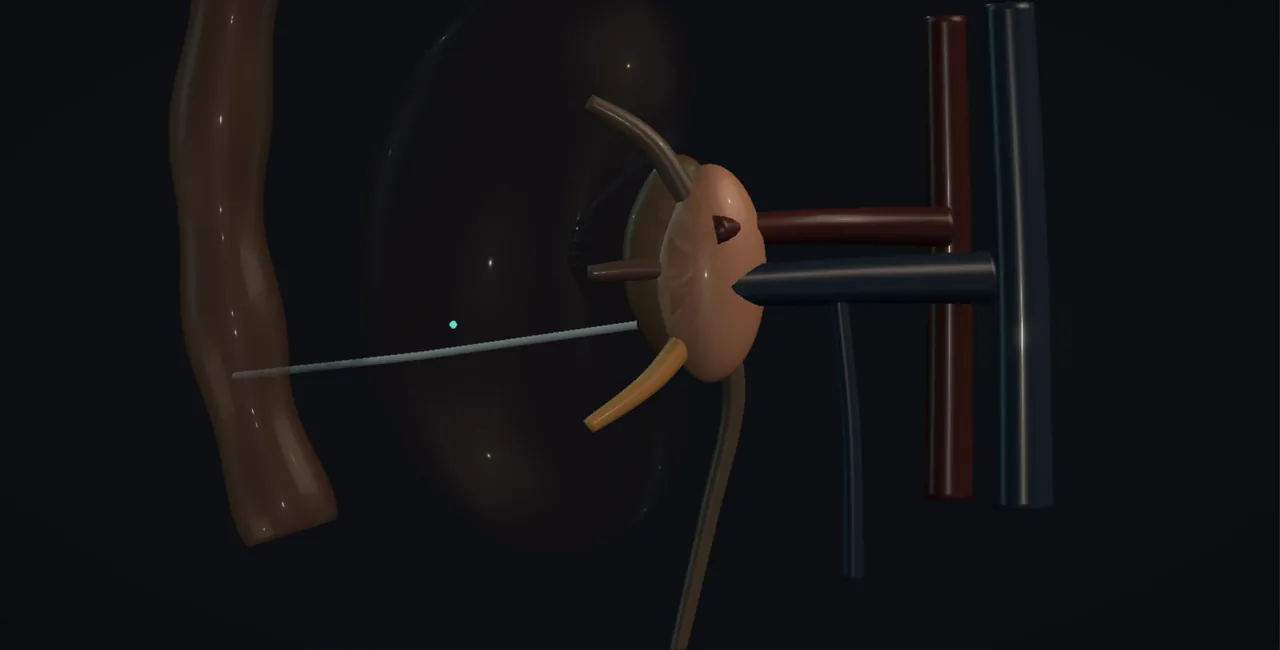 Interactive 3D Interactive emergency nephrostomy and stent Open the 3D animation
Teaching catalogue only. This coverage record is not a patient pathway or operative instruction.
Typical place in practice
Suspected infection behind upper-tract obstruction, or threatened renal function requiring urgent drainage after resuscitation and antimicrobial treatment begin.
Alternatives and neighbouring procedures
The choice between stent and nephrostomy depends on anatomy, stability, access and local expertise; definitive obstruction treatment is generally a later step.
Same procedure family, explicit technique branches
These are variations of this canonical operation. Complication modules below identify whether they apply to all branches or only to named approaches.
Retrograde ureteric stent
Traverses the obstruction from below and drains internally to the bladder.
Percutaneous nephrostomy
Drains externally through a flank catheter without traversing the ureter.
Open or surgical drainage
A rare rescue pathway when minimally invasive drainage cannot be established during required surgery.
High-level sequence
Coverage outline only; not a step-by-step technical guide.
- Resuscitate and identify the obstructed infected system
- Select the fastest safe drainage route for the anatomy and patient
- Establish access without pressurising the infected system
- Confirm free drainage and obtain appropriate specimens
- Stabilise before planning definitive obstruction treatment
Every failure mode is its own module.
Timing and variation coverage are recorded for each module.
Clinical deterioration or septic shock during drainage
Instrumentation and incomplete drainage can release infected material into the circulation.
Applies to: All variantsFailure to access or adequately drain the system
A misplaced, blocked or incompletely positioned drain may not relieve the infected obstruction.
Applies to: All variantsUreteric perforation or false passage
Wire and stent passage through inflamed or impacted anatomy can breach the ureter.
Applies to: Retrograde ureteric stentBleeding or adjacent-organ injury
Percutaneous or operative access can injure renal vessels, pleura, bowel or solid organs.
Applies to: Percutaneous nephrostomy · Open or surgical drainageDrain or stent displacement, blockage or encrustation
Temporary drainage devices require an explicit exchange or removal plan.
Applies to: All variantsMissed or delayed definitive treatment
Emergency drainage does not remove the stone or correct the underlying obstruction.
Applies to: All variantsSources for this module
SWL, ureteroscopy, RIRS, PCNL, bladder stones and decompression options.
Accessed 2026-08-03 · opens source European Association of Urology EAU Guidelines on Urological TraumaRenal, ureteric, bladder, urethral and genital trauma and reconstruction.
Accessed 2026-08-03 · opens source British Association of Urological Surgeons Patient information leaflets by procedureUK patient-facing procedure, alternatives, recovery and complication framing.
Accessed 2026-08-03 · opens source