
Fournier gangrene debridement and reconstruction pathway
Emergency source-control surgery with planned serial reassessment, organ protection, urinary/faecal diversion when required and delayed reconstruction.
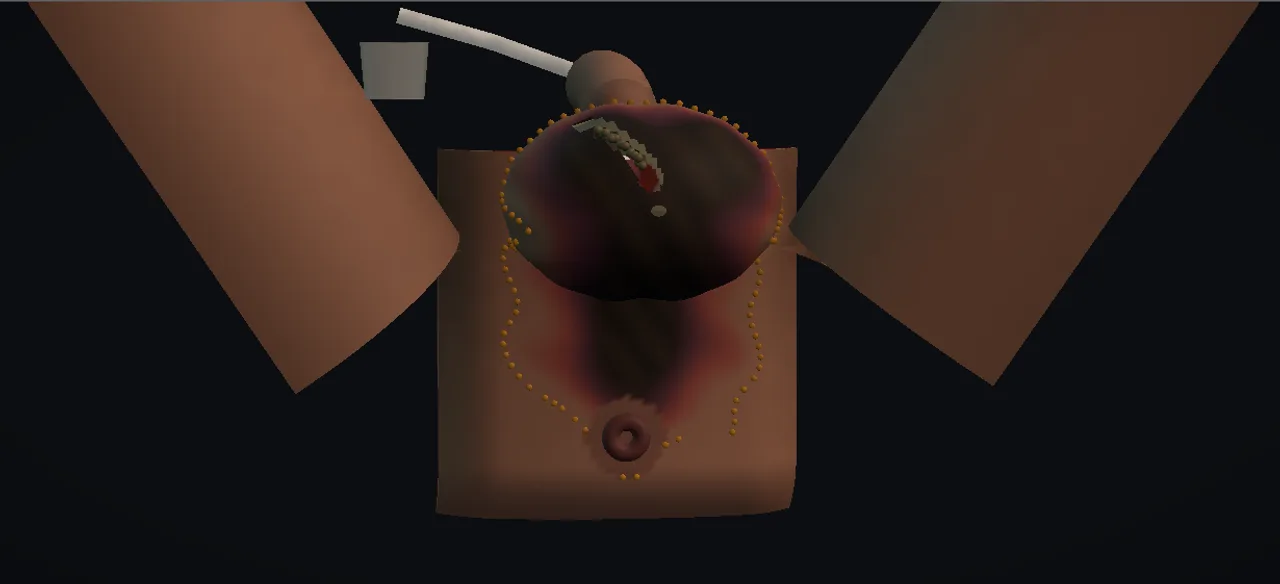 Interactive 3D Interactive Fournier debridement Open the 3D animation
Teaching catalogue only. This coverage record is not a patient pathway or operative instruction.
Typical place in practice
Suspected or confirmed necrotising infection of perineal, genital or lower abdominal fascial planes with systemic or rapidly progressive local features.
Alternatives and neighbouring procedures
Antimicrobial and critical-care treatment are essential parallel measures but do not replace indicated operative source control.
Same procedure family, explicit technique branches
These are variations of this canonical operation. Complication modules below identify whether they apply to all branches or only to named approaches.
Initial radical debridement
Removes necrotic skin, fascia and soft tissue while defining full disease extent.
Planned repeat debridement
Reassesses progression and removes newly demarcated or residual non-viable tissue.
Urinary or faecal diversion
Protects wounds or bypasses an injured/contaminated outlet in selected anatomy.
Delayed reconstruction
Restores coverage once infection control and tissue viability are established.
High-level sequence
Coverage outline only; not a step-by-step technical guide.
- Resuscitate and establish multidisciplinary source-control plan
- Explore beyond visible skin change to define fascial spread
- Excise all non-viable tissue and obtain diagnostic specimens
- Protect testes, urethra and rectum and plan repeat inspection
- Reconstruct only after infection and tissue viability are controlled
Every failure mode is its own module.
Timing and variation coverage are recorded for each module.
Persistent or progressive necrotising infection
Residual non-viable tissue or disease beyond the explored field can perpetuate sepsis.
Applies to: All variantsMajor bleeding or adjacent-organ injury
Inflamed tissue planes obscure vessels, urethra, rectum and corporal structures.
Applies to: All variantsCritical illness, organ failure or death
Severe systemic toxicity can continue despite local source control.
Applies to: All variantsUrinary or faecal fistula and diversion complication
Underlying organ injury and diversion procedures add leakage, obstruction and stoma risks.
Applies to: Urinary or faecal diversionLarge wound, scarring and contracture
Survival may be followed by prolonged wound care, deformity and functional restriction.
Applies to: All variantsGraft or flap loss
Residual contamination, poor vascularity or shear can compromise reconstructive coverage.
Applies to: Delayed reconstructionSexual, urinary and psychological dysfunction
Tissue loss, prolonged illness and altered body image can have durable multidomain consequences.
Applies to: All variantsSources for this module
Renal, ureteric, bladder, urethral and genital trauma and reconstruction.
Accessed 2026-08-03 · opens source British Association of Urological Surgeons Patient information leaflets by procedureUK patient-facing procedure, alternatives, recovery and complication framing.
Accessed 2026-08-03 · opens source