
Intervention for renal trauma
A multidisciplinary hub for angioembolisation, endourological drainage and operative renal exploration in haemorrhage or urinary extravasation.
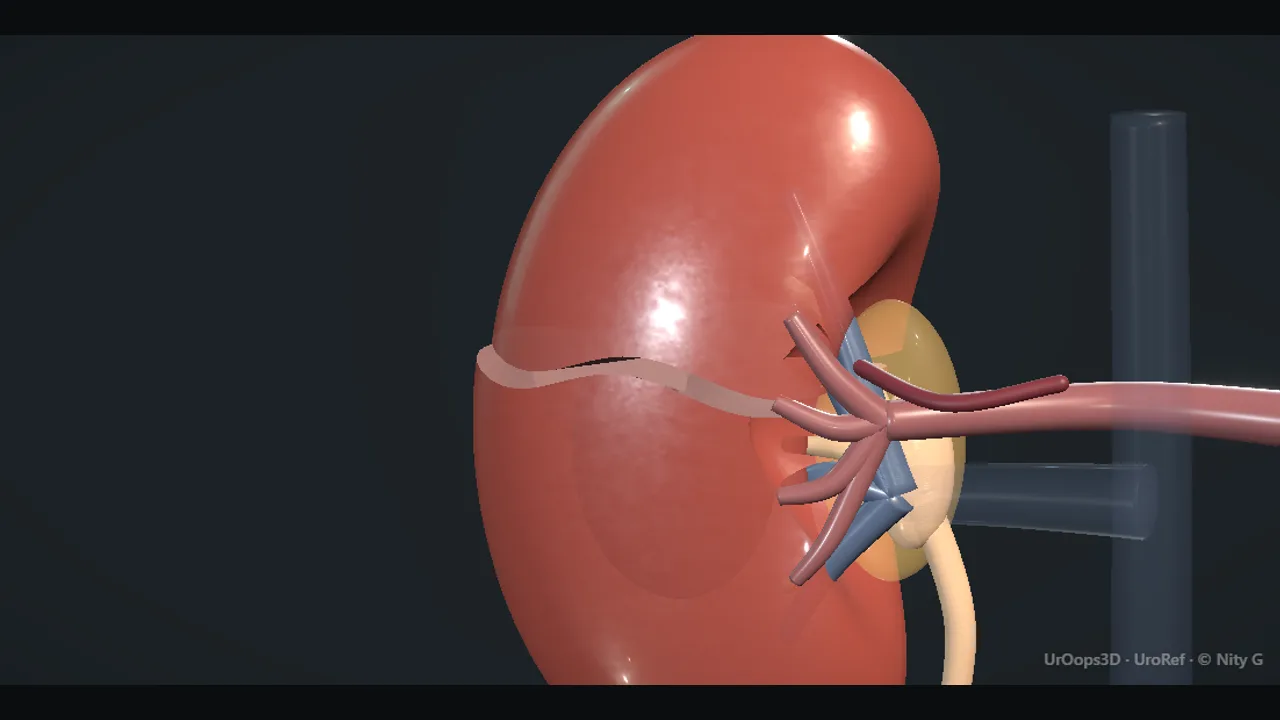 Interactive 3D Interactive case model Open the 3D animation
Teaching catalogue only. This coverage record is not a patient pathway or operative instruction.
Typical place in practice
Ongoing haemorrhage, haemodynamic concern, vascular lesion, failed non-operative care, expanding urinoma or associated injury requiring intervention.
Alternatives and neighbouring procedures
Observation with structured monitoring is preferred for many stable injuries; intervention is matched to physiology, injury pattern and available expertise.
Same procedure family, explicit technique branches
These are variations of this canonical operation. Complication modules below identify whether they apply to all branches or only to named approaches.
Selective renal angioembolisation
Controls a focal vascular source while aiming to preserve functioning renal tissue.
Ureteric stent or percutaneous drainage
Treats selected ongoing extravasation or urinoma without open renal exploration.
Renal exploration and repair
Controls bleeding and repairs or packs viable renal tissue when feasible.
Trauma nephrectomy
Prioritises haemorrhage control when renal preservation is unsafe.
High-level sequence
Coverage outline only; not a step-by-step technical guide.
- Define physiology, mechanism, contralateral kidney and associated injuries
- Choose observation, endovascular, drainage or operative pathway
- Control haemorrhage before extensive haematoma disruption
- Preserve viable renal tissue and drain significant urinary leakage when feasible
- Monitor renal function, delayed bleeding, infection and blood pressure
Every failure mode is its own module.
Timing and variation coverage are recorded for each module.
Uncontrolled or recurrent haemorrhage
Vascular injury can persist, recur or arise from a pseudoaneurysm after initial control.
Applies to: All variantsRenal loss or impaired renal function
The injury, vascular control and resection all determine preserved renal function.
Applies to: All variantsUrinary leak, urinoma or fistula
Collecting-system disruption may persist despite haemorrhage control.
Applies to: All variantsInfection or abscess
Devitalised tissue, haematoma and urine collections can become infected.
Applies to: All variantsAdjacent-organ or great-vessel injury
Emergency retroperitoneal dissection can injure bowel, pancreas, spleen, liver or major vessels.
Applies to: Renal exploration and repair · Trauma nephrectomyEmbolisation-related infarction or non-target injury
Arterial occlusion can sacrifice more renal tissue than intended or affect another vascular territory.
Applies to: Selective renal angioembolisationDelayed hypertension
Renal vascular or parenchymal injury can have later blood-pressure consequences.
Applies to: All variants