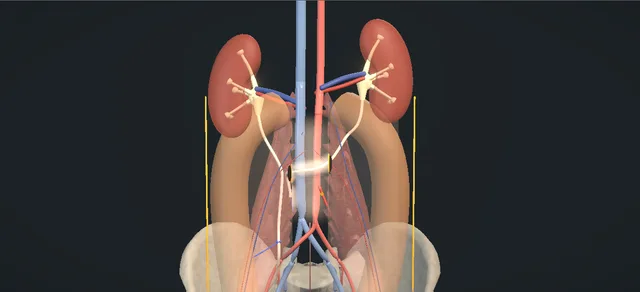
Operative Dictations in Urologic Surgery
Armenakas NA, Fracchia JA, Golan R. Transureteroureterostomy. Chapter 52. Wiley, 2019
Indications, the five essential steps, the variations (a retroperitoneal approach for select distal cases, tapering or reimplanting the recipient first, an omental or peritoneal flap, a stent in the recipient) and the complication list. Book sizes kept off the scene: the length mobilised, the lengths of the spatulation and the ureterotomy, the catheter and the suture gauges. The dictation places no stent, and none is drawn. The chapter does not describe a tie on the lower stump, vessel loops, the instrument that leads the ureter through the window, or the gonadal vessels being swept laterally; these are drawn from general practice. It lists no contraindications; those on this page are from Burks and Santucci.
Open guideline
EAU Guidelines
Urological Trauma: ureteral trauma, proximal and mid-ureteral injury (section 4.2.4.b.2.a) and the principles of surgical repair (Table 4.2.2), read 13 October 2026
Transureteroureterostomy is a valid option in extensive ureteral loss; a stenosis rate of 4 per cent and reintervention or revision in 10 per cent are quoted, figures that match the Iwaszko series below. Principles of repair: debridement, spatulation, a watertight tension-free mucosa-to-mucosa anastomosis with absorbable sutures, an internal stent, an external drain, and isolation with peritoneum or omentum.
Open guideline
Journal of Urology
Iwaszko MR, Krambeck AE, Chow GK, Gettman MT. Transureteroureterostomy revisited: long-term surgical outcomes. J Urol 2010;183:1055-1059. doi 10.1016/j.juro.2009.11.031 (abstract read 13 October 2026)
63 patients over 22 years, both directions used, 16 with radiation beforehand. Of the 56 with follow-up imaging the join was patent in 54 and obstructed in 2. Stones developed in 8 (two percutaneous operations, one ureteroscopy, two passed, three watched). Six needed a later intervention for obstruction or revision.
Open guideline
Therapeutic Advances in Urology
Burks FN, Santucci RA. Management of iatrogenic ureteral injury. Ther Adv Urol 2014;6:115-124. doi 10.1177/1756287214526767 (PMC4003841), read 13 October 2026
Contraindications: a donor too short to cross without tension, and disease of the recipient ureter such as urothelial carcinoma, urolithiasis or retroperitoneal fibrosis. The donor is passed under the sigmoid colon through the mesentery, very little of the recipient is mobilised, and the donor is stented with the stent passing down the recipient to the bladder (their practice; the dictation in the book places no stent, and none is drawn here).
Open guideline
International Journal of Colorectal Disease
Richter S, Kollmar O, Lindemann W, Schilling MK. Transureteroureterostomy allows renal sparing radical resection of advanced malignancies with rectosigmoid invasion. Int J Colorectal Dis 2007;22:949-953. doi 10.1007/s00384-006-0235-1 (abstract read 13 October 2026)
Fifteen transureteroureterostomies after multivisceral resection. The three patients operated on without double J stents needed a percutaneous nephrostomy: two for a leak at the join and one for bilateral hydronephrosis from a stenosis. The authors recommend double J stents in both ureters at the operation.
Open guideline