
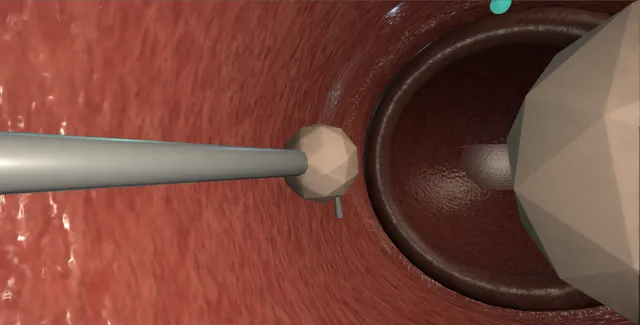
UrOops3D, danger-zone atlas
Operative animation, Urethral bulking injection

Urethral bulking injection

A small volume of inert gel placed under the mucosa of the proximal urethra so that the walls meet at rest and stress leakage stops, or lessens. Done under local anaesthetic through a cystoscope in twenty minutes, with modest and fading benefit and the near certainty of a repeat.

This page is the honest expectations, the depth and the sites, the endpoint of coaptation, and the retention that follows an injection done too well.

Core tier FRCS functional urology, stress incontinence Interactive 3D

Operative visualisation

Schematic scene preview: Urethral bulking injection
Preparing the 3D anatomy…

UrOops3D · UroRef · © Nity G

Click me next Section 2 of 8 Anatomy The structures this operation works between, and the one it must not cross.

The structures in the scene

Urethral bulking injection: how the structures relateThrough the 0 degree lens into the wall of the proximal urethra. Lumen and the injection needle: behind the sheath; bulking beside it: retention External sphincter (danger). Lumen and the injection needle: shallow angle at three and nine, bevel to lumen Mucosa a centimetre below the neck. Mucosa a centimetre below the neck: not the target; gel into it obstructs Bladder neck (danger). Mucosa a centimetre below the neck: a few millimetres in, the dome rises Submucosal plane. Submucosal plane: through the wall: blood, no dome, gel lost Periurethral vessels (danger).LumenPeriurethral tissueLumen and the injectionneedle!ExternalsphincterMucosa a centimetre belowthe neckBladder neckSubmucosal plane!Periurethral vesselsbehind the sheath;bulking beside it:retentionshallow angle at three andnine, bevel to lumennot the target; gelinto it obstructsa few millimetres in, the domerisesthrough the wall: blood, nodome, gel lostTargetDangerLandmarkContext
Through the 0 degree lens into the wall of the proximal urethra. Schematic, not to scale; relationships only.
  • The lens sits in the proximal urethra with the bladder neck at the top of the view and the sphincter behind the sheath.
  • The needle leaves the channel, enters the mucosa at three o'clock a centimetre below the neck at a shallow angle, and the gel raises a dome that grows toward the midline; nine o'clock is the mirror.
  • The endpoint is the two domes meeting so that the lumen is closed at rest; the atlas is male, and in the woman the urethra is shorter and the sites are often four and eight.
  • ›Proximal urethra, a centimetre below the neck - the injection site; mucosa thick enough to hold the gel and far enough from the neck and the sphincter.
  • ›Bladder neck - the landmark at the top of the view; gel placed into it obstructs, and the neck is not the target.
  • ›External sphincter - distal to the site in both sexes; bulking beside it causes retention and does not help leakage.
  • ›Submucosal plane - a few millimetres in; the only plane where the dome rises; deeper and the gel is lost to the periurethral tissue.
  • ›Periurethral vessels - a needle through the wall meets them; the sign is blood in the lumen and a dome that does not rise.
  • ›The injection needle and the 0 degree lens - the needle seen straight out of the sheath at a shallow angle, bevel to the lumen.
  • ›The atlas - a male lower tract; in the woman the urethra is short, the sites are often four and eight, and the principle is identical.
Click me next Section 3 of 8 Steps The operation in order, with the landmark that guards each move.

Operative steps

  1. Who, and the honest expectations Stress urinary incontinence with a urethra that does not move much on straining, intrinsic sphincter deficiency rather than hypermobility: the woman after previous continence surgery, the frail or elderly woman who will not tolerate a sling or colposuspension, the woman who wants to avoid mesh, and the man with mild leakage after prostatectomy who declines a sling or sphincter. The counselling is the operation: about two thirds are improved at a year, fewer are dry, the effect fades, and most who benefit will want a repeat within a few years. It is less effective than a sling and is offered as a lesser procedure, not a lesser sling.
  2. The agents and the consent The agents in current UK use are a polyacrylamide hydrogel and a silicone particle suspension, with older collagen and carbon-bead products largely gone; each has its own needle and syringe system, and the department uses one. The consent names urinary infection, transient retention needing a catheter or a few days of self-catheterisation, haematuria and dysuria, a lump or granuloma at the injection site, migration or extrusion of material into the lumen, no benefit, and the fading benefit that means repeat injection. The patient stops anticoagulants where the local protocol allows and gives a urine sample: an infected urine cancels the list.
  3. Cystoscopy under local anaesthetic Lithotomy, lidocaine gel in the urethra for a few minutes, and a rigid cystoscope with a 0 or 12 degree telescope, because the needle must be seen coming straight out of the sheath toward the wall. In a woman the urethra is short and the bladder neck is a few centimetres in; in a man the scope passes the sphincter and the prostatic or post-prostatectomy urethra to the neck. The bladder is inspected and emptied. The scope is drawn back so that the neck sits at the top of the view and the proximal urethra fills the field: the injection is made here, not at the neck and not at the sphincter.
    where it bites: the site is the proximal urethra with the neck at the top of the view; gel at the neck or beside the sphincter obstructs and does not stop leakage.
  4. Three and nine, a centimetre below the neck The injection needle passes through the working channel and out past the lens. The site is the proximal urethra about a centimetre distal to the bladder neck, where the mucosa is thick enough to hold the gel. The needle enters the mucosa at three o'clock at a shallow angle, bevel toward the lumen, and advances a few millimetres so that the tip lies in the submucosa, not in the muscle beyond it and not through the wall. In women the sites are often four and eight o'clock, with a third deposit at twelve or six to complete the ring. The plane is everything: too deep and the gel disappears into the periurethral tissue and does nothing.
    where it bites: the needle in the submucosa a few millimetres deep; through the wall the gel is lost and may bleed, at the neck or the sphincter it obstructs.
  5. Slowly, watching the bulge The gel is injected slowly, half a millilitre to a millilitre or so at each site, while the lens watches the mucosa rise into a smooth dome that grows toward the midline. If the mucosa blanches or the dome flattens and spreads instead of rising, the needle is too deep; it is withdrawn a little and the injection resumed. If gel appears in the lumen the mucosa has torn and that site is abandoned. The needle is held still for a few seconds after the injection before it is withdrawn, so that the gel does not follow it out of the puncture. The mirror site at nine is done the same way.
    where it bites: gel appearing in the lumen means the mucosa has torn; that site is finished and no more is put into it.
  6. The endpoint: coaptation The endpoint is the walls of the urethra meeting in the midline, the lumen closed at rest with the domes touching, and a scope that has to be advanced a little to pass. It is judged with the lens drawn back to see the whole ring, and the bladder must be empty so that the picture is not distorted. Too little and the leakage continues; too much and the patient goes into retention. A third deposit completes the ring if a gap remains. The total volume is small, and the maximum for the agent is not exceeded to chase a perfect picture: a second session is the correct answer to an incomplete result, not more gel today.
  7. The periurethral alternative and the check The periurethral route places the needle beside the meatus at three and nine, through the skin, and advances it parallel to the urethra to the same depth while the cystoscope watches the bulge from inside. It avoids the mucosal puncture and may be preferred for some agents, but the needle position is inferred rather than seen and the volume tends to be greater. Whichever route is used the check is the same: the cystoscope drawn back to see the closed ring and then passed once more into the bladder, without force, to confirm that the closure yields to an instrument and so will yield to a void.
  8. After: void, retention, repeat No catheter if possible: the patient voids in recovery and a residual is scanned before discharge. Retention or a large residual is expected in some, and is treated with a small catheter, 10 or 12 French, for a day or two, or a short period of intermittent self-catheterisation; a large indwelling catheter compresses and displaces the gel. Antibiotic prophylaxis is a single dose. Review is at about three months with a pad test or symptom score. A partial response is topped up at a second session; a complete failure after two sessions means the agent is not going to work and the ladder moves to a sling, colposuspension or, in the man, a sling or sphincter. The note records the agent, sites, volumes, the endpoint seen and the residual.
Click me next Section 4 of 8 Danger zones Where this operation bites, and why it bites there.
Critical relationship

Danger zones

The spatial relationships the animation is built to make automatic. Before you read each one, ask yourself: at this point in the operation, what is about to go wrong, and what is my first move? The save for each sits in the Complications tab.

  • RiskThrough the wall - the needle beyond the submucosa: blood in the lumen, no dome, and gel lost into the periurethral tissue.
  • RiskAt the neck or the sphincter - gel here obstructs without helping leakage; the site is a centimetre below the neck.
  • RiskToo much - a perfect picture with a lumen that will not yield: retention. A second session, not more gel today.
  • RiskInfected urine - bulking into an infected urethra risks abscess and sepsis; the list is cancelled on a positive dipstick.
Practise it Take me into the scene Opens the animation at a danger moment and asks you to predict the mechanism and your first move before it reveals.
Click me next Section 5 of 8 Complications The save for each one: the first move, the escalation trigger, the op-note line.

Complications and immediate saves

Trigger each of these live in the Animation tab, then read the save: the first move, the escalation trigger, and the line that goes in the op note.

Retention or a large residual

  • the lumen closed too well, or oedema at the sites: the patient cannot void in recovery, or voids and leaves a large residual.
The save
  1. Scan the residual; if she cannot void or the residual is large, drain with a 10 or 12 French catheter, not a large one. first move
  2. A day or two of a small indwelling catheter, or intermittent self-catheterisation, while the oedema settles.
  3. Retention persisting beyond about a week: cystoscopy, and consider needling or aspirating the deposit if the agent allows. escalation trigger
  4. Note: the residual, the catheter size and the review date. document

Urinary infection or abscess at the site

  • dysuria and frequency in the days after are common; fever, a tender urethral mass or purulent discharge is an infected deposit.
The save
  1. Culture the urine and start antibiotics by the local protocol. first move
  2. A tender urethral mass or fever: examine the urethra, ultrasound or MRI if a collection is suspected.
  3. An abscess or a systemically unwell patient: admit, intravenous antibiotics, and drainage or excision of the infected deposit with senior involvement. escalation trigger
  4. Note: the organism, the imaging, the antibiotic and whether the deposit was removed. document

Bleeding or urethral injury

  • the needle through the wall or a torn mucosa: blood in the lumen at injection, haematuria afterwards.
The save
  1. Stop injecting at that site; irrigate and look; do not put more gel into a bleeding puncture. first move
  2. Complete the other sites if the view allows; otherwise abandon and rebook.
  3. Persistent haematuria, clot retention or a haematoma: a small catheter, observation, and senior review if it does not settle. escalation trigger
  4. Note: the site, what was seen, the volume placed and the plan to complete. document

Migration, granuloma or extrusion

  • a lump at the injection site, gel or particles appearing in the lumen, or a deposit felt on vaginal examination months later.
The save
  1. Examine and cystoscope: an extruded deposit in the lumen is usually visible and often obstructive. first move
  2. Asymptomatic lumps are left alone; the patient is reassured and the finding recorded.
  3. Obstruction, pain or a discharging sinus: endoscopic or open excision of the deposit by a reconstructive urologist. escalation trigger
  4. Note: the agent and volume originally used, the finding, and the referral. document

No benefit or fading benefit

  • the leakage unchanged at three months, or back after a year of improvement: the expected course for many.
The save
  1. A symptom score or pad test at three months against the baseline; decide with the patient whether it was partial or nil. first move
  2. A partial response is topped up at a second session; the sites are checked at cystoscopy and gaps filled.
  3. Nothing after two sessions: stop injecting, and offer the next rung, a sling or colposuspension in the woman, a sling or artificial sphincter in the man, after urodynamics. escalation trigger
  4. Note: the outcome measure, the number of sessions, and the discussion of alternatives. document
Click me next Section 6 of 8 Troubleshooting When the case turns: the problem, then the next move.

Intra-operative troubleshooting

When the case turns: the problem, then the next move.

  • ActionThe needle will not enter the mucosa - the angle is too shallow or the bevel is wrong; steepen slightly, bevel to the lumen, and advance with the wall in view.
  • ActionNo dome rises on injecting - the needle is too deep; withdraw a millimetre or two until the mucosa starts to lift.
  • ActionGel appears in the lumen - the mucosa has torn; abandon that site and use another clock position for the ring.
  • ActionThe walls will not meet after three sites - accept an incomplete ring; the maximum volume is not exceeded, and a second session is planned.
  • ActionCannot pass the scope into the bladder after the injection - the closure is too tight; gentle passage without force, and a small catheter left if she cannot void.
  • ActionDipstick positive on the morning of the list - cancel and treat; bulking into infected urine is an abscess waiting to happen.
Click me next Section 7 of 8 FRCS viva Say it out loud, then mark yourself against the model answer.

FRCS viva questions

The examiner stems this scene prepares you for. Try to answer out loud first, then reveal, and learn the discriminator, the detail that turns a pass into a strong pass.

QA woman with stress incontinence asks about a bulking injection instead of a sling. What would you tell her?reveal answer
  • I would first confirm that her leakage is stress incontinence, with a bladder diary, examination showing leakage on cough, and urodynamics if the picture was mixed or she had had previous surgery.
  • I would explain that bulking places a small volume of gel under the lining of the urethra near the bladder neck so that the walls meet and leakage lessens, that it is done under local anaesthetic as a day case, and that it is quick with a rapid recovery.
  • I would be honest about the results: about two thirds improved at a year, fewer completely dry, an effect that fades so that most who benefit need a repeat within a few years, and lower and less durable success than a mid-urethral sling, colposuspension or autologous fascial sling, which NICE lists as the more effective options.
  • It suits the woman who wants to avoid mesh or a bigger operation, the frail woman, and the woman with a poorly mobile urethra after previous surgery.
  • I would consent her for infection, transient retention needing a catheter, haematuria, a lump or extrusion of gel, and no benefit.
Strong pass

Say both

  • Quoting the approximate benefit and its fading honestly
  • Positioning bulking as a lesser procedure with lower success rather than an equivalent to a sling
Examiner note
Quoting the approximate benefit and its fading honestly, and positioning bulking as a lesser procedure with lower success rather than an equivalent to a sling.
QDescribe the technique of transurethral bulking.reveal answer
  • With the patient in lithotomy under local anaesthetic gel, and a single dose of antibiotic, I would pass a rigid cystoscope with a 0 or 12 degree telescope, inspect and empty the bladder, and withdraw the scope so that the bladder neck sat at the top of the view and the proximal urethra filled the field.
  • I would pass the injection needle through the working channel and enter the mucosa at a shallow angle about a centimetre distal to the bladder neck, at three and nine o'clock in a man or often four and eight in a woman, advancing a few millimetres into the submucosal plane.
  • I would inject the agent slowly while watching a smooth dome rise toward the midline, pausing before withdrawing the needle so the gel did not follow it out, and repeat at the mirror site with a third deposit if needed to complete the ring.
  • The endpoint is coaptation, the walls meeting so that the lumen is closed at rest, checked with the lens drawn back and the bladder empty, and I would not exceed the agent's maximum volume.
  • I would confirm the scope still passed gently, then have her void and scan the residual before discharge.
Strong pass

Say all three

  • The submucosal plane a centimetre below the neck with the dome watched
  • Coaptation as the endpoint
  • The refusal to exceed the volume today
Examiner note
The submucosal plane a centimetre below the neck with the dome watched, coaptation as the endpoint, and the refusal to exceed the volume today.
QWhat are the complications of bulking and how are they managed?reveal answer
  • The early complications are transient retention or a large residual from over-coaptation or oedema, managed with a small 10 or 12 French catheter for a day or two or short-term self-catheterisation rather than a large catheter that displaces the gel;
  • urinary infection, prevented by a negative urine before the list and single-dose prophylaxis;
  • and haematuria or dysuria from the punctures, which settle.
  • The needle through the wall causes bleeding and loses the gel into the periurethral tissue, avoided by keeping the tip submucosal and watching the dome.
  • The late complications are a granuloma or lump at the site, migration or extrusion of material into the lumen, which can obstruct and may need excision, and a periurethral abscess or pseudocyst, which needs imaging, antibiotics and drainage.
  • The commonest outcome problem is no benefit or a fading benefit, which is managed by a second injection for a partial response and by moving to a sling, colposuspension or, in a man, a sling or artificial sphincter after two failed sessions.
  • Older particulate agents had more migration, which is why current gels are preferred.
Strong pass

Say all three

  • The small catheter for retention
  • The submucosal plane as prevention
  • Knowing when to stop injecting and move up the ladder
Examiner note
The small catheter for retention, the submucosal plane as prevention, and knowing when to stop injecting and move up the ladder.
QA man with mild stress incontinence after radical prostatectomy asks about bulking. What is its place?reveal answer
  • I would first make sure he was at least a year from surgery with pelvic floor physiotherapy completed, that his leakage was stress rather than urgency, quantified with a pad test, and that there was no anastomotic stenosis or residual cancer at cystoscopy.
  • For mild leakage, a pad or two a day, the standard options are a male sling, and for moderate to severe leakage the artificial urinary sphincter, which remains the reference treatment.
  • Bulking has a limited place: the results in men after prostatectomy are worse than in women, cure is uncommon, the effect fades, and repeat injections are usual, so the EAU regard it as an option only for mild leakage in a man who understands its limitations or who is unfit for or declines a sling or sphincter.
  • If he chose it I would inject at three and nine o'clock a centimetre below the bladder neck, in the proximal urethra above the sphincter, avoiding the sphincter itself, with the same endpoint of coaptation, and I would warn him that a later sling or sphincter remains possible.
  • The essential point is honest counselling about a modest, temporary benefit.
Strong pass

Say both

  • Placing bulking below the sling and sphincter in the male ladder with the reasons
  • The timing and assessment before any continence surgery in a man
Examiner note
Placing bulking below the sling and sphincter in the male ladder with the reasons, and the timing and assessment before any continence surgery in a man.
Click me next Section 8 of 8 Evidence The guidance each of these answers is built on.

Evidence and guidance

Two minutes

Close the lap: recall it before you leave.

Say it aloud, then reveal. Reading is not remembering.

  1. 01 The relationship Say the critical spatial relationship out loud, then reveal. reveal
    Memory frame

    The lens sits in the proximal urethra with the bladder neck at the top of the view and the sphincter behind the sheath.

    Why?
    The needle leaves the channel, enters the mucosa at three o'clock a centimetre below the neck at a shallow angle, and the gel raises a dome that grows toward the midline; nine o'clock is the mirror. The endpoint is the two domes meeting so that the lumen is closed at rest; the atlas is male, and in the woman the urethra is shorter and the sites are often four and eight.
  2. 02 The first move Retention or a large residual. Your first move? reveal
    First move

    Scan the residual; if she cannot void or the residual is large, drain with a 10 or 12 French catheter, not a large one.

  3. 03 The escalation trigger Retention or a large residual. What makes you call for help? reveal
    Escalate when

    Retention persisting beyond about a week: cystoscopy, and consider needling or aspirating the deposit if the agent allows.

  4. 04 The discriminator What turns a pass into a strong pass? reveal
    Strong pass

    Say both

    • Quoting the approximate benefit and its fading honestly
    • Positioning bulking as a lesser procedure with lower success rather than an equivalent to a sling
    Examiner note
    Quoting the approximate benefit and its fading honestly, and positioning bulking as a lesser procedure with lower success rather than an equivalent to a sling.
  5. 05 The pitfall Where does this operation bite first? reveal
    Pitfall

    Through the wall

    Why?
    the needle beyond the submucosa: blood in the lumen, no dome, and gel lost into the periurethral tissue.

Revision practice with self-marked answers, not an assessment of clinical competence. Kept in this browser only; it does not sync between devices.