Operative Dictations in Urologic Surgery
Armenakas NA, Fracchia JA, Golan R. Urethral diverticulectomy. Chapter 96. Wiley, 2019
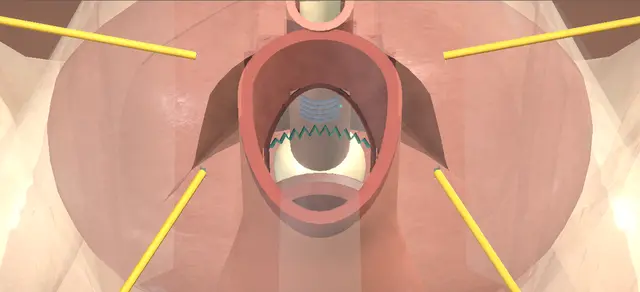
The indication, the six essential steps and their order, the template dictation followed step by step here, the variations (a midline or T incision, circumurethral diverticula, the Martius flap, marsupialisation, a concurrent sling, a vaginal pack) and the complication list: bleeding, infection, incontinence, retention, urethral stricture, dyspareunia, recurrent diverticulum, pseudodiverticulum, urethrovaginal fistula. The chapter lists complications without their management: the first, escalate and document steps, and the danger lines that do not restate the dictation, are general surgical practice and carry no figure. In the scene the sac is a single ventral mid-urethral pouch of an arbitrary size, the flap hangs from its base under its own weight, the cystoscope view is a rendered frame run shared with the cystoscopy modules, and the trimming of the vaginal edges and the irrigation are in the text only.
Open guideline
EAU Guidelines
Non-neurogenic Female LUTS: Disease management, section 4.9 Urethral diverticulum, read 13 October 2026
Magnetic resonance imaging for diagnosis and characterisation, with urethroscopy, voiding cystourethrogram and ultrasound where necessary (weak); ostia seen in only 42% of cases in one series; offer surgical removal of a symptomatic diverticulum (weak); warn of a small (1 to 6%) risk of cancer if managed conservatively (weak); question and investigate for coexisting voiding dysfunction and incontinence (strong); the six principles of transvaginal diverticulectomy; the situations in which a Martius flap is used more frequently; no randomised trials; dry rate 84 to 98% and reoperation 2 to 13% over a mean follow-up of twelve to 50 months; early urinary infection 0 to 39%, de novo stress incontinence 3.8 to 33% and de novo retention 0 to 9%; urethral stricture 0 to 5.2% and urethrovaginal fistula 0.9 to 8.3%; synthetic mid-urethral slings not recommended at the time of diverticulectomy; bothersome stress incontinence addressed with a concomitant non-synthetic sling after counselling (weak); counsel about de novo or persistent symptoms including incontinence (strong). These ranges are pooled from the case series the guideline cites.
Open guideline
International Urogynecology Journal
Bodner-Adler B, Halpern K, Hanzal E. Surgical management of urethral diverticula in women: a systematic review. Int Urogynecol J 2016;27:993-1001
Abstract read 13 October 2026. One hundred and eight studies and 1,947 patients: 40 single case reports and 68 case series, no comparative studies. Transvaginal resection with or without reconstruction in 84%, marsupialisation in 3.8%, endoscopic unroofing in 2.0%. Fifty-six studies documented resolution of symptoms: 717 of 1,044 patients symptom-free after surgery. The authors conclude that the evidence does not allow accurate estimation of success and complication rates. The symptom-resolution figure the guideline quotes is this one, so it is given once.
Open guideline