
Revision sheet
Transurethral cystolitholapaxy
9 steps, each one the authored title and caption from the interactive animation, with the frame captured from that step. Read it before the case, or print it and work through the steps in order.
Teaching only, not for diagnosis or treatment decisions. The text on this sheet is the animation's own step copy, reproduced verbatim.
UrOops3D · UroRef · © Nity G
- 01
Urethral access under vision
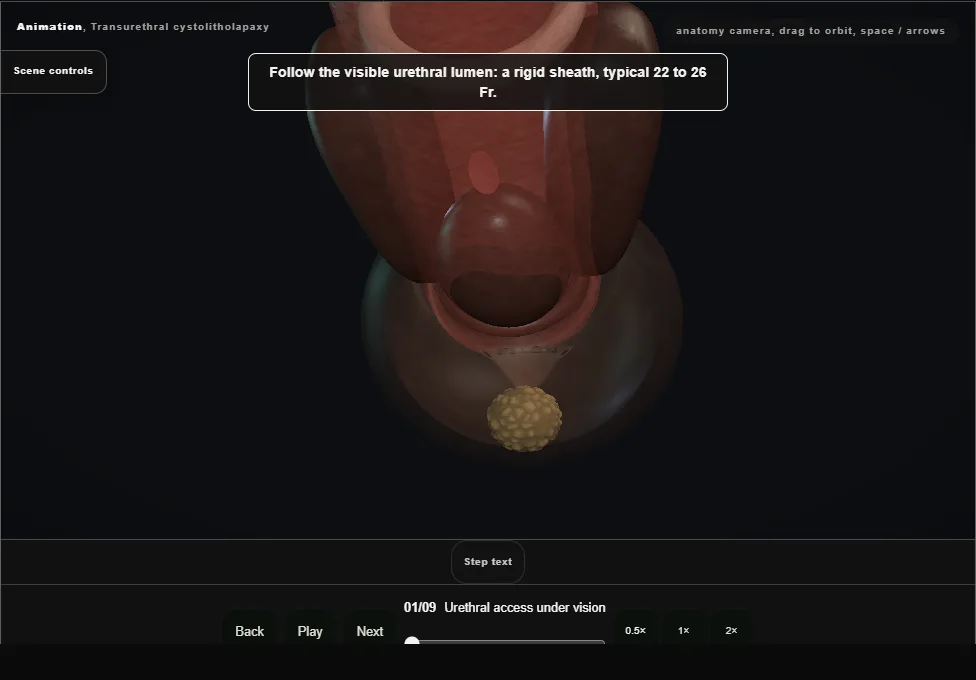
- The scope follows the visible urethral lumen from the meatus to the bladder: a rigid sheath, typical 22 to 26 Fr, or a nephroscope.
- Instrument calibre is matched to the urethra; resistance means reassessment, not a harder push.
- 02
Cystoscopy + stone burden
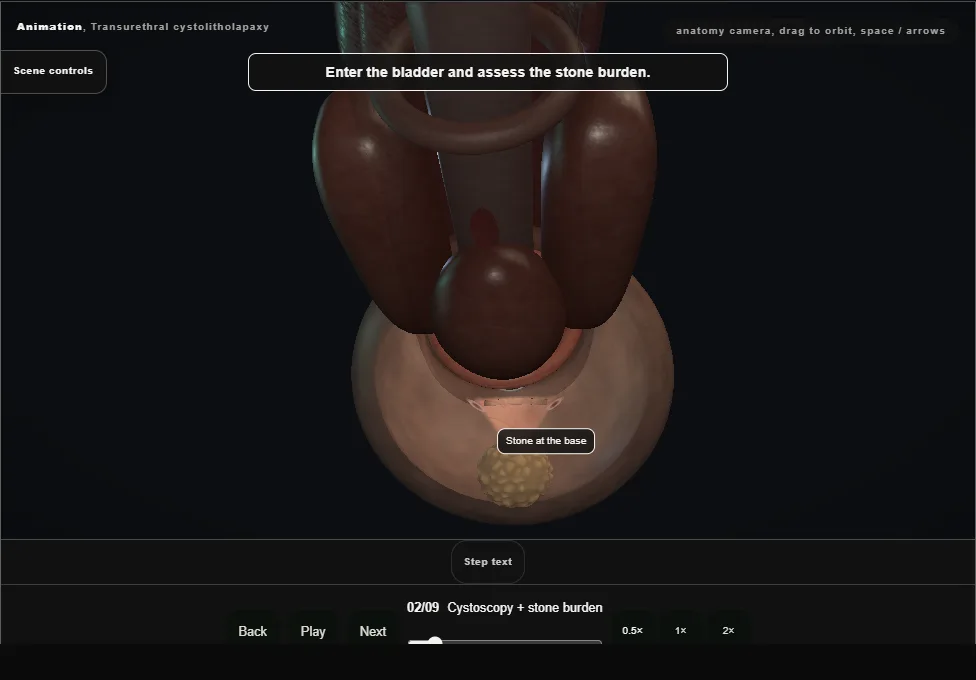
- The scope climbs to the bladder and the fill is kept moderate.
- Burden is judged before anything is broken: size, number, hardness, and the state of the outlet the stone grew behind.
- 03
Fragmentation
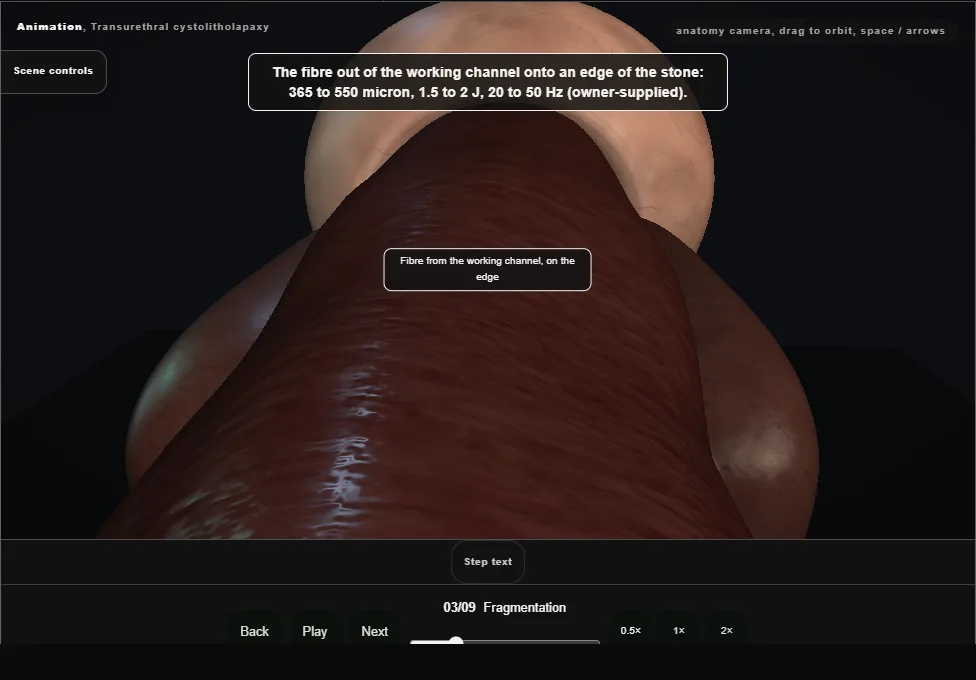
- The fibre comes out of the working channel and works the stone from one edge, not the centre: the stone breaks into pieces and each piece into chips small enough for the sheath, the wall in view behind every shot.
- The larger core, 365 to 550 micron, at 1.5 to 2 J and 20 to 50 Hz (owner-supplied).
- The stone punch is the mechanical alternative, shown at the end.
- 04
Evacuation under vision
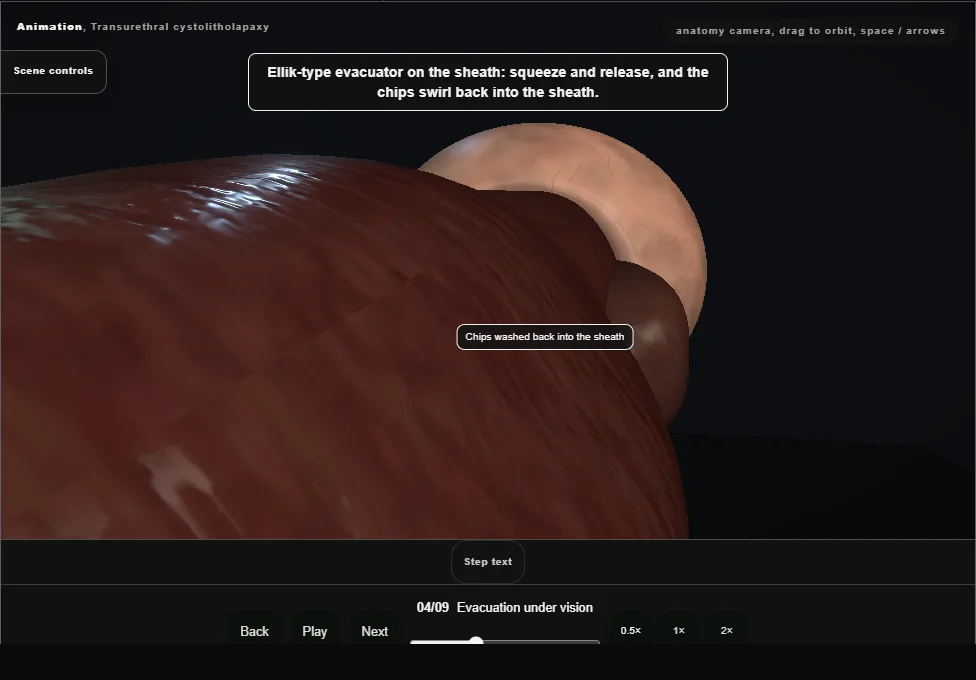
- An Ellik-type evacuator on the sheath: each squeeze and release washes the chips back into the sheath under vision.
- A piece too large to pass is refused at the sheath and lasered again.
- Over-distension is the enemy here: a thin dome under pressure is one cough away from a perforation.
- 05
Final survey
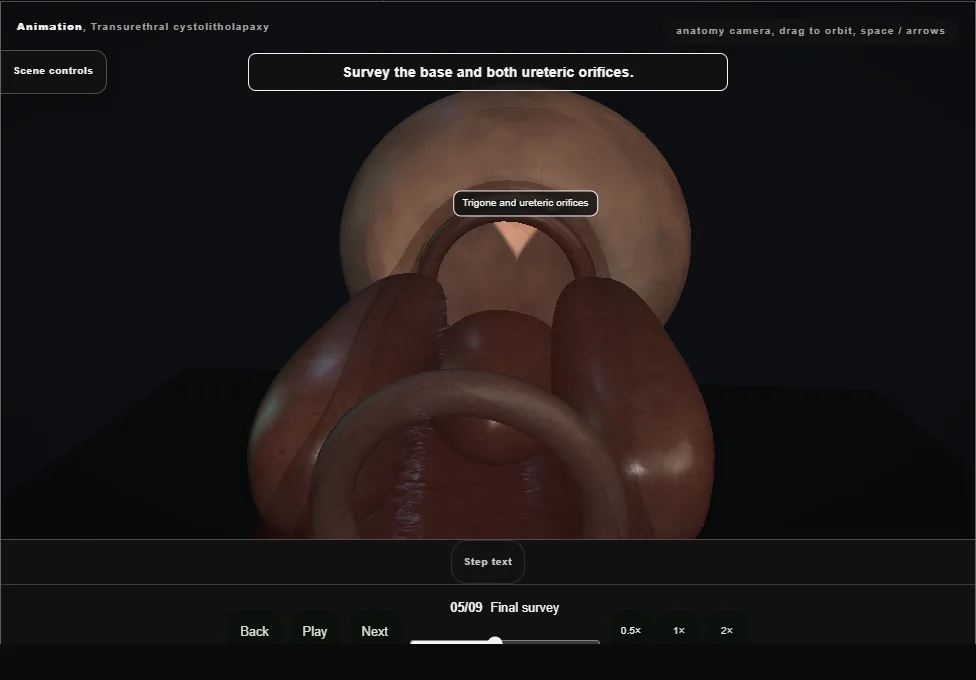
- The full mucosa is inspected systematically, base to dome, every wall.
- The stone was the presentation; the bladder behind it is the diagnosis.
- 06
Treat the cause
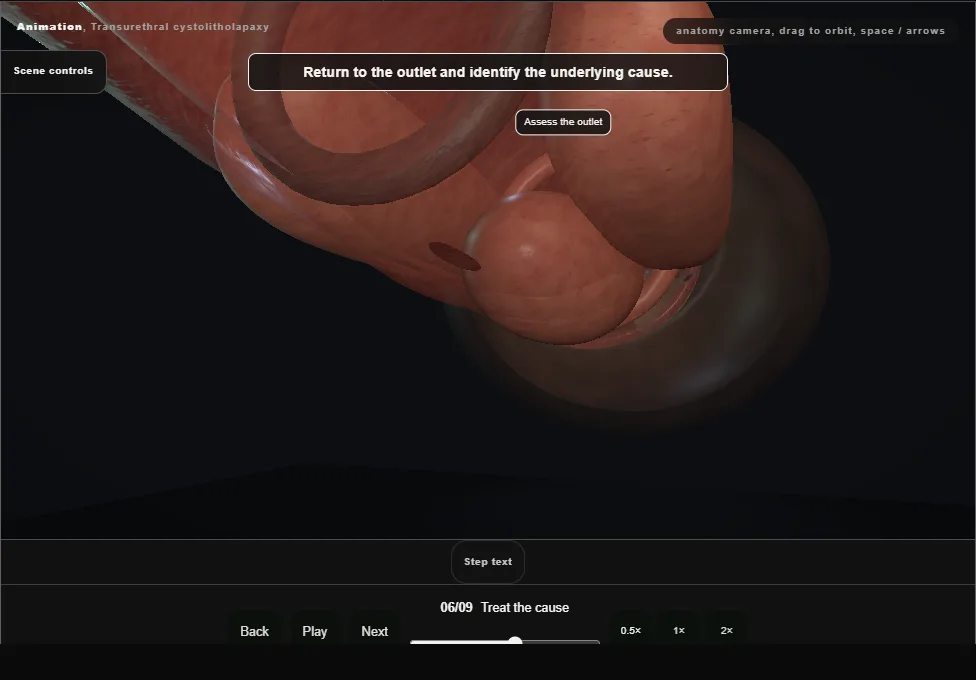
- A bladder stone is a symptom of the outlet.
- The obstructing prostate, a long-term catheter, a neurogenic bladder: the cause gets a plan the same day or it grows the next stone.
- 07
Exit + catheter decision
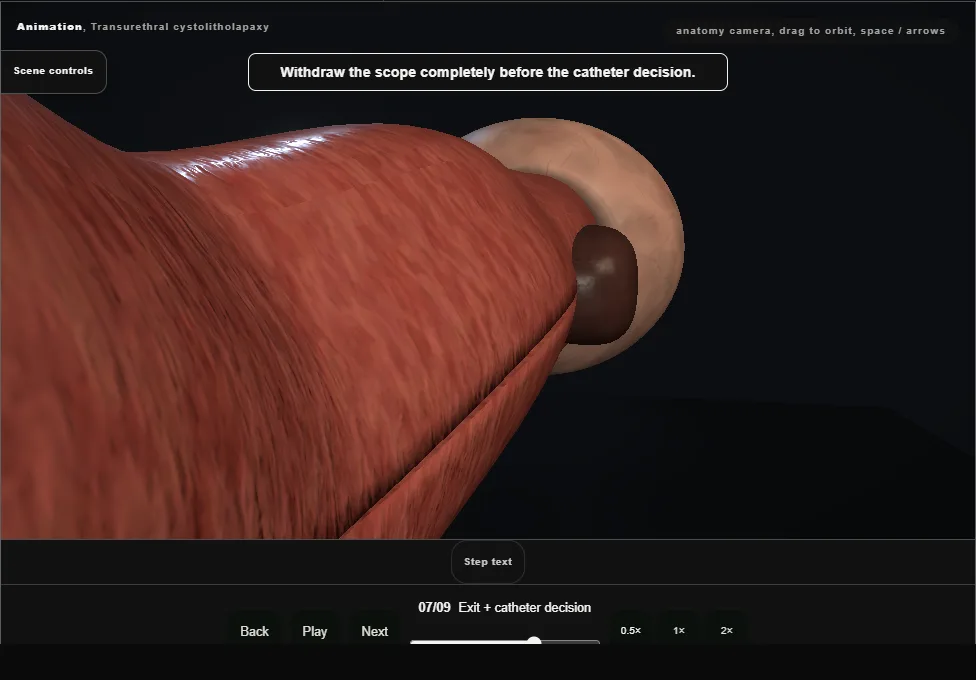
- A catheter rests the drained bladder briefly when the mucosa is raw or the outlet traumatised; drainage is a decision, not a reflex, and the metabolic workup is booked before discharge.
- 08
Alternative: the stone punch
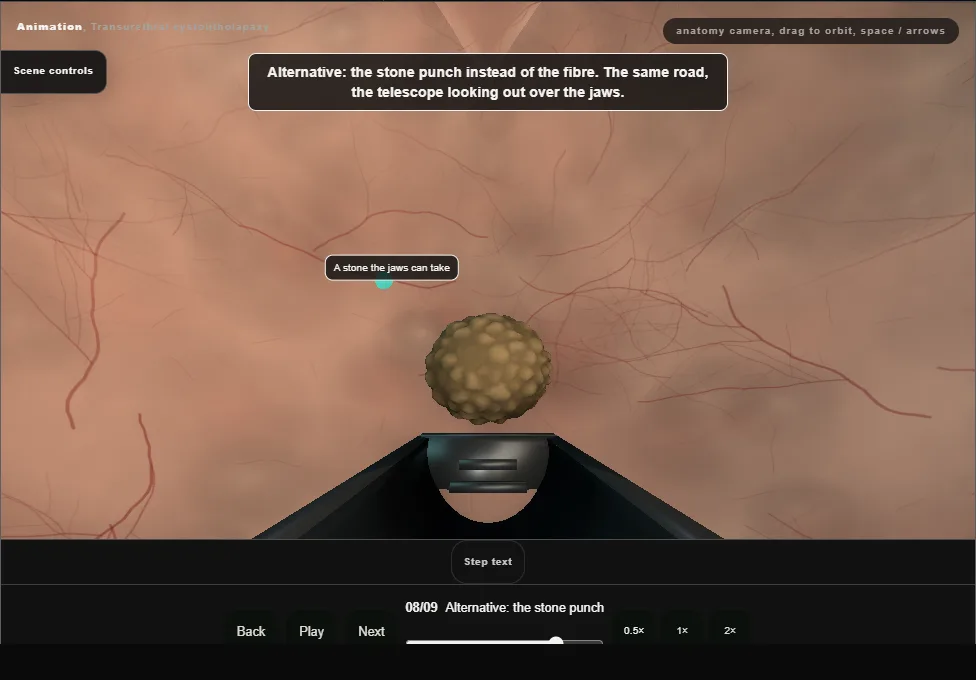
- The stone punch is the mechanical alternative to the fibre for a hard or large stone.
- The jaws open under vision and take the stone by an edge, the wall behind it in view;
- then the scope looks up and lifts the stone off the base into the centre of the bladder, clear of every wall, the lens clear and the whole stone in view.
- 09
Crunch, then evacuate
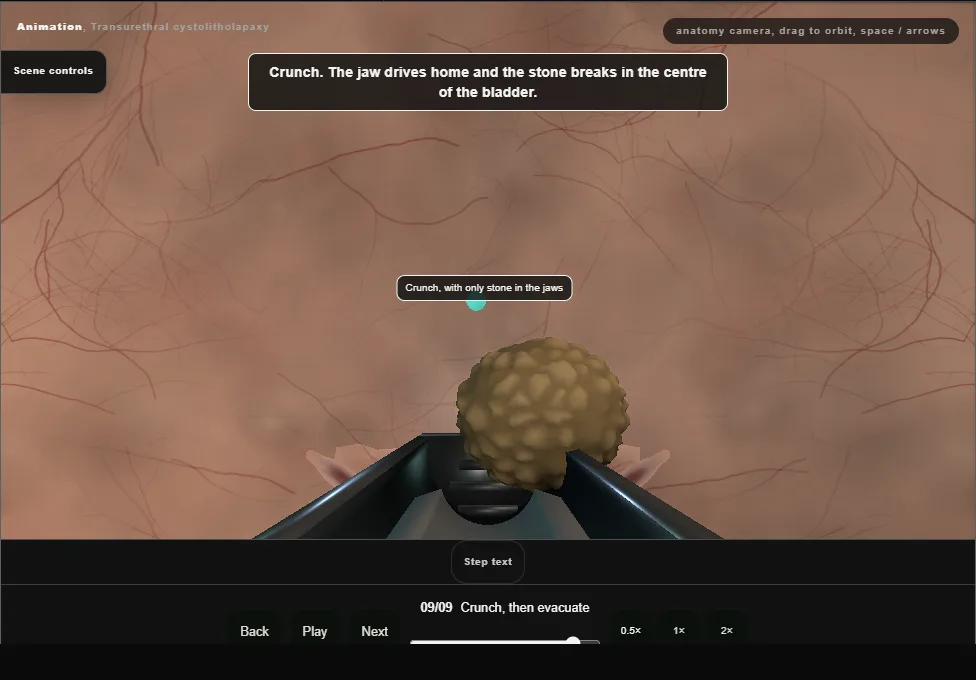
- Only when nothing but stone sits between the jaws does the punch close: the crunch happens in the centre of the bladder, never against the mucosa.
- The pieces fall to the base, are taken again if still too large, and are washed out through the sheath under vision before the survey.
Derived from CystolitholapaxyScene.tsx at build time: every step title and caption above is the authored
ProcedureDef text, reproduced verbatim, and this page shares its readable-points renderer with the animation
itself. 9 of 9 steps have a captured frame.
Text fingerprint ab822dabb33cc686. A caption edit without a re-capture fails the production
check, so the sheet and the animation cannot drift apart silently.