
Cystolitholapaxy and bladder stone removal
Fragmentation and evacuation of bladder calculi through transurethral or percutaneous access, with open removal retained for selected burdens or anatomy.
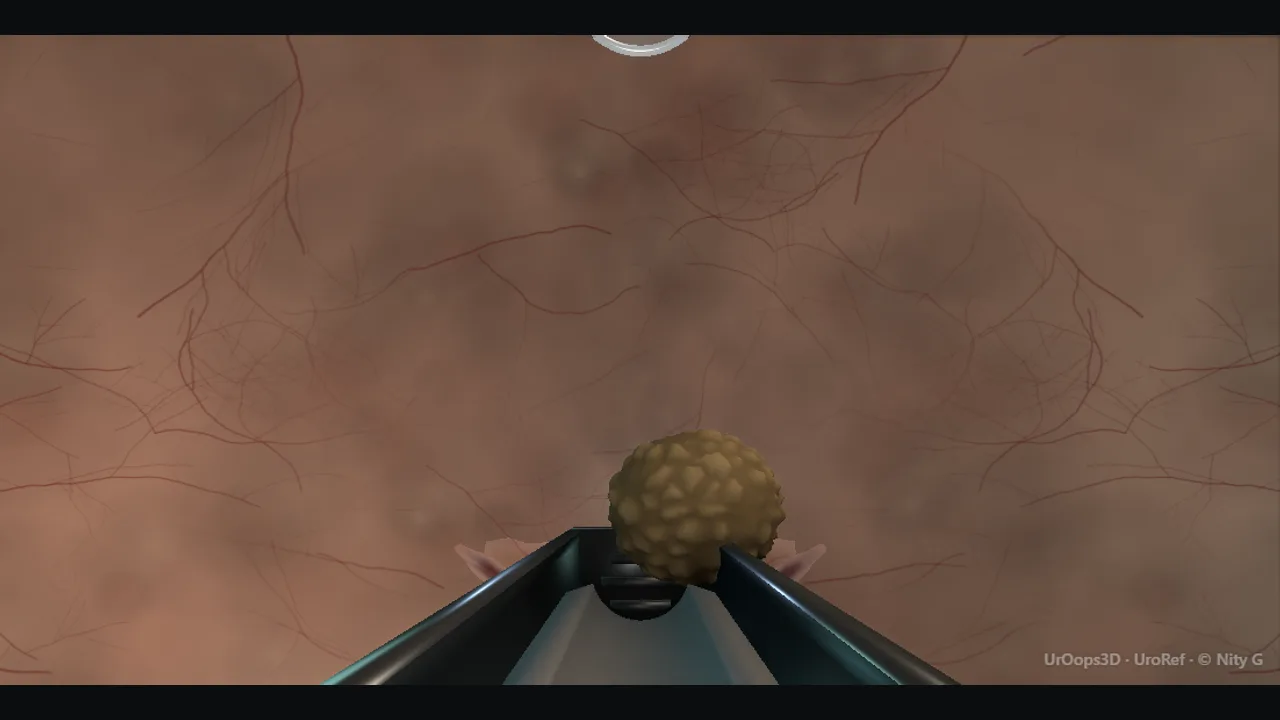 Interactive 3D Interactive operative model Open the 3D animation
Teaching catalogue only. This coverage record is not a patient pathway or operative instruction.
Typical place in practice
Symptomatic, obstructive, infected or otherwise clinically significant bladder stones after assessment of the underlying cause.
Alternatives and neighbouring procedures
Observation for selected small stones, percutaneous or open removal, and concurrent or staged treatment of outlet obstruction or foreign material.
Same procedure family, explicit technique branches
These are variations of this canonical operation. Complication modules below identify whether they apply to all branches or only to named approaches.
Transurethral cystolitholapaxy
A rigid scope fragments and evacuates stones through the urethra.
Laser cystolithotripsy
Laser energy divides stones under vision for irrigation or extraction.
Percutaneous cystolitholapaxy
A suprapubic tract provides direct bladder access while limiting urethral instrumentation.
Open cystolithotomy
The bladder is opened directly for intact or bulk removal when endoscopic strategies are unsuitable.
Combined outlet-and-stone procedure
Stone clearance and selected outlet treatment occur in one anaesthetic with cumulative risk considered.
High-level sequence
Coverage outline only; not a step-by-step technical guide.
- Confirm stone burden, bladder anatomy and underlying cause
- Choose access that accommodates stone size and urethral constraints
- Fragment under vision while protecting bladder and ureteric orifices
- Evacuate and account for fragments
- Confirm bladder integrity, drainage and a plan for the causal pathology
Operative notes
Concise operative notes covering the key steps, landmarks and watch points, in the order you encounter them.
Rigid cystoscopy
What it does: look inside the bladder with a straight scope.
- Assemble the scope. White-balance the camera. Check the focus.
- Never force. Always follow the lumen. Lose the view? Pull back till you find it.
- Too tight? Go smaller, dilate, or do an Otis cut. (Otis = a blade that slits a tight urethra at 12.)
- Left hand: penis vertical, gentle stretch. 10 mL gel. Right hand: scope vertical. Water on.
- Pass under vision. Penile urethra, then bulbar. The sphincter looks like a fold-narrowing.
- At the sphincter, drop your hand as you go in. The scope rides over the veru. (Veru = verumontanum, the mound at the prostate tip.)
- Note the prostate lobes and the bladder neck.
- In the bladder: drain and measure what comes out.
- Find the trigone and both ureteric orifices first.
- Survey all of the bladder. Rotate and slide. Order does not matter. Completeness does.
- Press the lower abdomen to see the front wall. Use the 70 degree scope near the bladder neck and for the dome. Hold the lens still: the view turns up.
- Do not over-fill. The front wall drifts away.
- Pull out the way you went in. Lift hands first.
- Watch: The light cable tip gets hot. Standby the light.
- Bladder stone: Stone found: survey first, then break it. Laser: the larger fibre, 365, 500 or 550 micron. 1.5 to 2.0 J at 20 to 50 Hz. Work one edge, wall in view behind every shot. Stone punch: jaws open under vision, take an edge. Look up. Lift the stone to the middle of the bladder, clear of the wall, lens clear. Then crunch. Never close on a stone resting on the wall. Wash the pieces out. Treat the cause the same day.
From the UroRef Operative Quick Guide. Open the note page →
Every failure mode is its own module.
Timing and variation coverage are recorded for each module.
Bladder perforation or extravasation
Instruments, energy, sharp fragments or access can breach the bladder wall, especially in a diverticulum or poorly visualised bladder.
Applies to: Transurethral cystolitholapaxy · Laser cystolithotripsy · Percutaneous cystolitholapaxy · Open cystolithotomy · Combined outlet-and-stone procedureUrethral injury or later stricture
Large instruments and repeated extraction can traumatise the urethra and lead to delayed narrowing.
Applies to: Transurethral cystolitholapaxy · Laser cystolithotripsy · Combined outlet-and-stone procedureUrinary infection or sepsis
Stones may harbour bacteria, and prolonged fragmentation or impaired drainage can disseminate infection.
Applies to: Transurethral cystolitholapaxy · Laser cystolithotripsy · Percutaneous cystolitholapaxy · Open cystolithotomy · Combined outlet-and-stone procedureBleeding or clot retention
Mucosal, tract, open wound or concurrent outlet bleeding may block postoperative drainage.
Applies to: Transurethral cystolitholapaxy · Laser cystolithotripsy · Percutaneous cystolitholapaxy · Open cystolithotomy · Combined outlet-and-stone procedureResidual fragments or stone recurrence
Incomplete evacuation or an uncorrected cause such as obstruction, foreign material or bladder dysfunction can lead to recurrent calculi.
Applies to: Transurethral cystolitholapaxy · Laser cystolithotripsy · Percutaneous cystolitholapaxy · Open cystolithotomy · Combined outlet-and-stone procedureBowel or tract injury
Suprapubic access or open dissection may injure bowel or create a persistent urinary tract or wound problem.
Applies to: Percutaneous cystolitholapaxy · Open cystolithotomyCombined-procedure fluid or bleeding burden
Adding outlet surgery increases operative duration, irrigation exposure and haemostatic burden compared with stone treatment alone.
Applies to: Combined outlet-and-stone procedureSources for this module
SWL, ureteroscopy, RIRS, PCNL, bladder stones and decompression options.
Accessed 2026-08-03 · opens source European Association of Urology EAU Guidelines on Urological InfectionsInfection prevention, recognition and procedure-associated infection context.
Accessed 2026-08-03 · opens source British Association of Urological Surgeons Patient information leaflets by procedureUK patient-facing procedure, alternatives, recovery and complication framing.
Accessed 2026-08-03 · opens source