
Flexible ureterorenoscopy and retrograde intrarenal surgery
Retrograde flexible endoscopy of the proximal ureter and collecting system for intrarenal stone fragmentation, extraction and selected diagnostic work.
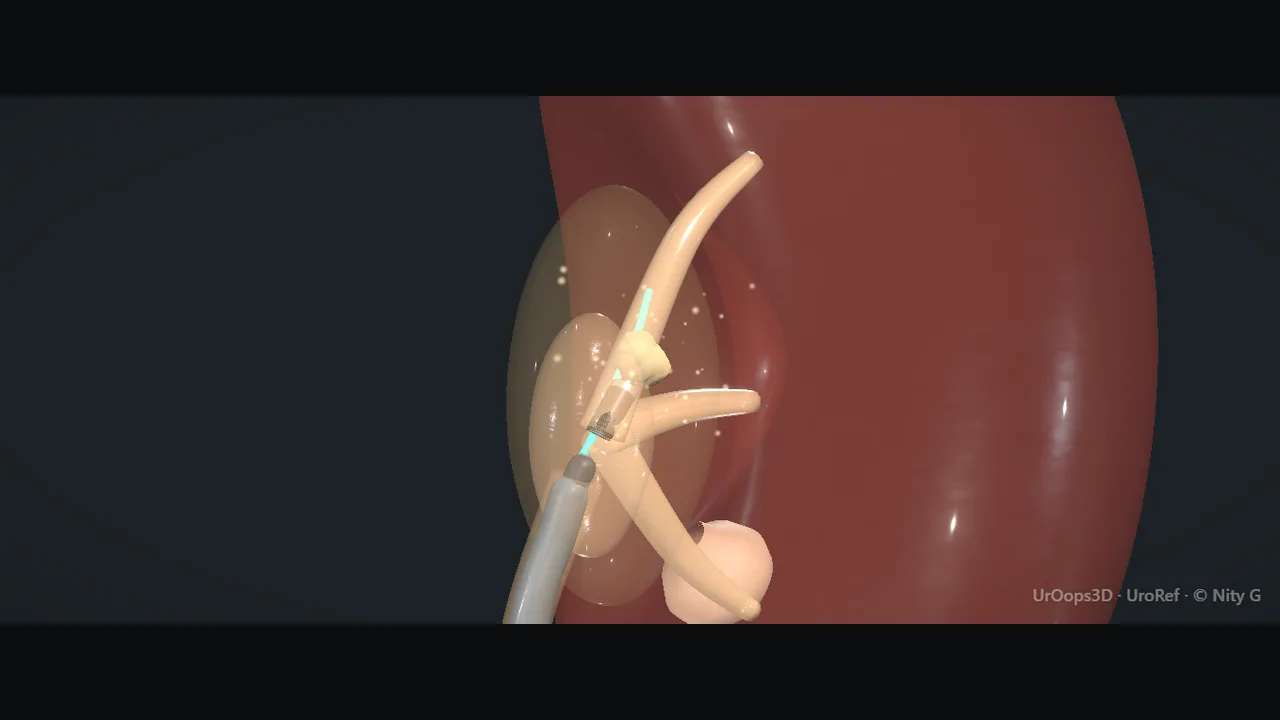 Interactive 3D Interactive operative model Open the 3D animation
Teaching catalogue only. This coverage record is not a patient pathway or operative instruction.
Typical place in practice
Active treatment of renal and proximal ureteric stones suitable for a retrograde approach.
Alternatives and neighbouring procedures
Shock-wave lithotripsy, percutaneous nephrolithotomy, semirigid or antegrade ureteroscopy, observation or selected surgical removal.
Same procedure family, explicit technique branches
These are variations of this canonical operation. Complication modules below identify whether they apply to all branches or only to named approaches.
Sheathless flexible URS
The flexible scope is passed over a wire without an access sheath, limiting sheath-related injury but requiring repeated access decisions.
Access-sheath RIRS
A ureteral access sheath facilitates repeated entry and outflow but introduces insertion and pressure-related trade-offs.
Dusting RIRS
Laser settings aim to create small fragments intended to pass rather than be individually retrieved.
Fragmentation-and-basketing RIRS
Stones are divided into retrievable fragments and removed with a basket.
Staged RIRS
Stone burden or access is managed over multiple sessions to limit operative burden or respond to anatomy.
High-level sequence
Coverage outline only; not a step-by-step technical guide.
- Confirm side, renal anatomy, stone burden and infection status
- Obtain safe ureteric access and decide whether a sheath is appropriate
- Map the collecting system with controlled irrigation
- Fragment and/or retrieve stones while protecting mucosa and optics
- Inspect for injury, assess residual burden and define drainage and imaging follow-up
Operative notes
Concise operative notes covering the key steps, landmarks and watch points, in the order you encounter them.
Flexible ureteroscopy for kidney stones
What it does: bendy scope up into the kidney. Laser the stone.
- GA with a tube. Breath holds = still kidney.
- Cystoscopy. Wire up the ureter under screening. Stop there: curl seen in the renal pelvis on the screen before anything follows it. That wire stays as the safety wire. Here: semirigid scope up beside it, second (working) wire through the scope into the renal pelvis under direct vision. Scope out over it.
- Empty the bladder. Stops scope coiling.
- Suction access sheath 10-14Ch over the wire under screening, dilator in. Length by sex: about 35 cm female, about 45 to 46 cm male (owner's typical values). Suction tubing on, suction off until the tip is in the kidney. Never force it: resistance = downsize, or stent and come back.
- Tip stopped at the renal pelvis on the image intensifier, not through the PUJ. Dilator and working wire out. Flexible scope up inside the sheath. Suction on once the tip is in the kidney.
- Saline only. In the kidney: water off.
- Map every calyx first: upper, middle, lower. Sure of the map? Straight to the stone. Not sure? Contrast 50:50 with saline outlines the pelvis and every calyx. Full-strength contrast hides small stones.
- Stone in the lower pole: open the basket beside it, around it, close it on the stone. Carry it to the renal pelvis or upper pole, release it, laser it there.
- Fibre stuck with the tip fully flexed in the lower pole? Never force it: pushing only straightens the tip off the target. Ease the flexion, back to the pelvis, fibre out of the channel, then flex again.
- Ho:YAG, owner's typical ranges: dusting 0.2 to 0.5 J at 20 to 40 Hz (about 4 to 20 W); fragmentation 0.8 to 1.2 J at 6 to 12 Hz (about 5 to 14 W); pop-dusting 0.3 to 0.5 J at 30 to 50 Hz (about 10 to 25 W). Dust first. Paint the stone.
- Tiny fragments: pop-dust them. Fibre held still above them in a confined calyx.
- Clearance: thumb on the suction port, sheath brought over the scope until the fragments are in view, scope withdrawn slowly to the marker with the suction running. The suction takes the fragments.
- TRAPPED BASKET (exam favourite): STOP. Never pull. Pulling tears the ureter off. Take the basket handle apart. Slide the scope off the basket wire. New wire past the stone, over the safety wire. Scope back alongside. Laser the stone. Still stuck? Stent 24 h. Dilates. Retry.
- 2026 update: No change in principle.
- 2026 update: Suction access sheath sequence, sheath lengths by sex and typical laser ranges added by the owner on 27 September 2026.
From the UroRef Operative Quick Guide. Open the note page →
Every failure mode is its own module.
Timing and variation coverage are recorded for each module.
Ureteric wall injury or perforation
Wires, scope passage, a sheath, basket or laser can injure the ureter and create extravasation.
Applies to: Sheathless flexible URS · Access-sheath RIRS · Dusting RIRS · Fragmentation-and-basketing RIRS · Staged RIRSAccess-sheath injury or ischaemia
A sheath that is too large or advanced against resistance can split, compress or devascularise the ureter.
Applies to: Access-sheath RIRSUrinary infection or sepsis
Bacterial burden and elevated collecting-system pressure can drive systemic infection despite a technically uncomplicated procedure.
Applies to: Sheathless flexible URS · Access-sheath RIRS · Dusting RIRS · Fragmentation-and-basketing RIRS · Staged RIRSCollecting-system or parenchymal injury
Guidewires, high pressure or energy applied near calyceal mucosa can cause bleeding, perforation or subcapsular collection.
Applies to: Sheathless flexible URS · Access-sheath RIRS · Dusting RIRS · Fragmentation-and-basketing RIRS · Staged RIRSBasket entrapment or laser-device damage
A basket can trap a fragment and the laser can damage a wire, basket or deflected scope when spatial control is lost.
Applies to: Dusting RIRS · Fragmentation-and-basketing RIRSResidual fragments or recurrent stone
Inaccessible calyces, large burden or dusting may leave fragments that grow, migrate or obstruct.
Applies to: Sheathless flexible URS · Access-sheath RIRS · Dusting RIRS · Fragmentation-and-basketing RIRS · Staged RIRSUreteric stricture
Mechanical, thermal or ischaemic injury may heal with delayed ureteric narrowing.
Applies to: Sheathless flexible URS · Access-sheath RIRS · Dusting RIRS · Fragmentation-and-basketing RIRS · Staged RIRSSources for this module
SWL, ureteroscopy, RIRS, PCNL, bladder stones and decompression options.
Accessed 2026-08-03 · opens source European Association of Urology EAU Guidelines on Urological InfectionsInfection prevention, recognition and procedure-associated infection context.
Accessed 2026-08-03 · opens source British Association of Urological Surgeons Patient information leaflets by procedureUK patient-facing procedure, alternatives, recovery and complication framing.
Accessed 2026-08-03 · opens source