
Revision sheet
Temporarily implanted nitinol device (iTind)
7 steps, each one the authored title and caption from the interactive animation, with the frame captured from that step. Read it before the case, or print it and work through the steps in order.
Teaching only, not for diagnosis or treatment decisions. The text on this sheet is the animation's own step copy, reproduced verbatim.
UrOops3D · UroRef · © Nity G
- 01
Who gets a temporary implant
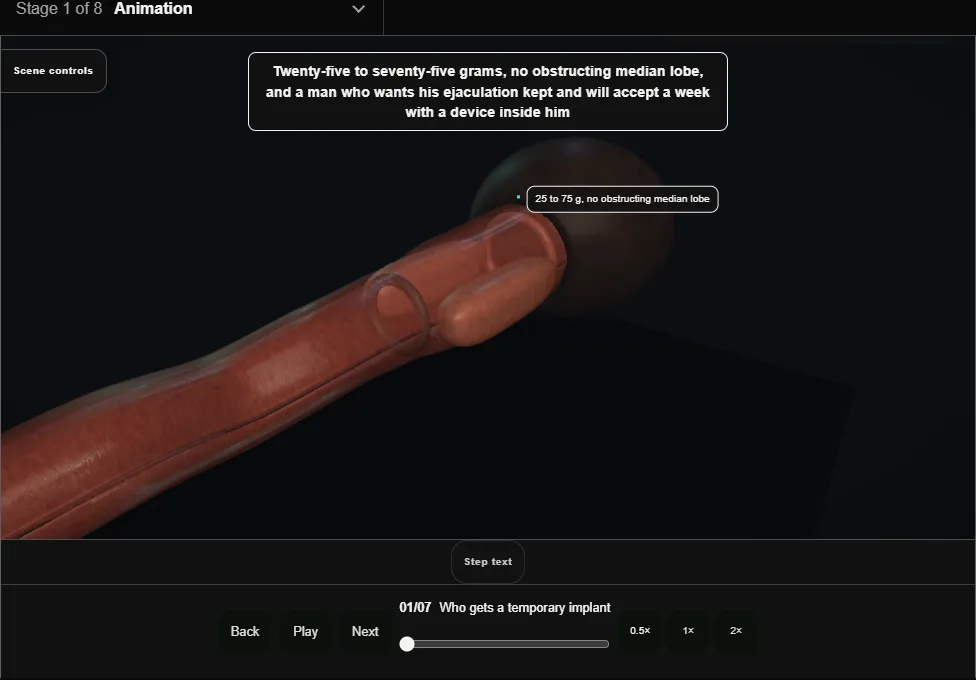
- 25 to 75 g and no obstructing median lobe, in a man who wants ejaculation kept and will accept a week with a device in.
- Consent covers a week of urgency and blood, a second visit to remove it, retention, infection and migration.
- 02
The device and the limits
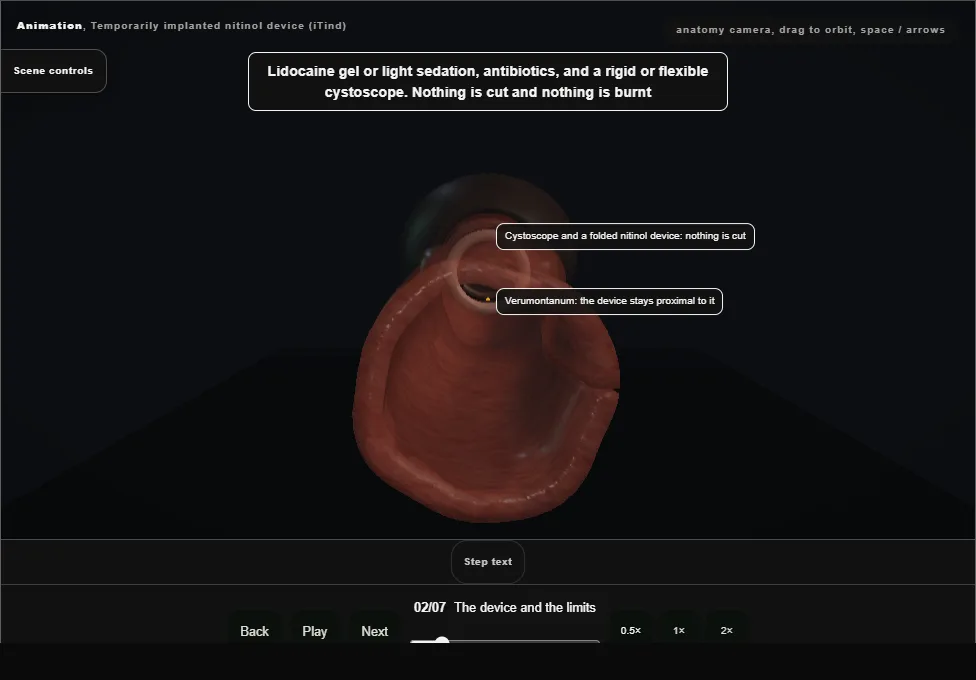
- Gel or light sedation, antibiotics, a cystoscope.
- Nothing is cut and nothing is burnt.
- The veru is the distal limit; the bladder neck and the anterior commissure are the targets.
- 03
Opened, then drawn back
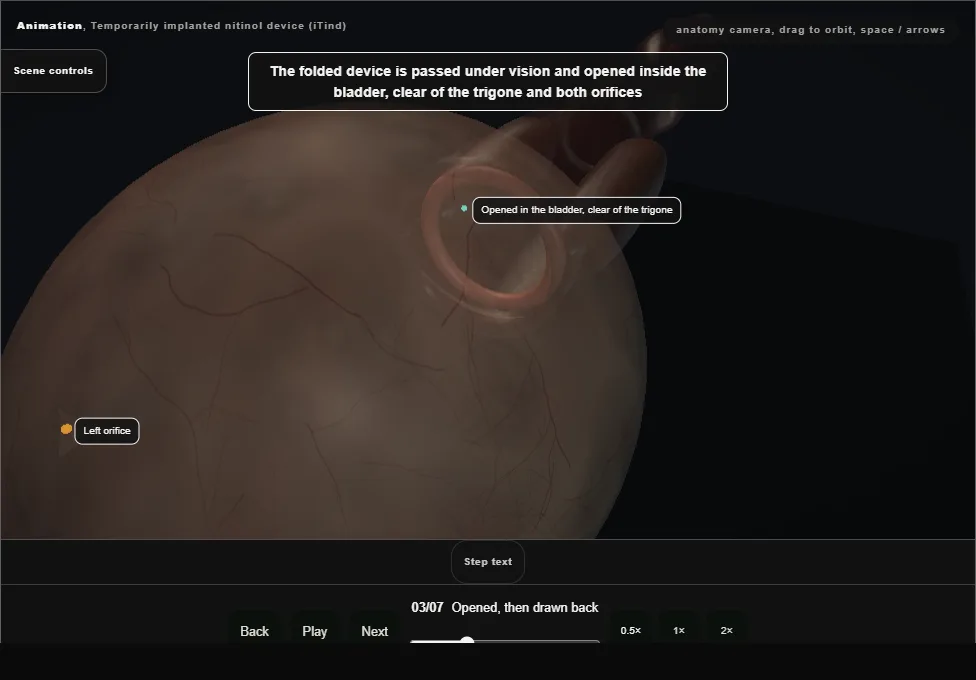
- The folded device is opened inside the bladder, clear of the trigone and both orifices, then drawn back through the neck so the three struts open against the prostatic urethra at twelve, five and seven.
- 04
The leaflet and the last look
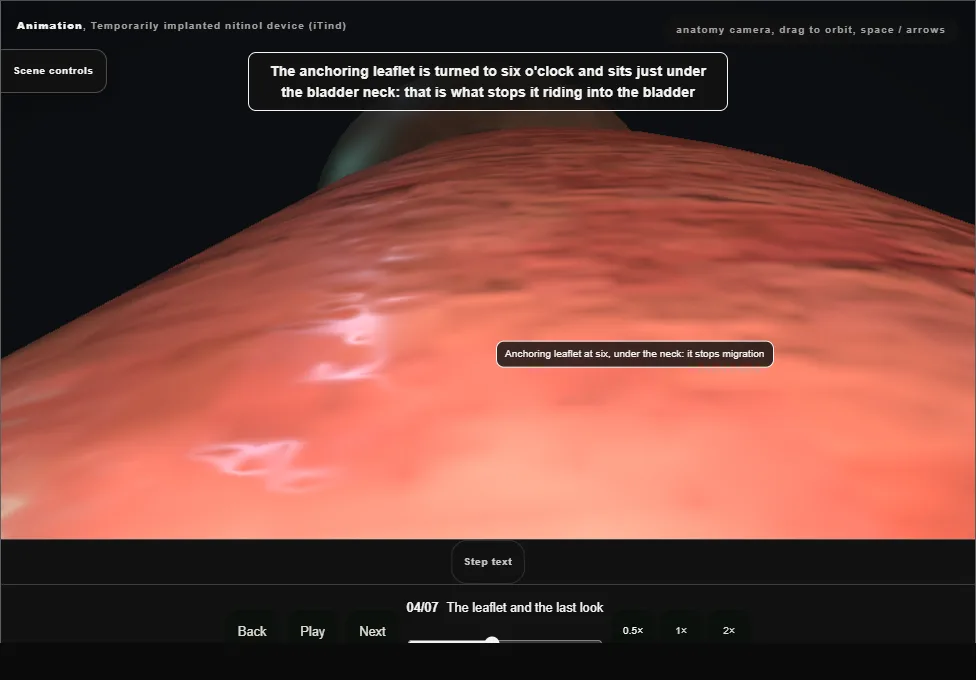
- The anchoring leaflet is turned to six o'clock under the bladder neck.
- The last look confirms the device wholly proximal to the veru, nothing across the sphincter, and the retrieval suture lying free.
- 05
Five to seven days
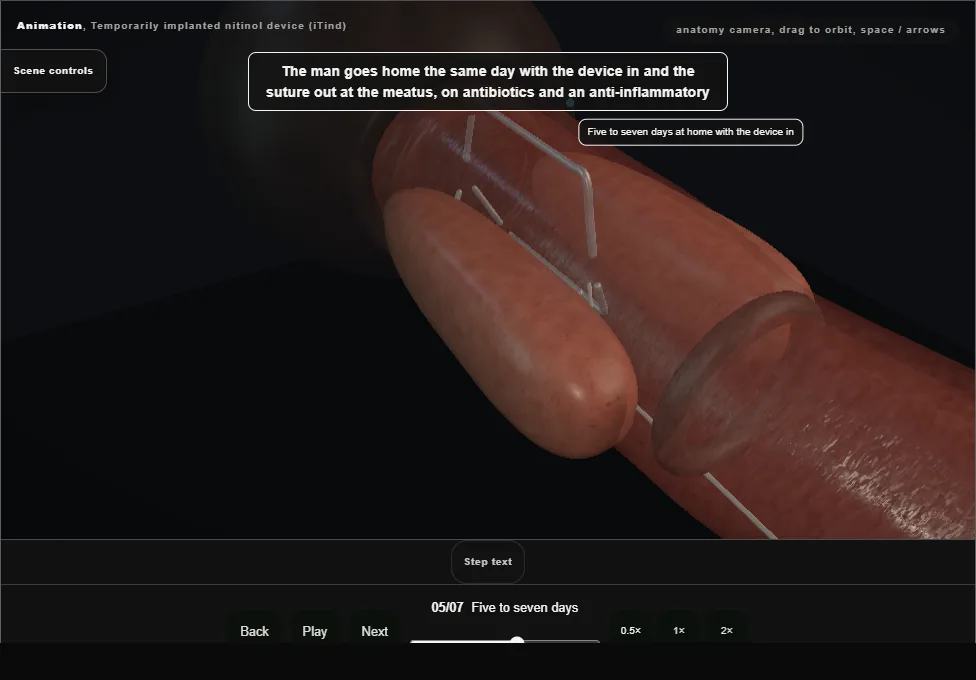
- Home the same day with the suture out at the meatus, on antibiotics and an anti-inflammatory.
- The struts press; the mucosa blanches and then the tissue under each strut dies in a line.
- The week is uncomfortable and that is expected.
- 06
Removal
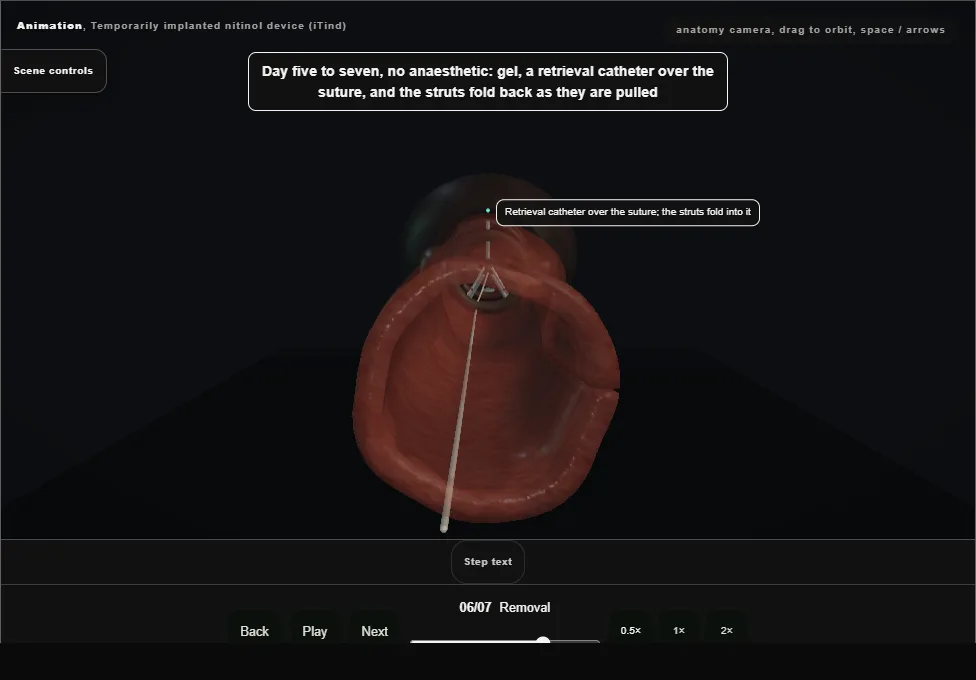
- Day five to seven, no anaesthetic: gel, a retrieval catheter over the suture, and the struts fold back as they are pulled.
- The device is checked against what went in: three struts and the leaflet.
- He voids before he leaves.
- 07
What it leaves behind
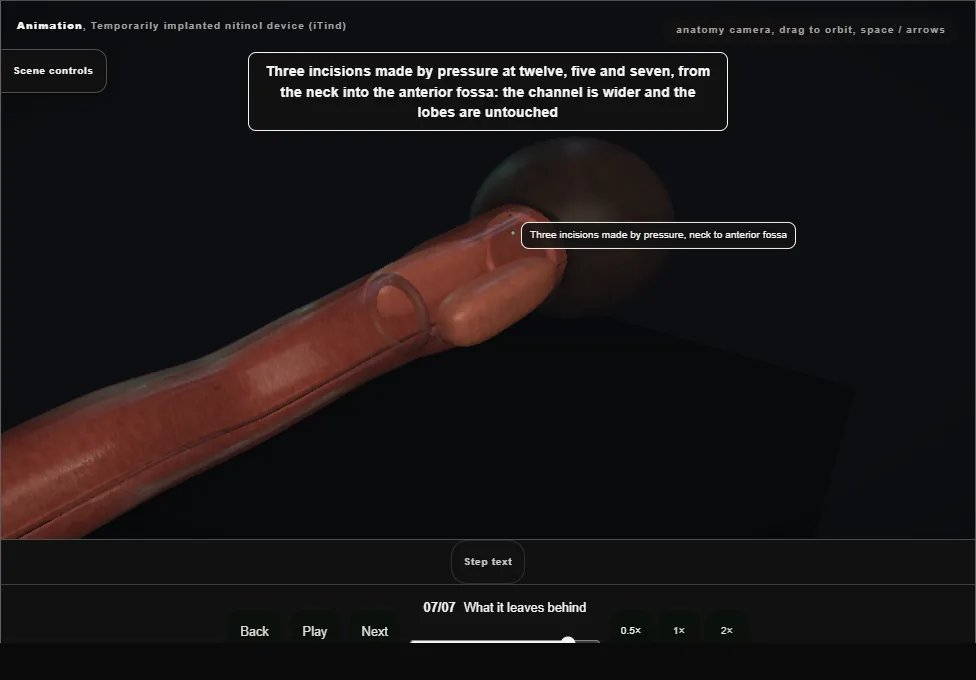
- Three incisions made by pressure, from the neck into the anterior fossa.
- The lobes are untouched and the neck muscle, urethra and sphincter are intact, which is why ejaculation is usually kept.
- The effect is smaller than a resection.
Derived from endoscopy/ITindScene.tsx at build time: every step title and caption above is the authored
ProcedureDef text, reproduced verbatim, and this page shares its readable-points renderer with the animation
itself. 7 of 7 steps have a captured frame.
Text fingerprint 1d993cc30b277e42. A caption edit without a re-capture fails the production
check, so the sheet and the animation cannot drift apart silently.