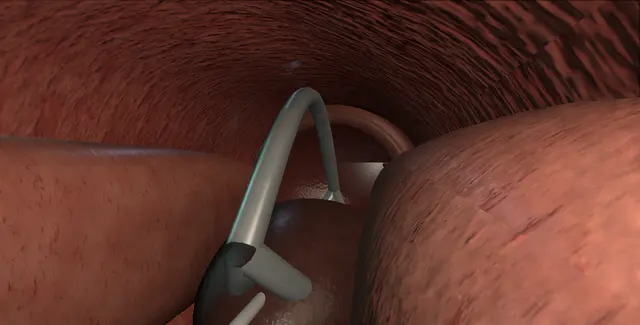
Nothing is cut, burnt or left behind. Three intertwined nitinol struts are opened in the bladder, drawn back into the prostatic urethra and left for five to seven days, where their radial pressure makes ischaemic incisions in the bladder neck and the anterior prostatic fossa.
Then they are pulled out on a suture. This page is who it suits, where the device sits, the week it stays in, and what it leaves behind.
Core tierFRCS core urology, BPH / LUTS and the minimally invasive optionsInteractive 3D
Along the prostatic urethra, sphincter to bladder, with the device seated. Schematic, not to scale; relationships only.
The device occupies the prostatic urethra from just inside the bladder neck to a point short of the verumontanum.
Three struts press outward at twelve, five and seven o'clock, so the ischaemic incisions form at those hours from the neck into the anterior fossa.
The anchoring leaflet sits at six o'clock immediately under the bladder neck and cranial to the veru, which is the only thing holding the device out of the bladder and off the sphincter.
›The three struts - nitinol at twelve, five and seven, pressing along the prostatic urethra.
›The anchoring leaflet - at six, under the bladder neck: the thing that stops migration.
›The retrieval suture - polyester, out at the meatus; the whole removal runs over it.
›The bladder neck - the proximal target; the device is seated against it, not through it.
›The anterior commissure - where the twelve o'clock strut does its work.
›The verumontanum - the distal limit; the device stays proximal to it.
›The external sphincter - never under a strut; continence depends on it.
Who gets a temporary implantThe man with bothersome symptoms and a prostate of about twenty-five to seventy-five grams, with lateral lobe obstruction and no obstructing median lobe, who wants to keep ejaculation and erections, avoid a general anaesthetic, and who will accept a week with a device inside him and a second visit to remove it. Gland size and the median lobe are assessed by ultrasound and cystoscopy before the day, because a lobe hanging into the bladder is treated by a different operation. He is told plainly that the effect is smaller than a resection.
Consent and the roomThe consent names a week of urgency, frequency, dysuria and blood while the device is in; pain that needs regular analgesia; retention; infection; the device that migrates into the bladder or sits too distally; and the fact that a second visit is not optional. Ejaculation and erections are expected to be preserved because no muscle is cut. The room is an endoscopy room with lidocaine gel, light sedation if wanted, antibiotic cover, a cystoscope and the device on its delivery system.
The deviceThree elongated nitinol struts intertwined at twelve, five and seven o'clock, an anchoring leaflet at six, and a polyester retrieval suture. The struts are the working part: they exert radial force on the bladder neck and the anterior prostatic fossa. The leaflet is the safety: it sits under the bladder neck and stops the device riding proximally. Nothing on it resects, ablates or delivers a drug.
Cystoscopy and the limitsPassed under vision like a rigid cystoscope. The sphincter, the verumontanum, the lateral lobes, the length from the veru to the bladder neck, and the neck itself are noted, and the bladder is entered to see both orifices and to look back at the neck. The verumontanum is the distal limit: the device is seated wholly proximal to it. The bladder neck and the anterior commissure above it are the targets. where it bites: a strut across the membranous urethra puts continence at risk for as long as it stays.
DeploymentThe folded device is passed and opened inside the bladder under direct vision, clear of the trigone and both orifices. It is then drawn back through the bladder neck into the prostatic urethra, and the struts open against the wall as it comes. The three struts now lie along the prostatic urethra at twelve, five and seven, pressing on the neck and the anterior fossa.
The leaflet and the last lookThe anchoring leaflet is turned to six o'clock so that it sits just under the bladder neck and cranial to the verumontanum. That orientation is what stops migration. The last look confirms the device wholly proximal to the veru, nothing crossing the sphincter, and the retrieval suture lying free down the urethra and out at the meatus. where it bites: a leaflet not turned to six is a device in the bladder by the second day.
The five to seven daysHe goes home the same day with the device in and the suture taped at the meatus, on antibiotics and an anti-inflammatory, with analgesia and a number to ring. The struts press: the mucosa blanches, and the tissue under each strut dies in a line. Urgency, frequency and blood are expected during that week and are not a reason to remove it early. Retention that will not settle, uncontrolled pain, or systemic sepsis are reasons to remove it early, which can be done at any point.
RemovalOn day five to seven, with gel and no anaesthetic, a retrieval catheter is passed over the suture and the device is drawn out; the struts fold back as they come. It is inspected against what went in: three struts and the leaflet, complete. He voids before he leaves, and the note records the days it was in, the device seen complete, and the void.
What it leaves behindThree incisions made by pressure, running from the bladder neck into the anterior prostatic fossa at twelve, five and seven. The lobes themselves are untouched and the muscle of the bladder neck, the prostatic urethra and the external sphincter is intact, which is why ejaculation is usually preserved. Symptoms improve within weeks rather than months. The improvement is smaller than a resection and a proportion of men come back for something more.
The spatial relationships the animation is built to make automatic. Before you read each one, ask yourself: at this point in the operation, what is about to go wrong, and what is my first move? The save for each sits in the Complications tab.
RiskAcross the sphincter - a device seated too distally: perineal pain now, continence at risk for as long as it stays.
RiskInto the bladder - a leaflet not turned to six, or too proximal a seat: a migrated device that needs graspers, not traction.
RiskThe obstructing median lobe - not what this device treats; another operation.
RiskThe week in between - retention, pain and infection happen at home; the plan and the phone number are part of the procedure.
Trigger each of these live in the Animation tab, then read the save: the first move, the escalation trigger, and the line that goes in the op note.
Retention with the device in
he cannot void on day two with the device in place.
The save
Bring him in and look at him rather than talking him through it on the phone.first move
Remove the device early with gel and the retrieval catheter; it can come out at any point.
If removal is not immediately possible, a small catheter alongside the device is difficult and a suprapubic catheter is safer.escalation trigger
Note: the day, the residual, that the device came out complete, and the plan for another treatment.document
Migration into the bladder
the device rides proximally and sits free in the bladder: the leaflet was not turned to six, or the seat was too proximal.
The save
Do not pull on the suture blindly; a migrated device is retrieved under vision.first move
Cystoscopy with graspers, and inspect the trigone and both orifices as it comes out.
Re-siting at the same visit is reasonable if the anatomy allowed it in the first place; otherwise abandon and plan another treatment.escalation trigger
Note: where it was found, how it was retrieved, the device complete, and what was seen of the trigone.document
Sitting across the sphincter
seated too distally: severe perineal pain, and a strut in the membranous urethra.
The save
Remove it the same day; pain of that character after this procedure is a malpositioned device until proven otherwise.first move
Re-site proximal to the veru, measured against the landmark rather than guessed, or abandon.
Leakage that persists after removal: pelvic floor physiotherapy from the start and a continence assessment at three months.escalation trigger
Note: the position found, the time it was in, and the continence plan.document
Urinary infection
a device and ischaemic tissue for a week: fever, dysuria or a positive culture in the first fortnight.
The save
Culture the urine and start antibiotics that cover the likely organisms.first move
Assess whether he is voiding; retention behind an infected device is the combination that escalates.
Systemically unwell: admit, and remove the device early rather than treating around it.escalation trigger
Note: the culture, the antibiotic, and whether the device was removed early.document
Haematuria after removal
blood for a few days as the ischaemic lines separate.
The save
Fluids and reassurance; this is expected and settles.first move
Clots and a failing stream: catheterise and wash out.
Heavy bleeding or clot retention that does not clear: flexible cystoscopy rather than continued observation.escalation trigger
Note: the degree, what was done, and the haemoglobin if it was checked.document
When the case turns: the problem, then the next move.
ActionCannot see the veru to measure from - draw back until the sphincter and the veru are seen; nothing is seated until the distal limit is known.
ActionThe device will not open in the bladder - it is not fully out of the sheath or the bladder is underfilled: fill, advance, and open under vision.
ActionThe leaflet will not turn to six - reposition the whole device rather than twisting against resistance; a leaflet at the wrong hour is a migration waiting to happen.
ActionThe suture is pulled out early at home - bring him in; removal is then cystoscopic with graspers, not a pull on a broken thread.
ActionHe rings on day three in pain - assess in person: pain out of proportion is a malposition, not the expected week.
ActionNo improvement at six weeks - review with a score and a flow; if the anatomy was right and nothing has changed, discuss a resection rather than a repeat.
The examiner stems this scene prepares you for. Try to answer out loud first, then reveal, and learn the discriminator, the detail that turns a pass into a strong pass.
QWhat is the temporarily implanted nitinol device and how does it work?reveal answer
It is a temporary implant for benign prostatic obstruction, made of three elongated nitinol struts intertwined at twelve, five and seven o'clock, with an anchoring leaflet at six and a polyester retrieval suture.
It is deployed cystoscopically: opened inside the bladder, then drawn back into the prostatic urethra so that the struts lie from just inside the bladder neck to a point short of the verumontanum.
It is left in place for five to seven days.
During that time the radial force of the struts produces focal ischaemia in the tissue beneath each one, and the tissue separates along those lines.
The result is three incisions made by pressure, running from the bladder neck into the anterior prostatic fossa, remodelling the outlet without any tissue being resected, ablated or left behind.
The device is then removed at a second visit using gel and a retrieval catheter passed over the suture, without anaesthetic.
Because no muscle is cut and nothing is delivered beyond the prostatic urethra, the bladder neck, the prostatic urethra and the external sphincter remain structurally intact, which is the basis for the preservation of ejaculation and continence that the technique is chosen for.
The trade-off is that the improvement in symptoms and flow is smaller than that of a transurethral resection, and a proportion of men return for a further procedure, so patient selection and honest counselling carry the result.
Strong pass
Say all three
Naming the mechanism as ischaemic incision by sustained radial pressure
Not dilation or ablation
Stating the two-visit structure
Examiner note
Naming the mechanism as ischaemic incision by sustained radial pressure, not dilation or ablation, and stating the two-visit structure.
QWho would you select, and who would you not?reveal answer
I would select a man with bothersome lower urinary tract symptoms attributable to benign prostatic obstruction, a prostate of roughly twenty-five to seventy-five grams, lateral lobe obstruction, and no obstructing median lobe on cystoscopy or imaging.
Beyond anatomy, the decisive factors are what he values and what he will accept.
He should want ejaculation and erectile function preserved, prefer to avoid a general or spinal anaesthetic, and be willing to live with a device in the urethra for five to seven days and to attend a second visit for removal.
He should understand that the effect is smaller and less durable than a resection.
I would not offer it to a man with a large intravesical median lobe, a very large gland, a urethral stricture that prevents safe passage of the device, an active urinary infection, or a bladder that is failing rather than obstructed, which is a urodynamic question rather than an anatomical one.
I would be cautious in a man in whom a week of urgency, frequency and blood would be unsafe or unmanageable at home, and in a man who cannot reliably return for removal, because an implant that is not removed is a stone in the making.
In a man in retention, the balance shifts toward a procedure with an immediate and larger effect.
Strong pass
Say both
Treating the obstructing median lobe as the anatomical exclusion
The reliability of the second visit as a genuine selection criterion
Examiner note
Treating the obstructing median lobe as the anatomical exclusion, and the reliability of the second visit as a genuine selection criterion.
QA patient rings on day three with severe perineal pain. What are you thinking?reveal answer
Severe perineal pain of that character after this procedure is a malpositioned device until proven otherwise.
The specific worry is a device seated too distally, so that a strut lies across the membranous urethra and the external sphincter, which both hurts and puts continence at risk for as long as it remains.
I would not manage this by telephone or by escalating analgesia.
I would bring him in the same day, assess him clinically, exclude retention and sepsis, and examine the urine.
I would then remove the device, which can be done at any point with gel and a retrieval catheter over the retrieval suture; the struts fold as they are drawn out.
I would inspect the device for completeness against what was implanted, three struts and the leaflet, and I would perform a cystoscopy if anything appeared missing or if the removal was not straightforward.
The differential includes expected postoperative irritative symptoms, urinary infection, retention and, less commonly, migration, so the assessment covers all of them rather than assuming malposition.
If continence is affected after removal I would start pelvic floor physiotherapy immediately and arrange a continence assessment at three months.
The event and the findings go in the notes, and the patient is told clearly what happened.
Strong pass
Say both
Recognising that removal is available at any time
Naming malposition across the sphincter as the lead diagnosis rather than expected pain
Examiner note
Recognising that removal is available at any time, and naming malposition across the sphincter as the lead diagnosis rather than expected pain.
QCompare this device with a prostatic urethral lift for a man who wants to keep his ejaculation.reveal answer
Both preserve ejaculation because neither resects tissue nor divides the bladder neck musculature, and both suit a gland with lateral lobe obstruction.
They differ in what they leave and what they ask of the patient.
The urethral lift places permanent implants that hold the lobes apart, is done under local anaesthetic as a single visit, gives an immediate result, and usually needs no catheter;
the implants remain in the urethra afterwards, are relevant to any later endoscopic surgery, and are MRI-conditional, and roughly a third of men need a further procedure within five years.
The temporary nitinol device leaves nothing behind: it works by ischaemic incision over five to seven days and is then removed, so there is no implant to complicate later surgery, but it requires a second visit, and the week in between is genuinely uncomfortable with urgency, frequency and blood.
Selection also differs in that an obstructing median lobe can be addressed with a device-specific lift technique but is an exclusion for the temporary implant.
For a man prioritising ejaculation I would discuss both, and let the decision turn on whether he prefers an immediate result with a retained implant or a week of discomfort with nothing left inside him.
Strong pass
Say both
Framing the choice as retained implant versus a week of symptoms with nothing left behind
Rather than quoting efficacy alone
Examiner note
Framing the choice as retained implant versus a week of symptoms with nothing left behind, rather than quoting efficacy alone.
Say it aloud, then reveal. Reading is not remembering.
01The relationshipSay the critical spatial relationship out loud, then reveal.reveal
Memory frame
The device occupies the prostatic urethra from just inside the bladder neck to a point short of the verumontanum.
Why?
Three struts press outward at twelve, five and seven o'clock, so the ischaemic incisions form at those hours from the neck into the anterior fossa. The anchoring leaflet sits at six o'clock immediately under the bladder neck and cranial to the veru, which is the only thing holding the device out of the bladder and off the sphincter.
02The first moveRetention with the device in. Your first move?reveal
First move
Bring him in and look at him rather than talking him through it on the phone.
03The escalation triggerRetention with the device in. What makes you call for help?reveal
Escalate when
If removal is not immediately possible, a small catheter alongside the device is difficult and a suprapubic catheter is safer.
04The discriminatorWhat turns a pass into a strong pass?reveal
Strong pass
Say all three
Naming the mechanism as ischaemic incision by sustained radial pressure
Not dilation or ablation
Stating the two-visit structure
Examiner note
Naming the mechanism as ischaemic incision by sustained radial pressure, not dilation or ablation, and stating the two-visit structure.
05The pitfallWhere does this operation bite first?reveal
Pitfall
Across the sphincter
Why?
a device seated too distally: perineal pain now, continence at risk for as long as it stays.
Revision practice with self-marked answers, not an assessment of clinical competence. Kept in
this browser only; it does not sync between devices.