
UP-012-c01 Stones & endourology multiple
Percutaneous nephrolithotomy
Renal haemorrhage or vascular lesion
Access, tract dilation or nephroscopic work can injure renal vessels, causing immediate bleeding or a delayed pseudoaneurysm or arteriovenous fistula.
This module records catalogue coverage only. Do not use it to make diagnosis or treatment decisions.
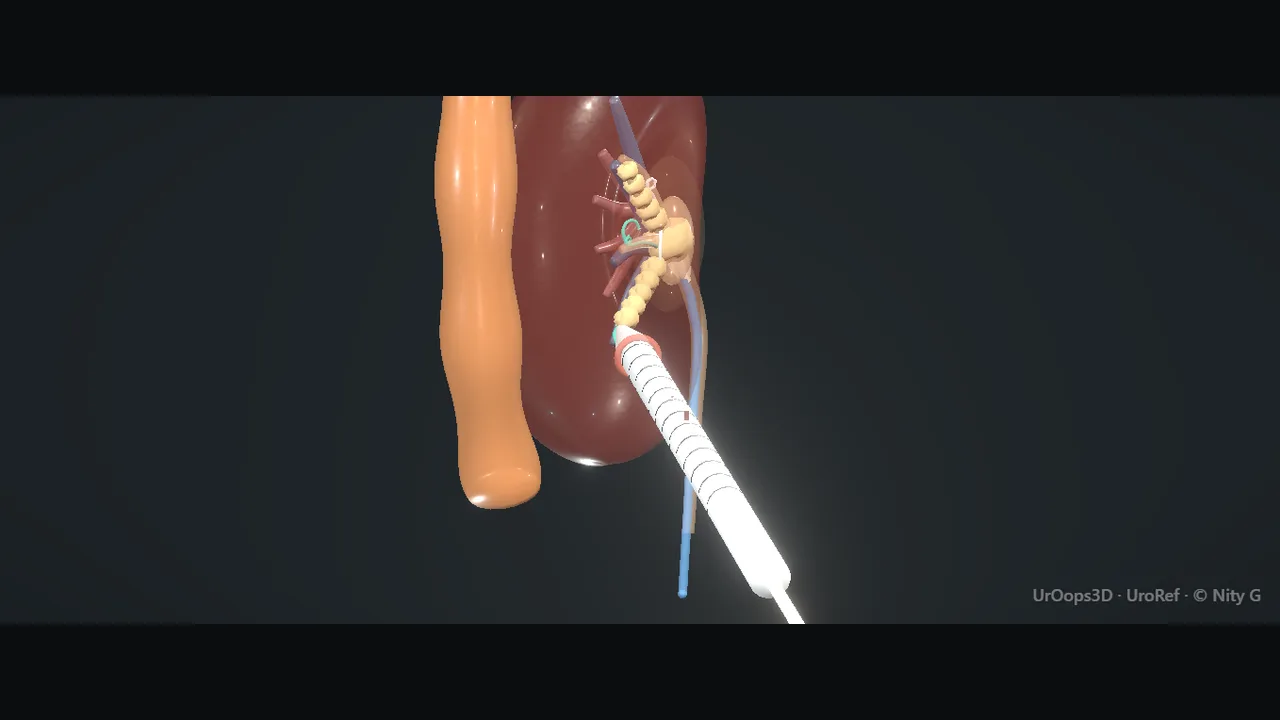 Interactive 3D The operation this complication belongs to: Percutaneous nephrolithotomy Interactive operative model Open the 3D animation
01 Variation coverage
Which versions of the operation this applies to
Standard-tract PCNLMiniaturised PCNLSupine PCNLProne PCNLECIRSTubeless PCNL
The parent hub contains 6 recorded variations.
The labels above prevent a complication from being implied for an approach where it is not relevant.
02 Evidence
Sources
European Association of Urology EAU Guidelines on Urolithiasis
SWL, ureteroscopy, RIRS, PCNL, bladder stones and decompression options.
Accessed 2026-08-03 · opens source European Association of Urology EAU Guidelines on Urological InfectionsInfection prevention, recognition and procedure-associated infection context.
Accessed 2026-08-03 · opens source British Association of Urological Surgeons Patient information leaflets by procedureUK patient-facing procedure, alternatives, recovery and complication framing.
Accessed 2026-08-03 · opens source03 Same procedure
Other PCNL complication modules
multiple Pleural injury, hydrothorax or pneumothorax multiple Colon or solid-organ injury early Urinary infection or sepsis early Collecting-system perforation or urinary leak late Residual stone or need for staged treatment intraoperative Tract or access loss early Drainage failure after tubeless exit
Return to the complete procedure hub