
UrOops3D, danger-zone atlas
Operative animation, Bladder neck and anastomotic stenosis

Bladder neck and vesicourethral stenosis: endoscopic treatment

A pinhole of scar where the bladder neck or the anastomosis should be, in a man who has already had his prostate operated on.

A wire through it under vision, incisions at three and nine o'clock with a cold knife or laser, dilatation over the wire, and the continence question that decides how brave to be. This page is the two patients, the safe sectors, the adjuncts, and what to do when it comes back.

Advanced tier FRCS reconstructive urology, the outlet after prostate surgery Interactive 3D

Operative visualisation

Schematic scene preview: Bladder neck and anastomotic stenosis
Preparing the 3D anatomy…

UrOops3D · UroRef · © Nity G

Click me next Section 2 of 8 Anatomy The structures this operation works between, and the one it must not cross.

The structures in the scene

Bladder neck and anastomotic stenosis: how the structures relateEndoscopic, from the bulbar urethra up to the scarred neck or anastomosis. External sphincter: directly under the anastomosis after prostatectomy Stenosis at the neck or anastomosis (danger). Stenosis at the neck or anastomosis: millimetres behind; six is never cut Rectum, at six after prostatectomy (danger). Stenosis at the neck or anastomosis: cut at three and nine once the wire curls Bladder, the guidewire curled in it. Bladder, the guidewire curled in it: close to a high neck stenosis after TURP Ureteric orifices (danger).Distal: bulbar urethraProximal: bladder!External sphincterStenosis at the neck oranastomosis!Rectum, at sixafterprostatectomyBladder, the guidewirecurled in it!Ureteric orificesdirectly under the anastomosisafter prostatectomymillimetres behind;six is never cutcut at three and nine once thewire curlsclose to a highneck stenosis afterTURPTargetDangerLandmark
Endoscopic, from the bulbar urethra up to the scarred neck or anastomosis. Schematic, not to scale; relationships only.
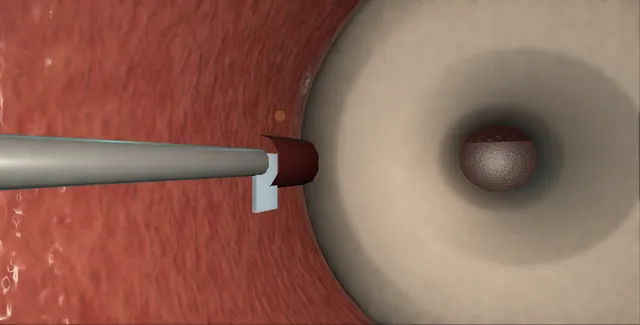
  • From the bulbar urethra the lens passes the sphincter and meets the scar where the neck or the anastomosis should be, a pinhole with the wire disappearing through it.
  • Three and nine o'clock are lateral scar with nothing important behind them; twelve is the venous complex under the pubis; six, after a prostatectomy, is the rectum a few millimetres away.
  • Beyond the ring lies the bladder, and after TURP the orifices may sit close to it.
  • ›The stenosis - a pinhole of scar at the bladder neck after TURP, or at the anastomosis after prostatectomy; the wire goes through it first.
  • ›External sphincter - two centimetres beyond the post-TURP neck, but directly under the post-prostatectomy anastomosis; the structure the incision must not reach.
  • ›Rectum - a few millimetres behind the anastomosis with no prostate between; six o'clock is never cut after a prostatectomy.
  • ›Dorsal venous complex and pubis - at twelve o'clock; an incision there bleeds and gains nothing.
  • ›Ureteric orifices - within a centimetre of a high bladder neck stenosis after TURP; found before the dilatation.
  • ›The guidewire - hydrophilic, curled in the bladder under vision; the only proof of the lumen beyond the scar.
  • ›The knife and the laser - a cold knife on the resectoscope or a holmium fibre through the cystoscope, cutting at three and nine until the ring springs.
Click me next Section 3 of 8 Steps The operation in order, with the landmark that guards each move.

Operative steps

  1. Who: two different patients The first is the bladder neck contracture after TURP or another outlet operation, in a few per cent, a ring of scar at the neck with the external sphincter intact two centimetres beyond it; opening the ring costs him little. The second is the vesicourethral anastomotic stenosis after radical prostatectomy, in a few per cent, and everything is different: the internal sphincter went with the prostate, the anastomosis sits directly on the external sphincter, and the rectum lies against its posterior wall. Opening his stenosis can unmask or cause incontinence, and a deep posterior cut can enter the rectum. The operation looks the same; the stakes are not.
  2. Assessment A poor stream, straining or retention weeks to months after the prostate operation, or a catheter that will not pass on the ward. Flexible cystoscopy under local shows the pinhole and, with a small scope, whether anything passes it; the calibre and the length of the scar decide the approach. Uroflowmetry and a residual give a baseline. The continence status is the decision that matters: a man who is dry has a sphincter to protect, and the incision is conservative; a man who is already wet through the pinhole will need an artificial sphincter later anyway, and the outlet can be opened generously first, because the sphincter cannot be placed across an unstable stenosis.
  3. The sheath and the wire A spinal or general anaesthetic, lithotomy, a 21 French cystoscope sheath or a 24 French resectoscope with a 30 degree telescope, and the ureteroscope on the trolley in case the pinhole takes nothing larger. The scope reaches the scar and stops. A hydrophilic guidewire is passed through the pinhole under vision, gently, until it curls in the bladder; if it goes anywhere other than the centre of the lumen it has found a false passage and is withdrawn. Nothing is cut until the wire is through, because the wire is the only proof of where the bladder is on the other side of the scar.
    where it bites: no wire, no cut; the wire in the bladder is the only guarantee that the incisions are in the outlet and not beside it.
  4. Incisions at three and nine, never at six With the wire as the guide, the cold knife on the resectoscope, or a holmium laser fibre through the cystoscope, incises the scar radially at three and nine o'clock, through the ring until the tissue springs and healthy pink or fat is seen, and no further. Some add five and seven. Twelve o'clock is avoided because the dorsal venous complex and the pubis lie there and it bleeds. Six o'clock is never cut after a prostatectomy: the rectum is a few millimetres behind the anastomosis with no prostate between, and a fistula there is a disaster. In the post-TURP neck the cuts stop short of the sphincter distally and the orifices proximally.
    where it bites: six o'clock after a prostatectomy is the rectum; three and nine are the safe sectors, cut until the ring gives and then stopped.
  5. Dilatation over the wire Once the ring is incised the lumen is opened further with graduated dilators passed over the wire, to about 24 to 30 French, or with a balloon dilator inflated across the scar under vision. The dilatation is gentle and wire-guided; it opens the incised ring rather than tearing the scar in an unplanned direction. The scope then passes into the bladder for the first time and the bladder is inspected: the trigone and both orifices in the post-TURP neck, where a high stenosis may sit within a centimetre of them, and the whole bladder in the post-prostatectomy patient for stones or other pathology. The sphincter is looked at from the bulbar side on the way out.
    where it bites: the orifices in a high bladder neck stenosis after TURP can sit within a centimetre of the scar; they are found before anything is dilated hard.
  6. Adjuncts into the incisions Recurrence after a single incision is common, so many add an antifibrotic. Mitomycin C in small aliquots, or triamcinolone, is injected into the edges of each incision with an endoscopic needle, into the scar and not through the wall; the dose and dilution are the local protocol. The evidence for both is modest and the rare reports of severe local injury with mitomycin, including necrosis, belong in the consent. In the post-prostatectomy patient every adjunct is injected away from six o'clock for the same reason as the incisions. Clean intermittent self-dilatation afterwards is the other adjunct, for the man who can manage it.
  7. The catheter and the trial A 16 or 18 French catheter goes in over the wire, sits across the incised outlet for a few days to a week, and comes out with a trial of void and a flow rate. The patient is warned about haematuria, dysuria and, after a prostatectomy, that he may be wetter for a time or permanently. Antibiotic prophylaxis covers the instrumentation. The note records the calibre and length of the stenosis, the wire, the sectors incised and their depth, the dilatation, any adjunct with its dose, the state of the sphincter and orifices, the bladder findings, the catheter and the date for review with a flow rate.
  8. Recurrence and the ladder A stenosis that recurs is reassessed at flexible cystoscopy and the question asked again: dry or wet, and how much does he have to lose. One repeat incision is reasonable; repeated blind dilatations are not, because each one makes the scar longer. The next rung is reconstruction: a Y-V or T plasty of the bladder neck, now usually robotic, for the refractory stenosis with a sphincter worth keeping, or a formal anastomotic revision. The artificial sphincter comes after, never before: it is placed only once the outlet has been stable for some months, because a cuff across a stenosis that recurs cannot be dilated through. The devastated outlet ends in a catheterisable channel or a diversion.
Click me next Section 4 of 8 Danger zones Where this operation bites, and why it bites there.
Critical relationship

Danger zones

The spatial relationships the animation is built to make automatic. Before you read each one, ask yourself: at this point in the operation, what is about to go wrong, and what is my first move? The save for each sits in the Complications tab.

  • RiskSix o'clock after prostatectomy - the rectum against the posterior anastomosis; a deep incision there is a rectourethral fistula.
  • RiskThe sphincter under the anastomosis - no internal sphincter remains; opening the stenosis can unmask or cause incontinence, and the man is told beforehand.
  • RiskThe false passage - a wire or dilator that leaves the lumen; nothing is cut or dilated until the wire has curled in the bladder.
  • RiskThe orifices behind a high neck stenosis - within a centimetre of the scar after TURP; identified before hard dilatation.
Practise it Take me into the scene Opens the animation at a danger moment and asks you to predict the mechanism and your first move before it reveals.
Click me next Section 5 of 8 Complications The save for each one: the first move, the escalation trigger, the op-note line.

Complications and immediate saves

Trigger each of these live in the Animation tab, then read the save: the first move, the escalation trigger, and the line that goes in the op note.

Bleeding or extravasation

  • an incision at twelve into the venous complex, or one carried through the scar into the perivesical space: the field red, or irrigant not returning.
The save
  1. Stop cutting; slow the irrigation and find the point, or note the deficit. first move
  2. Venous bleeding at twelve is tamponaded by the catheter, not chased with the electrode; a small extravasation is drained by a catheter for a week with a cystogram before removal.
  3. A large deficit, abdominal distension or peritonism: imaging, a drain and senior help. escalation trigger
  4. Note: the sector, the depth, the deficit, the catheter and the imaging plan. document

Rectal injury or fistula

  • a posterior incision or dilator through the anastomosis into the rectum: faeculent fluid, air in the irrigant, or a fistula weeks later.
The save
  1. Stop. Do not extend the incision or dilate further. first move
  2. Catheter drainage, broad-spectrum antibiotics, nil by mouth, and a rectal examination under anaesthetic to define the defect.
  3. A recognised injury needs a colorectal surgeon the same day: a diverting stoma is usual, with the fistula repaired later through a perineal or transanal approach. escalation trigger
  4. Pneumaturia, faecaluria or recurrent infection afterwards: cystoscopy and imaging for a fistula.
  5. Note: what was seen, the sector, who was called, the drainage and the repair plan. document

New or worse incontinence

  • the post-prostatectomy man who was dry through his pinhole and is wet once it is opened; or a post-TURP incision carried into the sphincter.
The save
  1. It was in the consent; confirm the patient understood before the trial without catheter. first move
  2. Pelvic floor physiotherapy from the start, containment products, and no rush to judge: some improve as the outlet settles.
  3. Persistent leakage at six to twelve months with a stable outlet: urodynamics and an artificial urinary sphincter, placed only once the stenosis has not recurred for some months. escalation trigger
  4. Note: continence before and after, what the patient was told, and the timing for sphincter assessment. document

Recurrent stenosis

  • the pinhole returns within months: a falling flow rate, straining, or a catheter that will not pass again.
The save
  1. Flexible cystoscopy and a flow rate; do not dilate blind on the ward. first move
  2. One repeat incision with an adjunct, or a programme of self-dilatation for the man who can do it.
  3. A second recurrence: a reconstructive urologist for Y-V or T plasty or anastomotic revision, with the artificial sphincter after the outlet is stable. escalation trigger
  4. The devastated outlet after several attempts: a catheterisable channel or diversion is discussed honestly.
  5. Note: the interval to recurrence, the calibre, the number of previous interventions and the referral. document

Urinary infection and epididymitis

  • an obstructed outlet instrumented and a catheter left across it: fever, rigors or a painful epididymis in the week after.
The save
  1. Cultures and antibiotics by the local protocol; check that the catheter is draining. first move
  2. A catheter that has blocked with clot is flushed or changed over a wire, not pulled and replaced blind.
  3. Sepsis, or a man who cannot void after the catheter comes out with a tender pinhole: admit, catheter over a wire under vision or a suprapubic catheter, senior review. escalation trigger
  4. Note: the organism, the antibiotic, the drainage and the revised trial date. document
Click me next Section 6 of 8 Troubleshooting When the case turns: the problem, then the next move.

Intra-operative troubleshooting

When the case turns: the problem, then the next move.

  • ActionThe wire will not pass the pinhole - a ureteroscope through the pinhole to see the lumen, an angled hydrophilic wire, or an antegrade wire through a suprapubic tract; never a blind push.
  • ActionThe wire passes but curls short of the bladder - a false passage; withdraw and start again under vision, the wire must be seen to curl in the bladder.
  • ActionCannot tell which way is six o'clock - orientate on the wire, the bulbar urethra and the pubis at twelve; a finger in the rectum if in doubt after a prostatectomy.
  • ActionThe ring does not spring after three and nine - deepen the same lines a little, then add five and seven; never six after a prostatectomy.
  • ActionBleeding obscures the field after a cut at twelve - the venous complex; stop, irrigate, a catheter to tamponade, and do not coagulate deeply.
  • ActionThe flow falls again within weeks - flexible cystoscopy; a repeat incision or self-dilatation now, and the reconstructive referral before the third attempt.
Click me next Section 7 of 8 FRCS viva Say it out loud, then mark yourself against the model answer.

FRCS viva questions

The examiner stems this scene prepares you for. Try to answer out loud first, then reveal, and learn the discriminator, the detail that turns a pass into a strong pass.

QA man is in retention eight weeks after a radical prostatectomy and the catheter will not pass. How would you manage him?reveal answer
  • I would suspect a vesicourethral anastomotic stenosis.
  • I would not persist with blind catheterisation and would arrange either a suprapubic catheter under ultrasound or a flexible cystoscopy in the emergency setting to see the anastomosis and pass a wire under vision, railroading a catheter over it.
  • Once drained, I would define the stenosis at flexible cystoscopy, record his continence, which is the key decision, and take him to theatre for an endoscopic treatment.
  • I would pass a hydrophilic wire through the stenosis under vision until it curled in the bladder, then incise the scar with a cold knife or holmium laser at three and nine o'clock until the ring gave, avoiding twelve and never cutting at six because the rectum lies directly behind the anastomosis, then dilate over the wire and inspect the bladder.
  • I would consider an antifibrotic injection into the incisions.
  • I would leave a catheter for a few days and consent him for haematuria, recurrence, and new or worse incontinence, explaining that an artificial sphincter may follow once the outlet is stable.
Strong pass

Say all three

  • The wire under vision before any cut
  • Three and nine with six forbidden because of the rectum
  • Continence as the decision that shapes how aggressively the stenosis is opened
Examiner note
The wire under vision before any cut, three and nine with six forbidden because of the rectum, and continence as the decision that shapes how aggressively the stenosis is opened.
QHow does a bladder neck contracture after TURP differ from an anastomotic stenosis after prostatectomy, and why does it matter?reveal answer
  • Both are rings of scar at the outlet and both are treated endoscopically, but the anatomy around them is different and so is the risk.
  • After TURP the contracture is at the bladder neck, the prostatic urethra and the external sphincter remain distal to it, the rectum is separated from it by the remaining prostatic capsule, and the ureteric orifices may lie within a centimetre of a high neck.
  • Incising it at three and nine, or five and seven, is safe provided the cuts stop short of the sphincter and the orifices are identified.
  • After radical prostatectomy the internal sphincter has been removed, the anastomosis sits directly on the external sphincter, and the rectum lies against its posterior wall with nothing between.
  • Opening it can therefore unmask or cause incontinence and a posterior cut can enter the rectum.
  • The continence status decides the aggressiveness: the dry man is treated conservatively to protect his sphincter, while the man already wet is opened generously because an artificial sphincter will follow and cannot be placed across an unstable outlet.
  • Recurrence is more frequent after the anastomotic stenosis and the ladder ends in reconstruction.
Strong pass

Say both

  • The internal sphincter gone and the rectum unshielded after prostatectomy
  • Continence as the variable that decides how much to open
Examiner note
The internal sphincter gone and the rectum unshielded after prostatectomy, and continence as the variable that decides how much to open.
QWhat adjuncts and follow-up would you use to reduce recurrence?reveal answer
  • Recurrence after a single endoscopic incision is common, quoted at about a third to a half in the anastomotic stenosis, so I would combine the incision with an adjunct where appropriate.
  • The options are injection of mitomycin C or triamcinolone into the incision edges, which have modest evidence and, for mitomycin, rare reports of severe local injury that I would include in the consent;
  • and a programme of clean intermittent self-dilatation for a man who can manage it, which keeps the lumen open while the scar matures.
  • I would leave a catheter for a few days to a week and follow him with a flow rate and residual at about six weeks and three months, and a flexible cystoscopy if the flow fell or symptoms returned.
  • I would do at most one repeat incision.
  • A second recurrence I would refer to a reconstructive urologist for a Y-V or T plasty or anastomotic revision.
  • In the incontinent man I would place an artificial sphincter only after the outlet had remained stable for several months, because a cuff across a recurrent stenosis cannot be dilated through.
Strong pass

Say all four

  • Quoting recurrence honestly
  • The mitomycin caveat
  • One repeat incision only
  • The sphincter timed after a stable outlet
Examiner note
Quoting recurrence honestly, the mitomycin caveat, one repeat incision only, and the sphincter timed after a stable outlet.
QWhat are the complications of endoscopic treatment of a bladder neck or anastomotic stenosis?reveal answer
  • The immediate complications are bleeding, particularly from an incision at twelve o'clock into the dorsal venous complex, extravasation from a cut carried through the scar into the perivesical space, and false passage from a wire or dilator that leaves the lumen, avoided by cutting only with the wire seen in the bladder and stopping when the ring gives.
  • The serious anatomical complication after prostatectomy is rectal injury from a posterior incision, which is prevented by never cutting at six o'clock and is managed with drainage, antibiotics, colorectal involvement and usually a diverting stoma with later fistula repair.
  • Functionally, opening the stenosis can unmask or cause stress incontinence, especially after prostatectomy, and this is consented for and managed with physiotherapy and later an artificial sphincter.
  • After TURP an incision carried distally can injure the sphincter and one carried proximally can involve the ureteric orifices.
  • Infection and epididymitis follow instrumentation.
  • The late complication is recurrence, which is frequent and requires a defined pathway to reconstruction.
Strong pass

Grouping the complications by sector, twelve, six, and the sphincter, and naming the fistula pathway and the recurrence ladder.

Click me next Section 8 of 8 Evidence The guidance each of these answers is built on.

Evidence and guidance

Two minutes

Close the lap: recall it before you leave.

Say it aloud, then reveal. Reading is not remembering.

  1. 01 The relationship Say the critical spatial relationship out loud, then reveal. reveal
    Memory frame

    From the bulbar urethra the lens passes the sphincter and meets the scar where the neck or the anastomosis should be, a pinhole with the wire disappearing through it.

    Why?
    Three and nine o'clock are lateral scar with nothing important behind them; twelve is the venous complex under the pubis; six, after a prostatectomy, is the rectum a few millimetres away. Beyond the ring lies the bladder, and after TURP the orifices may sit close to it.
  2. 02 The first move Bleeding or extravasation. Your first move? reveal
    First move

    Stop cutting; slow the irrigation and find the point, or note the deficit.

  3. 03 The escalation trigger Bleeding or extravasation. What makes you call for help? reveal
    Escalate when

    A large deficit, abdominal distension or peritonism: imaging, a drain and senior help.

  4. 04 The discriminator What turns a pass into a strong pass? reveal
    Strong pass

    Say all three

    • The wire under vision before any cut
    • Three and nine with six forbidden because of the rectum
    • Continence as the decision that shapes how aggressively the stenosis is opened
    Examiner note
    The wire under vision before any cut, three and nine with six forbidden because of the rectum, and continence as the decision that shapes how aggressively the stenosis is opened.
  5. 05 The pitfall Where does this operation bite first? reveal
    Pitfall

    Six o'clock after prostatectomy

    Why?
    the rectum against the posterior anastomosis; a deep incision there is a rectourethral fistula.

Revision practice with self-marked answers, not an assessment of clinical competence. Kept in this browser only; it does not sync between devices.