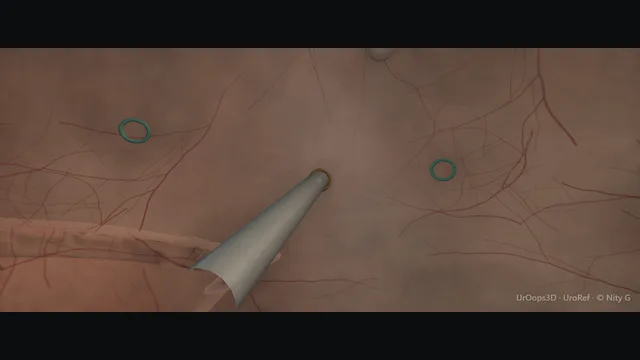
This scene follows the current UK BOTOX adult overactive-bladder reference technique: 100 Allergan Units divided across 20 detrusor injections of 0.5 ml, approximately 1 cm apart and about 2 mm deep, avoiding the trigone and bladder base.
Dose, site count and aftercare are product- and indication-specific; botulinum-toxin units are not interchangeable between products.
Core tierFRCS neuro-urology, functionalInteractive 3D
Cystoscopic, the bladder mapped before the injections. Schematic, not to scale; relationships only.
From the cystoscope the operator maps the trigone and base, then distributes 20 product-specific adult OAB injections through the remaining detrusor field.
The needle enters approximately 2 mm into detrusor; small completed-site markers in the animation record count and spacing, not a diagnostic wheal.
The final spatial checkpoint is the outlet: the scope is withdrawn and a spontaneous void is demonstrated before discharge.
›Trigone and bladder base - identified cystoscopically and avoided in the licensed adult OAB onabotulinumtoxinA pattern shown here.
›Detrusor - the labelled target: the injection needle is inserted approximately 2 mm into the muscle.
›Twenty injection sites - 0.5 ml at each site, spaced approximately 1 cm apart for the adult OAB 100-unit reference regimen.
›Ureteric orifices - landmarks that orient the trigone and base before the first injection.
›Outlet - the downstream checkpoint after treatment: spontaneous voiding is demonstrated before discharge.
Exclude active infectionThe current UK product information contraindicates intradetrusor treatment in a patient with a urinary tract infection. Symptoms, urinalysis and culture are assessed according to the patient and local protocol, and any active infection is treated before instrumentation. Antibiotic prophylaxis and antithrombotic management follow the product information and local policy. where it bites: active urinary tract infection is a reason to defer treatment, not to inject through it.
Cystoscopy + surveyA rigid or flexible cystoscope surveys the bladder before injection. The bladder is instilled with enough saline for adequate wall visualisation and to avoid product backflow, but over-distension is avoided. The trigone, base and ureteric orifices are identified so that the licensed adult OAB pattern can avoid them. where it bites: over-distension thins and tensions the wall; inadequate fill loses the landmarks and permits backflow.
Licensed adult OAB planThis scene deliberately teaches one named reference pattern, not every botulinum-toxin regimen: reconstituted BOTOX 100 Allergan Units in 10 ml, delivered as 20 injections of 0.5 ml spaced approximately 1 cm apart in the detrusor, avoiding the trigone and base. Adult neurogenic detrusor overactivity uses a different labelled dose and 30-site pattern. Units from different botulinum-toxin products are not interchangeable. where it bites: using a site count or dose from another indication or product is a medication error.
Systematic intradetrusor injectionThe primed needle passes through the working channel and is inserted approximately 2 mm into the detrusor at each planned site. The count, volume and spacing are checked systematically. A visible mucosal bleb may occur, but the current SmPC does not define it as a mandatory confirmation of correct depth; the reference endpoint is the specified intradetrusor placement and delivered dose. where it bites: a surface bleb is not a substitute for controlling needle depth, count and injected volume.
Withdraw + demonstrate voidingFor the adult OAB reference technique, the saline used for visualisation is not drained after the injections. The cystoscope is withdrawn and the patient is observed for at least 30 minutes and until a spontaneous void has occurred. Catheterisation or clean intermittent catheterisation is used when clinically significant retention occurs, not as a routine final animation state. where it bites: discharge before a spontaneous void, or without a defined retention plan, misses the labelled monitoring endpoint.
Re-injection expectationRe-injection is considered when the clinical effect of the previous treatment diminishes, taking the previous response and adverse effects into account. For bladder injection the current SmPC specifies no sooner than three months after the previous treatment. where it bites: repeating treatment sooner than the labelled minimum interval is outside this reference technique.
The spatial relationships the animation is built to make automatic. Before you read each one, ask yourself: at this point in the operation, what is about to go wrong, and what is my first move? The save for each sits in the Complications tab.
RiskThe avoided trigone and base - an explicit feature of the licensed adult OAB onabotulinumtoxinA pattern; evidence for trigone-including techniques is mixed and is not represented by this scene.
RiskNeedle depth and delivered volume - approximately 2 mm into detrusor and 0.5 ml at each of 20 sites for this named regimen.
RiskInfection and emptying - active UTI precludes treatment, and post-treatment voiding must be demonstrated before discharge.
Trigger each of these live in the Animation tab, then read the save: the first move, the escalation trigger, and the line that goes in the op note.
Symptomatic UTI
dysuria, frequency, fever or systemic upset after instrumentation requires clinical assessment, urine testing and attention to residual urine.
The save
Assess observations and symptoms, send urine for culture, and treat empirically only when the clinical picture warrants it, then refine to results.first move
Assess the residual: infection sitting on a bladder that cannot empty will not clear on antibiotics alone.
Manage pain and hydration; most infections settle with culture-directed treatment and drainage of the residual.
If a catheter is needed, teach or re-confirm self-catheterisation rather than defaulting to an indwelling tube where the patient can manage it.
Sepsis, a failing patient or a high fever with loin pain → imaging for upper tract involvement and inpatient management.escalation trigger
Note: culture result, antibiotic course, residual trend, and the plan before any future injection.document
Retention with high residual
a clinically significant rise in residual or inability to void after treatment requires drainage and a reviewed follow-up plan.
The save
Teach or resume the self-catheterisation plan the patient already owns; the first move is drainage, not drugs.first move
Check the residual and the pattern: a patient emptying partly and comfortably is watched, a patient retaining fully and painfully drains now.
Treat any infection riding on the retained urine, because residual and infection feed each other.
Review the daytime picture: timing, technique and fluid load often rescue an incomplete emptier without further intervention.
Persistent painful retention, recurrent infection on the residual, or a patient who cannot catheterise → urology review for drainage options and re-planning of future treatment.escalation trigger
Note: residual values and trend, catheter strategy taught, and the shared decision about future injections.document
Haematuria
an injection site can bleed; most haematuria settles, while persistent bleeding or clot retention needs active management.
The save
Irrigate gently and finish the field if vision holds; slow the pattern, do not abandon the map for one bleeding site.first move
Watch the urine at the end: pink urine is expected, clot or a blocked catheter is not.
If clot retention develops, washout with a large-bore catheter and irrigation until the urine clears.
Bleeding that will not clear, or a patient on antithrombotics, is monitored as a planned admission rather than a discharge.
Persistent heavy bleeding or circulatory concern → theatre for cystoscopic diathermy and a coagulation review.escalation trigger
Note: sites injected, bleeding site and method of control, antithrombotic status, and the follow-up urine check.document
When the case turns: the problem, then the next move.
ActionNeedle will not pass the working channel - Check the needle is matched to the channel and loaded with the tip aligned; withdraw, reload and re-pass rather than forcing, which buckles the tip.
ActionPatient cannot tolerate the rigid scope - Convert to flexible cystoscopy under local, which carries the same grid at slightly more patience per site.
ActionNo surface bleb at a site - Do not use a bleb as the sole depth test. Re-check needle extension, approximately 2 mm intradetrusor placement, injected volume and any visible leakage before continuing.
ActionBleeding obscures the next site - Irrigate, move to the mirrored site on the far wall, and return; the grid is a map, the order is a habit, neither is worth chasing into a red field.
The examiner stems this scene prepares you for. Try to answer out loud first, then reveal, and learn the discriminator, the detail that turns a pass into a strong pass.
QWhy does this animation avoid the trigone, and does that make trigone-sparing a universal rule?reveal answer
Because the scene is explicitly the current UK licensed adult overactive-bladder technique for BOTOX, and that product information directs injection into detrusor while avoiding the trigone and base.
It is important not to turn a labelled regimen into a universal anatomical claim.
Published studies of trigone-including techniques report mixed results, and the licensed pattern shown here does not prove that trigonal injection has no efficacy or necessarily causes reflux.
In practice I would name the product and indication, use its authorised dose and site pattern or a clearly justified local protocol, and document exactly what was delivered.
The safe viva answer separates three things: the licensed onabotulinumtoxinA reference technique, research comparing other site patterns, and local practice.
This animation teaches the first of those and marks alternatives as outside its scope.
Strong pass
Say all three
Separating a product label from a universal physiological claim
Explicitly naming the product and indication before quoting dose
Site count or avoided zones
Examiner note
Separating a product label from a universal physiological claim, and explicitly naming the product and indication before quoting dose, site count or avoided zones.
QWhich patients are unsuitable for intravesical botulinum toxin?reveal answer
The unsuitability falls into three groups.
The first is the bladder that will not cope with the treatment: the patient with a poor pre-existing emptying pattern, a high baseline residual or an acontractile detrusor, in whom further weakening contraction converts borderline emptying into retention, unless that patient can self-catheterise competently and is willing to, which moves them from unsuitable to suitable-with-a-plan.
The second is the bladder or patient that cannot safely be instrumented: untreated urinary infection, because injecting through infected urine seeds the wall;
active bladder pathology found at survey, tumour or stone, which takes priority and changes the operation;
and the patient who cannot comply with the surveillance the treatment needs, follow-up residuals and symptom review, where a treatment that depends on monitoring should not be started unmonitored.
The third is the expectation mismatch: the patient who wants a cure rather than a repeating treatment, because the effect is durable for months and then fades, and the patient who cannot accept self-catheterisation as a real possibility belongs in that same conversation.
Unsuitability here is rarely absolute;
it is the gap between what the treatment does and what the patient can live with, which is why suitability is decided in clinic with a residual measurement and a teaching session, not on the day with a consent form.
Strong pass
Say both
Making willingness and ability to self-catheterise the hinge of suitability
Naming the expectation-of-cure patient as unsuitable before listing any absolute contraindication
Examiner note
Making willingness and ability to self-catheterise the hinge of suitability, and naming the expectation-of-cure patient as unsuitable before listing any absolute contraindication.
QHow durable is the effect of intravesical botulinum toxin, and how do you manage the return of symptoms?reveal answer
The clinical effect is temporary and repeat treatment is considered when the benefit of the previous injection diminishes.
At review I confirm the original indication, quantify the previous response, ask about urinary infection, haematuria and emptying difficulty, review residual measurements and any catheterisation, and decide with the patient whether the balance still favours another treatment.
The timing is not symptom-driven without a floor: the current UK product information states that bladder re-injection should be no sooner than three months after the previous injection.
Dose and pattern are again selected for the named product and indication rather than copied from a different regimen.
Strong pass
Say both
Describing symptom recurrence as the pharmacological endpoint arriving on schedule
Making re-referral a taught patient skill rather than a clinic chase
Examiner note
Describing symptom recurrence as the pharmacological endpoint arriving on schedule, and making re-referral a taught patient skill rather than a clinic chase.
QA patient returns unable to pass urine and uncomfortable days after botox. What had to have happened in clinic beforehand, and what do you do now?reveal answer
Beforehand, three things: the residual was measured and the baseline emptying pattern understood;
the likelihood of retention was named plainly as the commonest significant consequence of a treatment that weakens the bladder;
and self-catheterisation was taught, practised and confirmed, with the equipment at home, before the injection was ever booked.
That is what turns this presentation from an emergency into an inconvenience.
Now, in order.
Confirm the picture: a palpable bladder, discomfort and a high residual on scan, in a patient recently injected, is retention until proven otherwise, and a urine sample is sent because infection rides on retention and retention worsens on infection.
Relieve it by the route the patient was taught: clean self-catheterisation on the plan already rehearsed, with an indwelling catheter reserved for the patient who cannot manage it, briefly, with a removal plan attached.
Treat any infection found.
Then the decision this admission really buys time for: review against the last injection, was the response good, was the residual manageable, can the patient sustain catheterisation, and either schedule the next injection with a modified expectation or revisit the maintenance strategy, antimuscarinic adjuncts, alternative agents or a different intervention entirely.
The outcome that separates good practice from bad is not whether retention happened, it happens to a proportion of well-selected patients, it is whether the patient meets it holding a catheter and a plan.
Strong pass
Stating that the pre-clinic teaching, not the technique, is what determines whether this is an emergency, and reviewing the maintenance strategy before discharge rather than only draining and discharging.
Say it aloud, then reveal. Reading is not remembering.
01The relationshipSay the critical spatial relationship out loud, then reveal.reveal
Memory frame
From the cystoscope the operator maps the trigone and base, then distributes 20 product-specific adult OAB injections through the remaining detrusor field.
Why?
The needle enters approximately 2 mm into detrusor; small completed-site markers in the animation record count and spacing, not a diagnostic wheal. The final spatial checkpoint is the outlet: the scope is withdrawn and a spontaneous void is demonstrated before discharge.
02The first moveSymptomatic UTI. Your first move?reveal
First move
Assess observations and symptoms, send urine for culture, and treat empirically only when the clinical picture warrants it, then refine to results.
03The escalation triggerSymptomatic UTI. What makes you call for help?reveal
Escalate when
Sepsis, a failing patient or a high fever with loin pain → imaging for upper tract involvement and inpatient management.
04The discriminatorWhat turns a pass into a strong pass?reveal
Strong pass
Say all three
Separating a product label from a universal physiological claim
Explicitly naming the product and indication before quoting dose
Site count or avoided zones
Examiner note
Separating a product label from a universal physiological claim, and explicitly naming the product and indication before quoting dose, site count or avoided zones.
05The pitfallWhere does this operation bite first?reveal
Pitfall
The avoided trigone and base
Why?
an explicit feature of the licensed adult OAB onabotulinumtoxinA pattern; evidence for trigone-including techniques is mixed and is not represented by this scene.
Revision practice with self-marked answers, not an assessment of clinical competence. Kept in
this browser only; it does not sync between devices.